

The healthcare industry is facing a defining paradox. Demand for medical services has never been higher, yet the resources available to meet it — clinical staff, administrative teams, and communication infrastructure — are stretched beyond their traditional limits. Patients now expect faster responses, more personalized interactions, and seamless access to care. At the same time, healthcare organizations are under mounting pressure to reduce operational costs, maintain strict regulatory compliance, and deliver measurably better health outcomes.
Artificial intelligence is emerging as the most consequential response to this challenge. AI-powered customer support tools are no longer experimental additions to healthcare systems — they are becoming foundational infrastructure. From automated patient triage and intelligent call center routing to voice-driven clinical documentation and predictive engagement, these platforms are redefining how healthcare organizations communicate with patients and manage their operations from the inside out.
This article examines the top AI healthcare customer support tools for 2026 — presented alphabetically for impartial reference — exploring how each platform works, what it delivers for healthcare organizations, and what business leaders should understand as they evaluate their digital transformation strategies.
Section 1: The AI Revolution in Healthcare Customer Support
Healthcare customer support has historically been a high-volume, labor-intensive function. Call centers handle millions of appointment requests, insurance queries, prescription follow-ups, and urgent triage inquiries annually. Administrative teams spend enormous hours managing records, routing communications, and coordinating care pathways. The cumulative cost of this overhead is staggering — and when it underperforms, the impact falls directly on patient safety and satisfaction.
AI is fundamentally changing the economics and quality of this equation. By automating routine workflows, analyzing patient data in real time, and enabling natural, context-aware communication across multiple channels, AI-powered tools are helping healthcare organizations reduce operational costs significantly while simultaneously improving the patient experience. The global AI in healthcare market is projected to exceed $188 billion by 2030, with patient engagement and support automation representing some of its fastest-growing segments.
Crucially, this transformation goes well beyond efficiency gains. AI tools are increasingly capable of detecting emotional distress in patient communications, identifying high-risk cases before they escalate clinically, and personalizing outreach based on individual health histories. They are enabling healthcare organizations to move from reactive support toward anticipatory, data-informed engagement — a shift with profound implications for both operational performance and patient outcomes.
Section 2: How AI Healthcare Support Tools Work
Modern AI healthcare support platforms combine several foundational technologies to deliver their capabilities. Natural Language Processing (NLP) and Natural Language Understanding (NLU) allow systems to interpret patient queries in plain language — whether typed or spoken — and generate relevant, accurate responses in real time. Machine learning models trained on extensive clinical datasets recognize symptom patterns, predict patient needs, and refine their performance with each interaction.
Conversational AI frameworks power the chatbots and voice assistants that handle complex, multi-turn interactions without human intervention, seamlessly integrating with Electronic Health Records (EHR) and Customer Relationship Management (CRM) platforms to maintain consistent patient context. Sentiment analysis layers add a layer of emotional intelligence, detecting urgency or distress and triggering escalation to trained human agents when the situation demands it.
Underlying all of this is a non-negotiable commitment to data privacy and regulatory compliance. Leading platforms are architected with HIPAA, GDPR, and other healthcare-specific security standards built in by design — not bolted on as an afterthought — ensuring that patient data is handled with the highest standards of care at every touchpoint in the support journey.
Section 3: Top 9 AI Healthcare Customer Support Tools for 2026
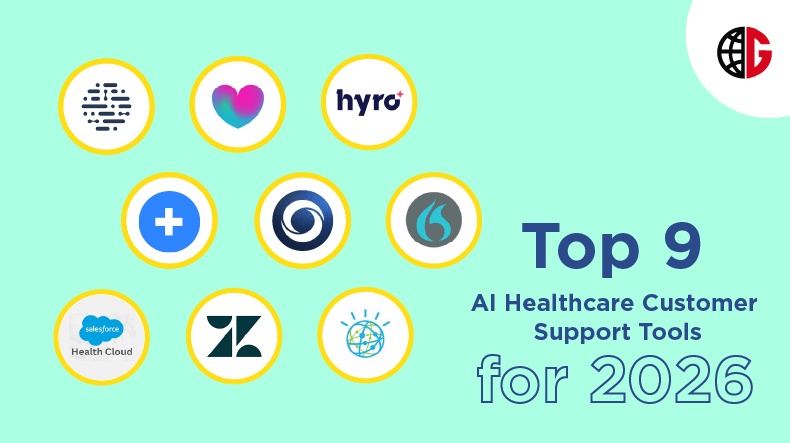
The following platforms represent the current frontier of AI-driven healthcare support. They are listed alphabetically to provide an impartial reference for decision-makers evaluating solutions for their organizations.
- Ada Health
Best For: AI-driven symptom assessment and patient triage
Ada Health delivers intelligent symptom assessment designed to guide patients through pre-clinical decision-making before they engage with a provider. Its adaptive AI engine asks structured, clinically informed questions, cross-references responses against a comprehensive medical database, and recommends appropriate next steps — from self-care to urgent consultation.
By empowering patients to assess their own symptoms accurately, Ada reduces the volume of non-urgent inbound contacts reaching call centers and clinical staff, freeing healthcare resources for patients who genuinely need them. The platform integrates directly with telehealth systems, creating a seamless handoff between digital self-assessment and live medical consultation when required.
- Babylon Health
Best For: Virtual consultations and automated healthcare advice
Babylon Health merges AI-powered triage with on-demand telemedicine, enabling patients to have their symptoms assessed and connect with a qualified physician within a single, continuous digital journey. The platform is designed for scale — managing millions of patient interactions daily across multiple global markets — making it a strong fit for health systems seeking to extend care access beyond the constraints of traditional clinic infrastructure.
Babylon’s integration with wearable devices and mobile health applications also positions it as a proactive care partner, providing patients with ongoing health monitoring and data-driven guidance between clinical episodes.
- Hyro
Best For: Voice and chat automation for hospitals and clinics
Hyro offers a conversational AI platform built around deep natural language understanding, engineered specifically for hospital and healthcare network environments. Its voice and chat assistants handle appointment scheduling, patient FAQs, and intake workflows with a level of fluency that minimizes friction in the patient access journey.
A notable differentiator is Hyro’s no-code deployment model, which enables healthcare organizations to implement and configure the platform without extensive technical resources. This accessibility makes it a practical choice for organizations at varying stages of digital maturity, from large academic medical centers to regional clinic networks.
- IBM Watson Health
Best For: Predictive analytics and advanced triage systems
IBM Watson Health draws on decades of enterprise AI research and a vast clinical knowledge base to deliver predictive analytics and decision support at scale. Its platform processes large, complex datasets — from EHRs to diagnostic imaging — to surface insights that help providers anticipate patient needs, allocate resources more effectively, and reduce avoidable adverse events.
In the contact center environment, Watson Health provides AI-generated guidance to support human agents in real time, improving both the speed and accuracy of triage decisions. Its enterprise-grade data security architecture makes it particularly suitable for large health systems with stringent compliance requirements.
- Infermedica
Best For: Pre-diagnosis, triage, and intelligent care routing
Infermedica’s clinical AI engine specializes in pre-diagnosis and intelligent triage, helping patients understand the appropriate level of care for their specific situation. By analyzing patient-reported symptoms and medical history against a continuously updated clinical knowledge base, the platform directs patients toward self-management, primary care, or urgent intervention with a high degree of accuracy.
Infermedica’s API-first architecture makes it highly adaptable, integrating cleanly into existing healthcare portals, mobile applications, and call center systems. This flexibility has made it a popular choice among healthcare organizations seeking to enhance their patient-facing digital infrastructure without undertaking full platform replacements.
- Kore.ai HealthAssist
Best For: Conversational AI for healthcare call centers
Kore.ai HealthAssist is purpose-built for the demands of high-volume healthcare communication environments. The platform supports omnichannel deployment across web, SMS, IVR, and voice channels, with multilingual capability that extends its reach to diverse patient populations. Its advanced sentiment analysis layer detects emotional urgency in patient interactions and routes cases to the most appropriate resource — automated or human — in real time.
The platform’s deep integration with EHR and CRM systems ensures that patient context is preserved across every channel and interaction, enabling more coherent, personalized support experiences at scale.
- Nuance Dragon Medical One (Microsoft)
Best For: Voice-driven healthcare documentation and clinical communication
Nuance Dragon Medical One addresses one of healthcare’s most persistent operational pain points: the documentation burden placed on clinicians. By enabling physicians and nurses to dictate structured, accurate medical notes through AI-powered voice recognition, the platform dramatically reduces the time clinical staff spend on administrative tasks — time that can be redirected to direct patient care.
Backed by Microsoft’s enterprise cloud infrastructure and integrated with major EHR platforms, Nuance is trusted by leading hospital systems globally. Its AI language models are specifically trained to understand complex medical terminology and clinical context, delivering near-perfect transcription accuracy even in high-pressure clinical environments.
- Salesforce Health Cloud
Best For: Patient relationship management and data-driven engagement
Salesforce Health Cloud brings enterprise CRM capabilities to healthcare, unifying patient data from EHRs, communication platforms, and support systems into a single, actionable view. Its built-in Einstein AI engine surfaces predictive insights and automates personalized outreach campaigns, enabling providers and insurers to engage patients proactively — well before health issues escalate into costly interventions.
For organizations focused on long-term patient retention, preventive care programs, and population health management, Salesforce Health Cloud provides both the analytical depth and communication workflow automation needed to operate at scale.
- Zendesk for Healthcare
Best For: Scalable ticketing and patient inquiry management
Zendesk adapts its established enterprise customer service framework to the specific requirements of healthcare organizations, delivering AI-powered chat, intent detection, automated ticketing, and performance analytics within a HIPAA-compliant environment. Its flexibility and scalability make it equally effective for small specialist practices and large multi-site hospital networks.
Zendesk’s analytics dashboard provides healthcare teams with actionable data on inquiry volumes, resolution times, and patient satisfaction scores — creating a continuous feedback loop that supports ongoing operational improvement.
Section 4: Business and Industry Impact
The deployment of AI healthcare support tools is producing measurable, documented outcomes across the sector. Healthcare organizations report meaningful reductions in average call handling times, lower rates of unnecessary emergency department visits, and improved patient satisfaction scores following implementation. For health insurers, AI-powered claims processing and inquiry management are compressing resolution timelines and reducing administrative overhead. For hospital networks, conversational AI is freeing clinical staff from routine communication tasks — directly benefiting staff retention and workforce morale.
The business case is equally compelling at a strategic level. AI tools are enabling a fundamentally more proactive model of care. Predictive analytics identify patients at risk of deterioration before symptoms become clinical emergencies, allowing healthcare teams to intervene earlier and with greater precision. For CFOs and COOs, this translates to measurable reductions in avoidable hospitalizations, readmission rates, and the associated costs that accompany reactive, episodic care.
For the health insurance sector in particular, AI-driven support tools are streamlining claims adjudication, reducing fraud risk through anomaly detection, and improving member engagement — capabilities that directly influence competitive positioning in an increasingly commoditized market.
Section 5: Risks, Limitations, and Challenges
Despite their considerable promise, AI healthcare support tools are not without complexity or risk. Clinical accuracy remains a central concern: AI triage systems must be continuously updated with verified, evidence-based clinical data to remain reliable. In healthcare, the consequences of an incorrect recommendation carry a weight that does not exist in other industries — making rigorous validation, ongoing monitoring, and clear escalation protocols essential requirements for any deployment.
Data privacy and regulatory compliance present ongoing challenges, particularly as tools operate across jurisdictions with varying and evolving healthcare data protection frameworks. Organizations must conduct thorough vendor due diligence to ensure that data processing agreements, access controls, audit capabilities, and breach notification procedures are fully aligned with their regulatory obligations.
Perhaps the most nuanced challenge is the risk of over-automation — the point at which the efficiency gains of AI begin to erode the human empathy and relational quality that patients expect and often need when navigating health concerns. The most successful AI implementations in healthcare maintain a clear and deliberate boundary between interactions suited to automation and those that require human judgment, emotional intelligence, and professional accountability.
Section 6: Future Outlook — What Comes Next
The trajectory of AI in healthcare customer support points toward deeper personalization, broader clinical integration, and significantly more sophisticated emotional intelligence. Large language models are becoming increasingly capable of nuanced, contextually appropriate patient interaction — navigating sensitive conversations around diagnosis, mental health, and end-of-life care in ways that were not technically feasible even two years ago.
In the near term, expect leading platforms to expand their roles in proactive care coordination: managing chronic disease follow-up programs, automating medication adherence reminders, and integrating with wearable health devices to deliver real-time, individualized guidance between clinical episodes. Voice AI will continue to evolve from a documentation tool into a clinical decision support partner, active in the consultation room rather than confined to the administrative workflow.
Healthcare organizations that invest strategically in AI support capabilities today — selecting tools aligned to their specific operational priorities and patient populations — will be materially better positioned to deliver the connected, continuous, and truly personalized care that both patients and regulators will increasingly demand in the years ahead.
Expert & Industry Perspective
Healthcare technology analysts widely concur that the most successful AI implementations in patient support share three characteristics: they are integrated deeply into existing clinical and administrative workflows rather than deployed as standalone additions; they maintain meaningful human oversight at critical decision points; and they are evaluated continuously against patient outcome data rather than purely operational metrics.
Industry leaders also emphasize that AI adoption in healthcare is as much a cultural challenge as a technical one. Clinical staff must be engaged as partners in implementation, not passive recipients of technology change. When AI tools demonstrably reduce documentation burden and administrative friction, clinician adoption follows naturally — and the patient experience benefits in proportion.
Conclusion
AI healthcare customer support tools are no longer a competitive differentiator for early adopters — they are rapidly becoming a baseline expectation for any organization committed to delivering modern, efficient, and patient-centered care. The platforms reviewed in this article represent the current frontier of what is possible: intelligent, compliant, and genuinely capable of transforming the patient experience at organizational scale.
For business leaders, the key question is no longer whether to adopt AI in healthcare support, but how to do so with strategic clarity and operational discipline. That means selecting tools that align with specific patient population needs, investing in change management and clinical engagement, and preserving the human oversight that ensures AI serves patients — rather than simply processing them. The future of healthcare support is intelligent, integrated, and unmistakably human at its core.
Frequently Asked Questions (FAQ)
Q1. What are AI healthcare customer support tools?
AI healthcare customer support tools are software platforms that use artificial intelligence — including natural language processing, machine learning, and conversational AI — to automate and enhance communication between healthcare organizations and their patients. They manage tasks ranging from symptom triage and appointment scheduling to claims processing, clinical documentation, and proactive patient outreach.
Q2. How do AI tools improve patient experience in healthcare?
AI tools improve the patient experience by enabling faster response times, 24/7 service availability, personalized interactions based on individual health data, and more accurate triage guidance. They reduce wait times, minimize administrative errors, and allow clinical staff to focus on delivering direct care rather than managing routine communication workflows.
Q3. Are AI healthcare support tools HIPAA compliant?
Leading AI healthcare platforms are designed with HIPAA compliance as a core architectural requirement. However, healthcare organizations should conduct thorough vendor due diligence to ensure that data processing agreements, audit controls, access management, and breach notification protocols align with their specific regulatory obligations and organizational risk standards.
Q4. What is the difference between an AI chatbot and an AI triage tool in healthcare?
An AI chatbot typically handles general patient inquiries such as appointment scheduling, FAQs, and administrative requests. An AI triage tool is specifically designed to assess patient-reported symptoms and clinical history, determining the most appropriate level of care — from self-management at home to urgent clinical intervention — based on evidence-based medical protocols.
Q5. Which AI healthcare support tool is best for large hospital networks?
For large hospital networks, platforms such as IBM Watson Health, Kore.ai HealthAssist, and Salesforce Health Cloud offer the scalability, enterprise-grade integration, and omnichannel capability required to manage high patient volumes across complex organizational and geographic structures.
Q6. Can AI fully replace human agents in healthcare call centers?
AI can automate a substantial proportion of routine interactions in healthcare call centers — appointment booking, prescription refill requests, insurance queries, and standard FAQs. However, it is not a substitute for human agents in complex, clinically sensitive, or emotionally charged situations. The most effective implementations use AI to manage high-volume routine tasks while routing nuanced cases to trained clinical or support staff.
Q7. What is the future of AI in healthcare customer support?
The future of AI in healthcare support lies in deeper clinical personalization, predictive care management, and stronger integration with wearable health data and real-time clinical workflows. As AI language models continue to mature, they will take on increasingly active roles in continuous care delivery, chronic disease management, and proactive patient engagement — moving well beyond traditional reactive support functions.
Q8. How do healthcare organizations measure the ROI of AI support tools?
Key ROI metrics for AI healthcare support tools typically include reductions in average call handling time, decreases in unnecessary emergency department visits, improvements in first-contact resolution rates, increases in patient satisfaction scores, and reductions in clinical staff time spent on administrative tasks. Leading organizations also track longer-term outcome metrics such as readmission rates and chronic disease management program engagement.
Read more similar Top List articles at Europe’s Top 15 Healthcare Leaders Transforming Patient Care & Healthcare Leaders