
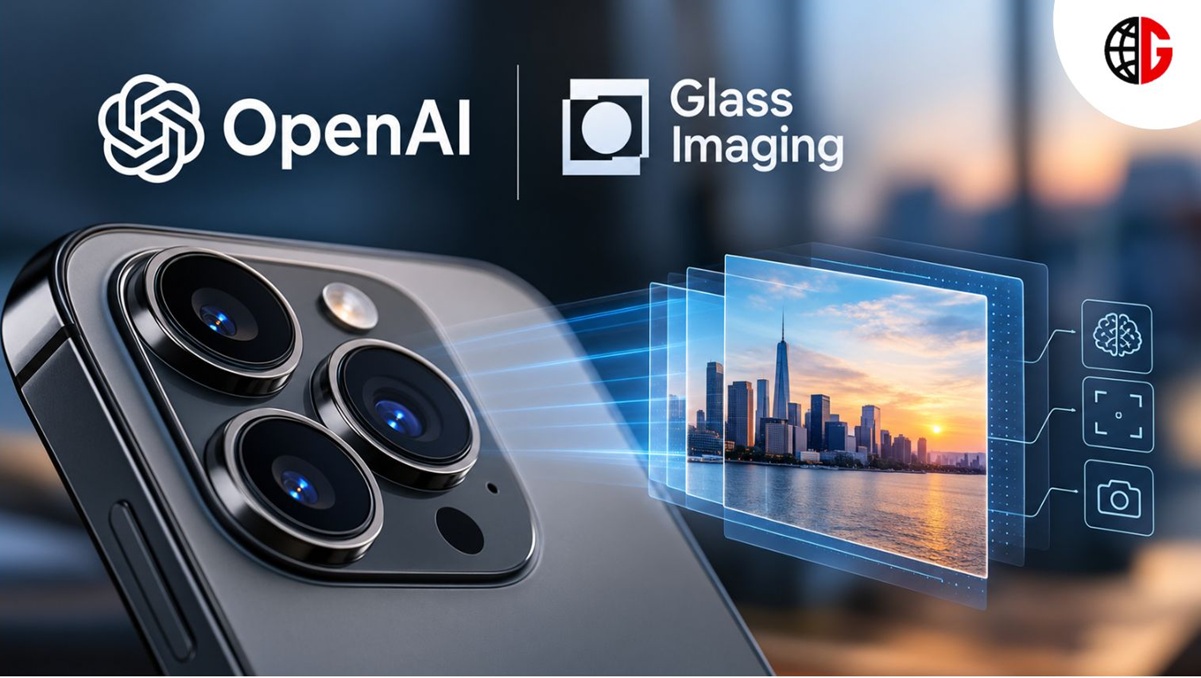
OpenAI has acquired Glass Imaging, a California-based startup specializing in computational photography and AI-driven camera technology, in a move that could strengthen the company’s growing ambitions in consumer hardware.
Founded in 2019 and headquartered in Los Altos, California, Glass Imaging has developed technology designed to enhance smartphone photography using artificial intelligence and neural networks. The startup was founded by Ziv Attar and Tom Bishop, former Apple engineers who contributed to technologies associated with Apple’s Portrait Mode.
Before the acquisition, Glass Imaging had reportedly raised approximately $30 million from investors.
Glass Imaging Brings AI Into the Camera Capture Process
Glass Imaging takes a different approach to conventional AI-powered photo enhancement.
Traditional AI photography tools often process and improve an image after it has already been captured. Glass Imaging’s technology is designed to work during the image-capture process itself, using AI and neural networks to understand the characteristics of individual camera systems and optimize image quality accordingly.
This approach, known as computational photography, combines camera hardware, software algorithms and machine learning to produce better photographs from relatively compact smartphone camera systems.
The company’s technology has also been used in smartphones from Honor, a major Chinese smartphone manufacturer, demonstrating its potential for commercial mobile photography applications.
Why Glass Imaging Matters to OpenAI
OpenAI has not publicly provided extensive details about how it intends to use Glass Imaging’s technology following the acquisition. However, the deal could give the AI company additional expertise in areas such as computational photography, imaging software and smartphone camera systems.
The acquisition is particularly notable as OpenAI continues to explore opportunities beyond its core AI software and model business.
Camera technology could become an important component of future consumer devices if OpenAI develops hardware that relies on visual input. Advanced imaging capabilities could support applications ranging from photography and video to AI-powered visual assistants and other interactive experiences.
OpenAI’s Growing Consumer Hardware Strategy
The Glass Imaging acquisition also fits into OpenAI’s broader expansion into consumer hardware.
The company has been associated with plans for multiple categories of AI-enabled devices, including smartphones, earbuds and AI companion products. In 2025, OpenAI also acquired hardware startup io, founded by former Apple design chief Jony Ive, in a deal valued at approximately $6.5 billion.
Together, these developments suggest that OpenAI is increasingly interested in creating dedicated hardware experiences rather than relying exclusively on existing smartphones, computers and other platforms.
Glass Imaging’s expertise could therefore become relevant to future OpenAI products where cameras and visual intelligence play a central role.
What the Acquisition Could Mean for Future AI Devices
The combination of advanced AI models with sophisticated camera technology could open up new possibilities for consumer devices.
Future AI hardware could potentially use cameras not simply to capture photographs, but also to understand surroundings, recognize objects, interpret environments and provide users with real-time visual assistance.
While it remains unclear exactly how OpenAI will integrate Glass Imaging’s technology, the acquisition highlights the increasing convergence between artificial intelligence, computational photography and consumer electronics.
For OpenAI, the deal represents another step toward building a broader technology ecosystem in which AI models, software and specialized hardware work together.
The Bigger Picture
OpenAI’s acquisition of Glass Imaging underscores how AI companies are increasingly looking beyond language models and software applications.
As the next generation of consumer AI devices takes shape, capabilities such as cameras, sensors, audio systems and specialized processors could become just as important as the underlying AI models.
Glass Imaging’s experience in computational photography could provide OpenAI with valuable expertise as it evaluates how visual intelligence can be integrated into future hardware.
For now, the specific plans for Glass Imaging remain undisclosed. However, the acquisition adds another significant piece to OpenAI’s expanding hardware strategy and could offer an early indication of the kinds of technologies that may power its future consumer devices.
Read more: STADA Appoints Diana Wiedmann as Chief Culture & People Officer