
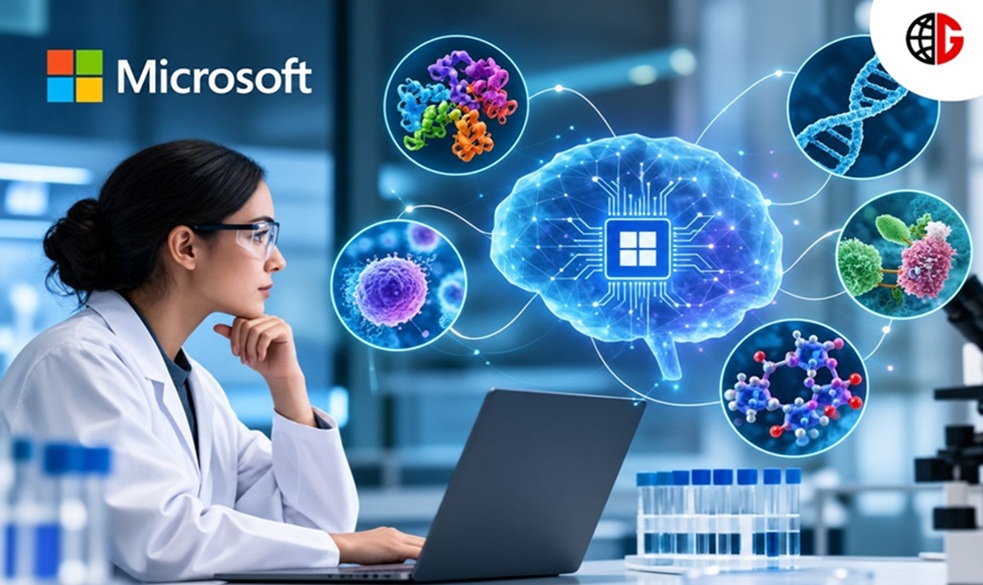
Microsoft Research has unveiled Quine, an experimental AI research system designed to help scientists navigate the enormous complexity of biological research. Rather than focusing on a single biological dataset or task, Quine is being developed as a multimodal world model of biology that connects information across genomics, proteins, chemistry, cellular states, and bioimaging.
The system represents a broader shift in how AI could participate in scientific discovery. Instead of simply analyzing existing information, Quine is designed to help researchers formulate hypotheses, explore possible interventions computationally, prioritize experiments, and then learn from the results generated in real laboratories.
Building AI That Understands Biology Across Scales
Biology rarely follows the boundaries imposed by individual datasets or research disciplines. Genetic information can influence proteins, proteins interact within cells, cells organize into tissues, and experimental findings can change the questions scientists investigate next.
Microsoft says this interconnected nature of biology creates a challenge for conventional AI systems, which are often trained for specialized tasks or individual data modalities.
Quine takes a different approach. Its underlying world model is designed to learn shared representations across biological sequences, structures, functions, cellular states, and imaging data. This allows information from one biological level to potentially inform predictions at another.
The objective is not to create a perfect digital replica of biology. Instead, Microsoft describes the goal as developing a system that can provide useful predictions and insights that help scientists decide which questions and experiments are worth pursuing next.
From AI Predictions to Real Laboratory Experiments
One of Quine’s defining features is its connection between computational reasoning and physical experimentation.
The system combines its biological world model with an interactive “harness” that connects AI models with scientific tools, research literature, orchestration and reasoning systems, and scientists themselves. Researchers can pose a scientific question, use Quine to generate and prioritize potential approaches, and then test promising ideas through wet-lab experiments.
The results from those experiments can subsequently inform the next research question, creating a continuous loop:
Scientific question → computational exploration → experimental proposal → wet-lab testing → new evidence → refined research
This closed-loop structure is central to Microsoft’s vision for Quine. Rather than positioning AI as a replacement for laboratory science, the system is intended to help researchers make better use of limited experimental time and resources.
Quine Demonstrates Its Potential in Cancer Research
Microsoft has already tested Quine in collaboration with researchers at the Broad Institute of MIT and Harvard, using pancreatic ductal adenocarcinoma (PDAC) as a research setting.
The research focused on the idea that cancer behavior and drug responses may be influenced not only by genetic characteristics but also by the transcriptional state of tumor cells.
Using Quine, researchers computationally evaluated thousands of compounds and prioritized candidates predicted to shift tumor cells between different biological states. According to Microsoft, several of the highest-ranked compounds produced the strongest intended changes when evaluated through wet-lab assays.
One particularly notable aspect was the speed of the process. Microsoft reports that the complete cycle—from narrowing a large compound search space to identifying a smaller group of candidates for laboratory validation—was completed over a weekend.
That could potentially compress a research process that might otherwise require months of experimental work.
Unexpected Results Could Be Just as Valuable
Quine’s cancer research also demonstrated an important characteristic of scientific discovery: useful AI systems do not necessarily need to produce only expected answers.
In the pancreatic cancer experiments, Quine identified compounds associated with a different cellular phenotype than the researchers had initially expected. Laboratory experiments subsequently supported the prediction, suggesting that pancreatic cancer cell states may be more complex than a straightforward two-state model.
For researchers, such results can be valuable because an AI system can potentially do more than confirm an existing hypothesis. It can also highlight relationships or experimental directions that scientists may not have considered initially.
The experiments, in turn, provide additional evidence that can be used to refine subsequent predictions.
A Multimodal Approach to Scientific Discovery
A key component of Quine is its attempt to connect different forms of biological evidence within one model.
Traditional research workflows can involve separate computational models for genomics, protein structures, chemical compounds, cell states, and imaging. While specialist systems can be highly capable within their individual domains, connecting their outputs can introduce additional complexity.
Microsoft’s approach is to train Quine across multiple biological modalities jointly. The company says this enables the system to use evidence from one modality when making predictions in another, reflecting the interconnected nature of biological systems.
This could become increasingly important as biological datasets continue to expand. Scientific discovery increasingly depends on combining information rather than analyzing each dataset in isolation.
AI Is Not Being Positioned as a Replacement for Scientists
Despite the ambitious nature of the project, Microsoft is clear that Quine remains an experimental research technology.
The company says its outputs can be incomplete or inaccurate and require review by qualified researchers, along with appropriate scientific and experimental validation. Quine is currently intended for research rather than clinical or medical use.
That distinction is particularly important in biology and medicine, where computational predictions ultimately need to withstand experimental scrutiny before they can support real-world applications.
Microsoft’s vision therefore centers on collaboration between scientists, AI systems, computational models, and laboratory experiments, rather than autonomous scientific decision-making.
Microsoft Opens Quine Fellows Program
Microsoft Research is also inviting scientists to participate in the early development of the technology through its Quine Fellows program.
The initiative is intended to provide a cohort of researchers with access to the system while gathering feedback from scientists working on frontier biological problems. Microsoft says access will initially be limited to the fellowship and selected research collaborations as the technology continues to evolve.
The company also says it expects to expand access to the technology over time through products such as Microsoft Discovery, subject to further development and appropriate safeguards.
A New Direction for AI-Powered Biology
Quine reflects a growing ambition within AI research: moving from models that simply recognize patterns toward systems that can participate in iterative scientific reasoning and discovery.
For biology, that distinction matters. The challenge is not simply processing more data. Researchers need to connect information across scales, understand possible consequences of interventions, determine which hypotheses deserve testing, and learn continuously from experimental evidence.
Microsoft’s Quine project is an early attempt to bring those pieces together.
The technology is still experimental, and its real scientific value will ultimately depend on how reliably it performs across different biological problems and how effectively researchers can validate its predictions. But its architecture points to a model of scientific AI in which computation doesn’t end when a prediction is generated—the prediction becomes the starting point for the next experiment.
Microsoft’s larger ambition is clear: make the journey from a biological question to a testable scientific discovery faster, more connected, and more iterative, while keeping scientists and real-world experiments at the center of the process.
Read more: OpenAI Introduces Dots: Always-On AI Agents Designed to Work Alongside You