
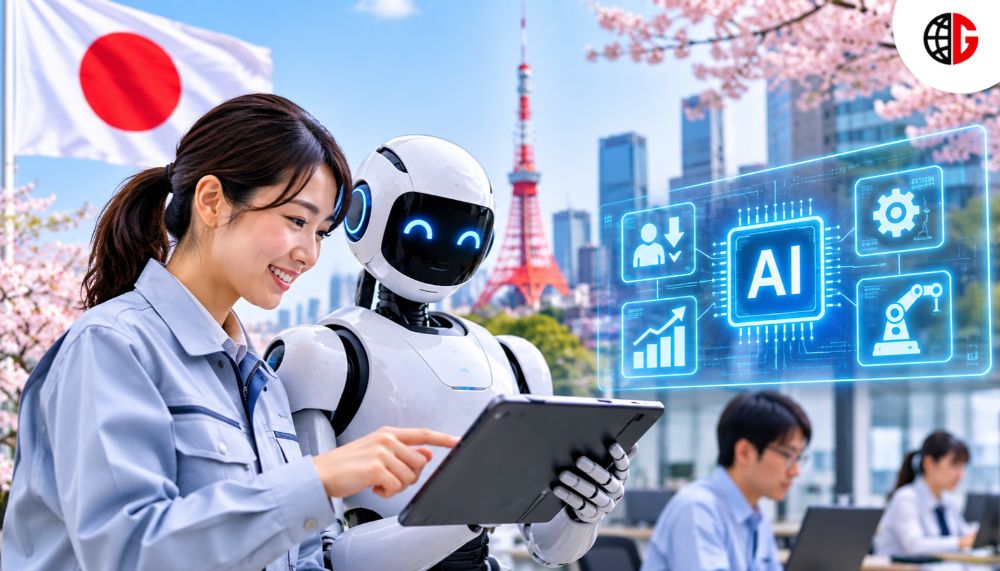
Japan is facing one of the most significant workforce challenges among developed economies. An ageing population, declining birth rate and shrinking working-age population are putting increasing pressure on businesses across industries. From manufacturing plants and logistics companies to hospitals, hotels and retail stores, employers are struggling to find enough people to maintain operations and meet growing customer expectations.
However, Japanese businesses are responding to this challenge with more than conventional recruitment strategies. Artificial intelligence (AI), robotics, automation and intelligent software are becoming essential tools for keeping businesses productive despite a shrinking workforce.
Rather than treating AI simply as a technology upgrade, many Japanese companies are beginning to view it as a practical solution to a long-term economic problem. AI-powered robots are helping factories maintain production, generative AI is reducing administrative workloads, automated systems are improving warehouse operations, and intelligent tools are supporting employees in customer service and healthcare.
This shift is changing how businesses approach productivity, workforce management and long-term competitiveness. Japan’s experience also offers an important lesson to other economies: when finding more workers becomes increasingly difficult, making better use of technology and the existing workforce can become a strategic necessity.
Why Japan Is Turning to AI to Solve Its Workforce Crisis
Japan’s labour shortage is not a temporary hiring challenge. It is closely connected to long-term demographic changes that are reshaping the country’s economy.
According to Japan’s Ministry of Health, Labour and Welfare, the country’s working-age population is projected to decline from approximately 75 million in 2020 to 62 million by 2040. Although greater participation by women and older people has helped maintain the labour force, the pressure on employers continues to increase.
The problem is particularly visible in industries that depend on large numbers of employees for everyday operations. Manufacturing companies need skilled technicians, logistics businesses require warehouse workers and delivery drivers, while healthcare facilities and nursing homes need more caregivers to support an ageing population.
The OECD’s November 2025 report, Artificial Intelligence and the Labour Market in Japan, highlights both the opportunity and the limitations of AI adoption. Only 8.4% of workers in Japan reported using AI in their workplaces across industries. The report also found that 35.8% of AI users said the technology had improved their job performance or working conditions.
These figures reveal an interesting situation: Japan has a strong technological foundation and an urgent need for automation, but workplace AI adoption still has considerable room to grow.
For businesses, the objective is becoming increasingly clear: use technology to reduce repetitive work, improve productivity and allow existing employees to concentrate on responsibilities that require human judgement, expertise and communication.
1. AI-Powered Robots Are Transforming Manufacturing
Manufacturing has traditionally been one of Japan’s strongest industries, with companies depending on skilled workers to operate production lines, inspect products and maintain machinery. However, as experienced employees approach retirement and fewer young workers enter certain technical occupations, manufacturers are increasingly exploring automation.
AI-powered industrial robots are helping companies perform repetitive and physically demanding activities with greater consistency. These systems can support assembly, welding, material handling, quality inspection and equipment monitoring.
Unlike conventional automation, which generally follows pre-programmed instructions, AI-enabled systems can analyse information from cameras and sensors, identify patterns and respond to changing conditions. This makes them particularly useful in production environments where products, materials or operating conditions may vary.
For example, computer vision systems can inspect products for defects that might be difficult to identify consistently through manual inspection. Predictive maintenance tools can analyse machine performance and detect unusual patterns before equipment failures interrupt production.
Collaborative robots, commonly known as cobots, are another important development. They are designed to work alongside human employees, helping with lifting, positioning and repetitive handling tasks rather than requiring businesses to replace entire production teams.
A May 2026 Reuters survey of Japanese companies illustrates the growing interest in this technology. Approximately one-third of respondents were already using, planning to deploy or considering AI-powered robots. Among potential applications, manufacturing was identified by 71% of interested companies, making it the leading area of anticipated use.
For Japanese manufacturers, AI-powered robotics offers an opportunity to maintain production capacity even when recruiting additional workers becomes difficult.
2. AI Is Making Warehouses and Logistics More Efficient
Japan’s logistics industry is facing increasing pressure from labour shortages, rising delivery expectations and restrictions on working hours for truck drivers. The challenge is particularly serious because distribution networks depend on a large workforce to move goods between warehouses, businesses and consumers.
AI and robotics are helping logistics companies rethink how products are stored, picked, sorted and transported.
Automated mobile robots can move goods across warehouse floors, while AI-powered systems help coordinate routes, organise inventory and determine more efficient picking sequences. Automated sorting equipment also reduces the amount of manual handling required in distribution centres.
One notable example is Amazon’s fulfilment centre in Chiba, Japan. The company has been expanding its use of warehouse robotics, automated packing and sorting technologies. According to a report by the Financial Times, its DeepFleet AI system increased robot travel speed by 10%, demonstrating how intelligent coordination can improve warehouse productivity.
The significance of these developments extends beyond faster deliveries. Businesses can process larger volumes of orders without increasing their workforce at the same rate.
AI-based demand forecasting can also help companies anticipate purchasing patterns, manage inventory and position products closer to customers. This reduces unnecessary movement, improves resource allocation and helps businesses respond to changing demand.
Nevertheless, adoption is not equally widespread across Japan. Smaller warehouses often face financial and operational barriers, including installation costs, limited floor space and the difficulty of automating facilities designed around different product categories.
Even so, logistics automation is becoming an increasingly important part of Japan’s strategy for maintaining reliable supply chains with fewer available workers.
3. Healthcare and Elderly Care Are Exploring AI and Robotics
Few industries demonstrate Japan’s demographic challenge more clearly than healthcare and elderly care. As the population ages, demand for medical services, rehabilitation and long-term care continues to grow, while healthcare providers face difficulties recruiting and retaining enough staff.
AI is emerging as a valuable support system in this environment.
Hospitals are introducing autonomous robots to transport medicines, medical supplies and other materials. These systems reduce the time nurses and healthcare professionals spend walking between departments and carrying equipment, allowing them to dedicate more attention to patients.
A notable example is Toyota Memorial Hospital, which introduced an autonomous transport robot called Potaro in its new hospital building in May 2023. The robot supports the movement of medicines and other supplies, helping reduce nurses’ routine workload and giving them more time for patient care.
The initiative also reflects Toyota’s well-known Kaizen approach, which focuses on continuously improving everyday processes.
Beyond hospitals, Japan is also investing in more advanced robotic caregiving technologies.
One ambitious project is AIREC, a humanoid robot developed by researchers at Waseda University with government support. Designed to assist with physical caregiving activities, the approximately 150-kilogram robot is being developed to perform tasks such as helping patients change position, putting on socks, preparing food and folding laundry.
However, the technology is still under development, with researchers anticipating that practical deployment in medical and nursing facilities may take until around 2030.
This distinction is important: humanoid caregiving robots are a developing solution, not yet a widespread replacement for professional caregivers.
AI is also being explored for patient monitoring, healthcare administration and identifying potential health risks. By automating documentation and routine monitoring, these technologies could help healthcare professionals manage increasing workloads without compromising the human element of care.
4. Hotels and Restaurants Are Using AI to Maintain Customer Service
Japan’s hospitality industry is another sector where labour shortages are encouraging businesses to adopt intelligent technologies.
Hotels, restaurants and tourism businesses must maintain service standards even during busy travel periods. However, recruiting enough receptionists, housekeeping employees, kitchen staff and service personnel can be difficult.
Businesses are responding by introducing automated check-in systems, AI-powered customer support, cleaning robots and robotic food-delivery systems.
Self-service kiosks allow hotel guests to complete check-in and check-out procedures without requiring continuous assistance from reception staff. AI chatbots can answer frequently asked questions, provide information about hotel facilities and assist international visitors with basic enquiries.
In restaurants, serving robots can transport food from kitchens to tables, reducing the distance employees need to walk and helping staff manage busy periods. Cleaning robots can also support housekeeping teams by handling routine floor-cleaning activities.
Japan’s Tourism Agency has documented labour-saving initiatives in accommodation businesses, including automatic check-in machines, cleaning robots, serving robots and AI concierge systems.
These technologies are intended not only to reduce staffing pressure but also to improve operational efficiency and service quality.
The larger opportunity lies in allowing employees to focus on interactions that genuinely benefit from human attention. Instead of spending most of their time answering repetitive questions or completing administrative procedures, hotel employees can concentrate on guest experiences, personalised assistance and problem-solving.
For businesses operating in tourism destinations with fluctuating visitor numbers, this combination of automation and human service can be particularly valuable.
5. Generative AI Is Reducing Administrative Workloads
While robotics is attracting attention in manufacturing and logistics, generative AI is creating opportunities across office-based businesses.
Japanese companies are increasingly exploring AI assistants for writing, translation, research, document preparation, customer communication and internal knowledge management.
These applications are especially relevant in organisations where employees spend significant time completing repetitive administrative tasks.
For example, generative AI can help employees prepare meeting summaries, draft business emails, organise reports, translate documents and retrieve information from internal knowledge databases. AI-powered customer service tools can also handle routine enquiries, allowing human representatives to focus on complex customer requirements.
Japanese businesses with international operations can benefit from AI translation and multilingual communication tools. These systems can help employees communicate with overseas customers, suppliers and business partners more efficiently.
AI is also supporting software development, data analysis and business planning. Employees can use AI assistants to generate initial drafts, identify patterns in large datasets and accelerate routine research.
However, adoption remains uneven. The OECD’s 2025 research highlights that Japan faces challenges involving AI skills, specialist talent, employee training and the integration of AI into existing business processes.
This means that purchasing AI software alone is unlikely to deliver meaningful results. Companies must also prepare employees to use these systems effectively and establish clear rules for handling confidential information and sensitive business data.
For many organisations, the most immediate benefit of generative AI may not be replacing employees but reducing the amount of time required to complete everyday work.
6. Retail Businesses Are Experimenting with AI Automation
Japan’s retail industry, particularly convenience stores and supermarkets, depends on employees to manage inventory, replenish shelves, operate checkout counters and assist customers. With fewer workers available, retailers are looking at AI to make everyday store operations more efficient.
AI-powered inventory management systems can monitor stock levels, analyse purchasing patterns and predict when products need replenishment. Computer vision technology can help identify empty shelves, misplaced products and inventory discrepancies.
Automated checkout systems and self-service payment technologies are also reducing the need for employees to handle every transaction manually.
One particularly interesting development involves AI-equipped shelving robots. As highlighted in the OECD’s research on Japan’s labour market, some convenience store operators are exploring robots that can restock heavy products, including beverages stored in refrigerated environments.
Such tasks can be physically demanding, particularly for older employees. Automating them could make retail workplaces more accessible and help businesses retain a wider range of workers.
The objective is not necessarily to eliminate human involvement in stores. Instead, AI can take responsibility for repetitive inventory and stocking activities while employees focus on customer assistance, merchandising and store management.
7. Construction Companies Are Using AI to Address Worker Shortages
Construction is another industry where Japan’s labour shortage is becoming increasingly difficult to manage. An ageing workforce, demanding physical conditions and a shortage of younger skilled workers are putting pressure on infrastructure projects and building companies.
AI is helping construction businesses improve productivity through intelligent machinery, drones, computer vision and automated project management systems.
AI-powered drones can survey construction sites, capture aerial images and help monitor project progress. Computer vision systems can analyse site footage to identify potential safety risks, monitor equipment and assess whether work is progressing according to schedule.
Predictive analytics can also help project managers anticipate delays, allocate machinery more effectively and identify maintenance requirements.
Meanwhile, robotic equipment is being explored for activities such as surveying, material transportation, site inspection and certain repetitive construction tasks.
These technologies can reduce the time employees spend on physically demanding or repetitive activities while improving accuracy and workplace safety.
For construction companies, the opportunity is particularly important because projects often involve multiple contractors, tight deadlines and complex coordination requirements.
By combining AI-based planning with robotics and digital monitoring, businesses can potentially complete more work with smaller teams while maintaining operational standards.
8. Japan Is Supporting AI and Robotics Adoption Among Smaller Businesses
Large corporations generally have greater financial resources, technical expertise and infrastructure to invest in advanced automation. However, small and medium-sized enterprises (SMEs) are equally important to Japan’s economy and often face even greater difficulties when trying to recruit employees.
Recognising this challenge, Japan’s Ministry of Economy, Trade and Industry (METI) announced the establishment of the Robotics & Regional Initiative Networking Group (RING Project) in June 2025.
The initiative aims to accelerate robot adoption across different regions of Japan, particularly by supporting businesses that lack the expertise and resources needed to introduce robotics independently.
The project brings together local governments, support organisations and robotics-related institutions to encourage practical adoption. Its activities include helping local businesses introduce robots, developing specialist robot coordinators and sharing successful implementation approaches.
The initiative also recognises that technology adoption is not simply about purchasing machines. Businesses need guidance, technical knowledge and suitable implementation strategies to make automation work effectively.
This is particularly relevant for smaller manufacturers, food-processing businesses and regional enterprises that may not have dedicated technology departments.
By creating a support network, Japan is attempting to make robotics more accessible beyond major corporations and large industrial centres.
The Challenges: Why AI Adoption Is Not Always Easy
Although AI presents significant opportunities, Japanese businesses cannot overcome labour shortages simply by introducing more machines and software.
The first challenge is implementation cost. Advanced robotics, automated production systems and AI infrastructure require substantial investment. Smaller businesses may struggle to justify these expenses, particularly when their operations involve limited production volumes.
The second challenge is a shortage of digital expertise. Companies need employees who understand AI systems, can integrate them into existing operations and can manage their performance. Ironically, businesses facing workforce shortages may also find it difficult to recruit the specialists required to implement automation.
The third challenge is employee training. Workers must understand how AI tools function, when their outputs should be trusted and how to identify mistakes. Without appropriate training, new technology may create additional workloads rather than reduce them.
The OECD has also highlighted differences in AI adoption among employee groups. Older workers and non-regular employees are less likely to use AI at work and may be less likely to benefit from its introduction. Ensuring that technological improvements reach all employees will therefore be essential.
There are also concerns involving data privacy, cybersecurity, transparency and accountability. In industries such as healthcare and finance, incorrect AI-generated information can have serious consequences.
Consequently, businesses need clear governance policies, human oversight and appropriate safeguards.
The OECD recommends stronger workplace training, employee consultation, responsible AI guidelines and measures to reduce barriers to adoption. These steps can help ensure that AI improves working conditions instead of simply increasing pressure on employees.
The Future of Work in Japan: Humans and AI Working Together
Japan’s approach to AI adoption offers an important perspective on the future of business. The country’s demographic situation is encouraging companies to reconsider traditional workforce models and explore how technology can help maintain productivity with fewer available workers.
However, the long-term opportunity is not limited to replacing repetitive manual activities. AI can also help businesses make better decisions, preserve institutional knowledge, improve employee capabilities and create more flexible working environments.
For example, experienced employees approaching retirement can use AI-based knowledge management systems to document processes and share expertise with younger colleagues. Employees with physical limitations may benefit from assistive technologies that make certain jobs easier to perform. Businesses can also use intelligent scheduling systems to distribute workloads more effectively.
These developments could help Japan retain valuable human expertise while making workplaces more adaptable to demographic changes.
Nevertheless, technology must complement broader workforce strategies. Better working conditions, higher productivity, professional development, greater participation by women and older workers, and appropriate opportunities for international talent will remain important.
AI is therefore one part of a much larger transformation in Japan’s employment landscape.
Conclusion: Can AI Help Japan Build a More Productive Economy?
Japan’s experience demonstrates how demographic pressure can accelerate technological innovation. As businesses face growing difficulties in recruiting and retaining employees, AI and robotics are becoming practical tools for maintaining operations and improving productivity.
From manufacturing robots and intelligent warehouses to automated hotel services, healthcare support systems and generative AI assistants, Japanese businesses are exploring different ways to accomplish more with limited human resources.
However, the country’s experience also highlights an important distinction between technological potential and actual adoption. The OECD’s finding that only 8.4% of Japanese workers reported using AI at work suggests that considerable opportunities remain untapped.
The next phase will depend on how effectively businesses integrate AI into everyday operations, train employees and make advanced technologies accessible to smaller enterprises.
Ultimately, Japan’s strategy is not simply about creating workplaces where machines replace people. It is about building workplaces where technology takes over repetitive, time-consuming and physically demanding responsibilities, allowing people to contribute where their judgement, creativity and experience matter most.
As the global economy faces similar demographic and workforce pressures, Japan’s evolving relationship with AI could offer valuable lessons for businesses worldwide. The companies that succeed may not necessarily be those with the most advanced machines, but those that understand how to combine human capabilities with intelligent technology.