
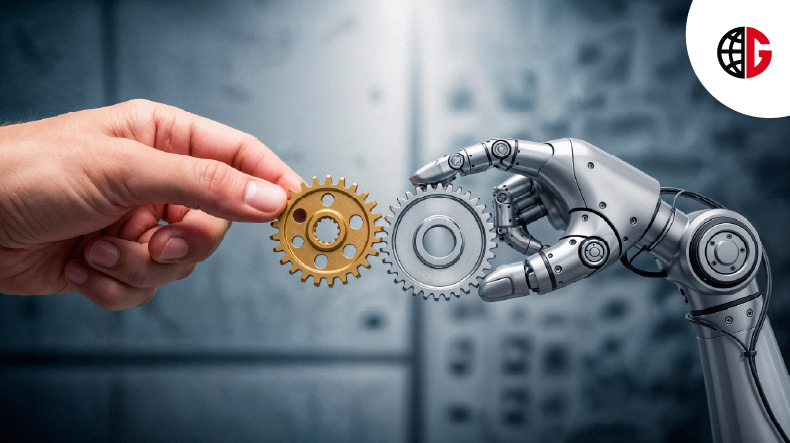
Picture a digital colleague that operates around the clock, perpetually evolving its capabilities, and seamlessly adjusting to organizational requirements. This represents the fundamental proposition of AI agents—intelligent systems reshaping how businesses operate in 2025 and beyond.
Equipped with capabilities to monitor environments, strategize approaches, and execute tasks independently, these intelligent automation systems are ushering in a transformative era of comprehensive organizational evolution across sectors—optimizing operational frameworks, generating actionable data intelligence, and amplifying human capabilities in unprecedented ways.
Understanding AI Agents: A Comprehensive Overview
At their core, AI agents represent artificial intelligence systems that leverage various tools and resources to achieve defined objectives. These sophisticated platforms possess several distinguishing characteristics:
- They maintain contextual awareness across multiple assignments and evolving conditions
- They harness one or multiple AI models to execute diverse functions
- They autonomously determine when to engage with internal or external platforms on behalf of users
This capability framework empowers AI agents to execute decisions and implement actions with limited human intervention.
Real-World Example: Marketing Automation
Consider a practical application: a multinational consumer products corporation sought to enhance its worldwide marketing initiatives through an AI agent-driven process transformation.
What previously demanded six analysts dedicating a full week now requires just one employee collaborating with an agent, producing outcomes in less than sixty minutes.
The workflow operates as follows:
Data Aggregation Phase: Each week, the agent independently compiles and consolidates marketing information through integrated data infrastructure.
Performance Evaluation Phase: The system conducts comprehensive contextual assessment of the data to interpret campaign effectiveness indicators and benchmark against projected outcomes, consulting with a human operator when additional business context is required.
Strategic Recommendation Phase: The agent generates a formatted report outlining proposed optimization strategies. A human operator validates and refines these recommendations as necessary.
Implementation Phase: Upon receiving human authorization, the agent modifies media procurement platforms with the approved recommendations.
The Operational Framework of AI Agents
AI agents function through a continuous cycle: monitoring their surroundings, utilizing large language models for strategic planning, and interfacing with integrated systems to execute actions and accomplish objectives.
Monitor
These intelligent systems continuously gather and interpret information from their operational environment, encompassing user engagements, critical performance indicators, and sensor-derived data.
They maintain conversational memory, providing sustained context throughout multi-phase plans and operations.
Strategize
Employing language models, AI agents independently assess and rank potential actions based on their comprehension of:
- Challenges requiring resolution
- Objectives to achieve
- Contextual factors
- Historical knowledge
Execute
AI agents utilize connections with enterprise infrastructure, applications, and information repositories to carry out assignments. These tasks are directed by strategies formulated by large or small language models.
During execution, the AI agent may:
- Access corporate services (including HR platforms, order processing systems, or CRM tools)
- Assign responsibilities to additional AI agents
- Request user clarification when needed
These intelligent software platforms can identify anomalies, remediate them, and improve through multi-stage processes and internal validation mechanisms.
This monitor-strategize-execute framework creates a self-reinforcing loop, as AI agent tools persistently examine how conditions have evolved based on previous engagements and develop enhanced efficiency and effectiveness over time.
Core Components Comprising AI Agents
While AI agents differ in their technical implementation, they generally incorporate five essential elements:
- Agent-Focused Interfaces
The protocols and application programming interfaces connecting agents to users, databases, sensors, and additional systems, enabling intelligent software agents to perceive their environment.
- Memory Architecture
Encompasses both short-duration memory for recent occurrences and immediate context, alongside long-duration memory for factual information, conceptual frameworks, previous conversation details, and knowledge of historical task execution.
- Profile Configuration
Establishes the agent’s characteristics, including its function, objectives, and behavioral frameworks.
- Planning Architecture
Typically powered by an LLM or SLM, this component processes environmental observations, including memory and the agent’s profile, to construct appropriate action plans.
- Action Framework
Comprises the APIs and system integrations that establish the spectrum of capabilities available to the AI agent.
Capabilities and Functions of AI Agents
AI agents signify a paradigm shift in artificial intelligence, substantially exceeding conventional software capabilities.
Rather than static instruments, these intelligent software agents operate as autonomous, decision-executing entities. They interpret data, organize tasks, implement actions, and persistently adapt—frequently in real-time.
What Makes AI Agents Powerful?
AI agents transcend mere instruction-following—they demonstrate initiative. They interact with their environment, continuously learning and adjusting.
These systems perpetually accumulate information from diverse sources, employing memory and specialized tools to comprehend environmental dynamics and track significant details.
AI agents determine optimal action sequences by evaluating goals, roles, and limitations. They can modify their strategies in real-time as circumstances evolve, rendering them more flexible to process modifications and exceptional scenarios than approaches like robotic process automation.
AI agents achieve outcomes by leveraging connected infrastructure and coordinating with other intelligent agents.
These systems are engineered as active workflow contributors. They represent not merely tools—they function as competent, high-performing team members delivering genuine value to their supported teams.
Categorization of AI Agents by Sophistication Level
AI agents range in complexity, from elementary coding assistants to intricate networks capable of automating processes currently requiring entire human teams.
Using software development as an illustration, we can observe different sophistication tiers:
Level 1: Basic Assistance
A coding copilot can produce code when prompted by a developer.
Level 2: Contextual Intelligence
A more sophisticated intelligent agent could automatically analyze the existing codebase and tailor its output accordingly. This agent might even generate output proactively by automatically creating code that satisfies a unit test once a developer authors that test.
Level 3: Advanced Execution
Even more advanced AI agents could not only develop code but also compile and execute the application within a testing environment.
Level 4: Full Deployment Capability
Future AI agents may advance this further and deploy validated applications to production environments through automated pipelines following human approval. This would effectively empower anyone, using natural language, to create and launch complete applications.
Implementing AI Agents: Best Practices
Optimal AI agent performance derives from closely replicating human-followed processes. This is because LLMs, the central planning component of contemporary agents, can “absorb” human cognition—they are trained on extensive human-generated content and consequently can resolve problems similar to those people can address.
Like LLMs, virtual agents in AI excel on challenges that can be decomposed into constituent elements. They require:
- Discrete, clearly-defined assignments
- Pertinent context
- Robust feedback mechanisms for error correction through iteration
Three Primary Value Domains
AI agents generate business value across three primary domains:
- Standardized Process Automation
AI agents can manage repetitive assignments with precision and velocity, minimizing human error and allowing employees to concentrate on higher-value contributions.
- Human-AI Collaboration
Operating as intelligent collaborators, virtual agents in AI strengthen human teams by delivering actionable intelligence, supporting decision-making processes, and executing tasks that complement human expertise.
- Data Intelligence Discovery
In data-intensive environments, AI agents analyze and synthesize information at scales no human team could replicate, identifying patterns and delivering insights that inform strategic decisions.
Current Enterprise Applications of AI Agents
AI agents are rapidly becoming prevalent across industries. Early implementers have already extracted value from these intelligent software agents across multiple functions.
Industry-Specific Applications
Marketing
A prominent consumer packaged goods enterprise utilized intelligent agents to generate blog content, reducing expenditures by 95% and accelerating speed by 50x (publishing new blog posts in one day versus four weeks).
Customer Service
A major international banking institution employed AI virtual agents to interact with customers, reducing costs by 10x.
Research and Development
A biopharmaceutical company deployed AI agents for lead generation, decreasing cycle time by 25% and achieving 35% time efficiency gains for drafting clinical study documentation.
Data and Technology
An IT division utilized AI agents to modernize legacy technologies, increasing productivity by up to 40%.
The Trajectory of AI Agents in Business
AI agents are achieving momentum rapidly across a spectrum of business applications. According to GlobalBiz Outlook research, the market for AI agents is projected to expand at a 45% compound annual growth rate over the next five years.
The Future Workplace
As AI agents become ubiquitous, humans will collaborate closely with them as colleagues. AI agents will undergo onboarding, similar to human workers, to:
- Acquire roles and responsibilities
- Access relevant company data and business intelligence
- Integrate into workflows
- Support human responsibilities
Sophisticated disciplines, such as software engineering, customer support, and business analytics, that previously demanded large human teams will now become substantially smaller teams of humans working alongside various types of AI agents.
Consequently, organizations will scale more rapidly since AI agents can replicate quickly, and companies will not depend as heavily on hiring to expand.
Unlocking New Business Models
By developing AI agents, companies will also unlock novel business models and accelerate productivity. AI agents will:
- Automate and manage tasks, liberating workers to be more creative
- Expedite labor- and time-intensive processes
- Enable workers to be more productive
The Human Element Remains Critical
Overseeing virtual AI agents will emerge as a fundamental teaming competency, ensuring agents accomplish their objectives and maintain standards of privacy, fairness, and ethical implementation.
As AI agents proliferate, the demand for employee management of these systems intensifies—placing a premium on training employees in responsible AI practices at every organizational level.
Frequently Asked Questions About AI Agents
What is the difference between AI agents and traditional automation?
Unlike traditional automation tools that follow fixed rules, AI agents can make autonomous decisions, learn from interactions, and adapt to changing circumstances in real-time.
How secure are AI agents when accessing enterprise systems?
AI agents operate within governed frameworks with defined permissions, access controls, and audit trails to ensure security and compliance with organizational policies.
Can small businesses benefit from AI agents?
Yes, AI agents are scalable solutions. Small businesses can start with simple automation tasks and expand capabilities as needs grow, without requiring large technical teams.
Read more: Nine Trends Reshaping How Leaders Build Authority in 2026