

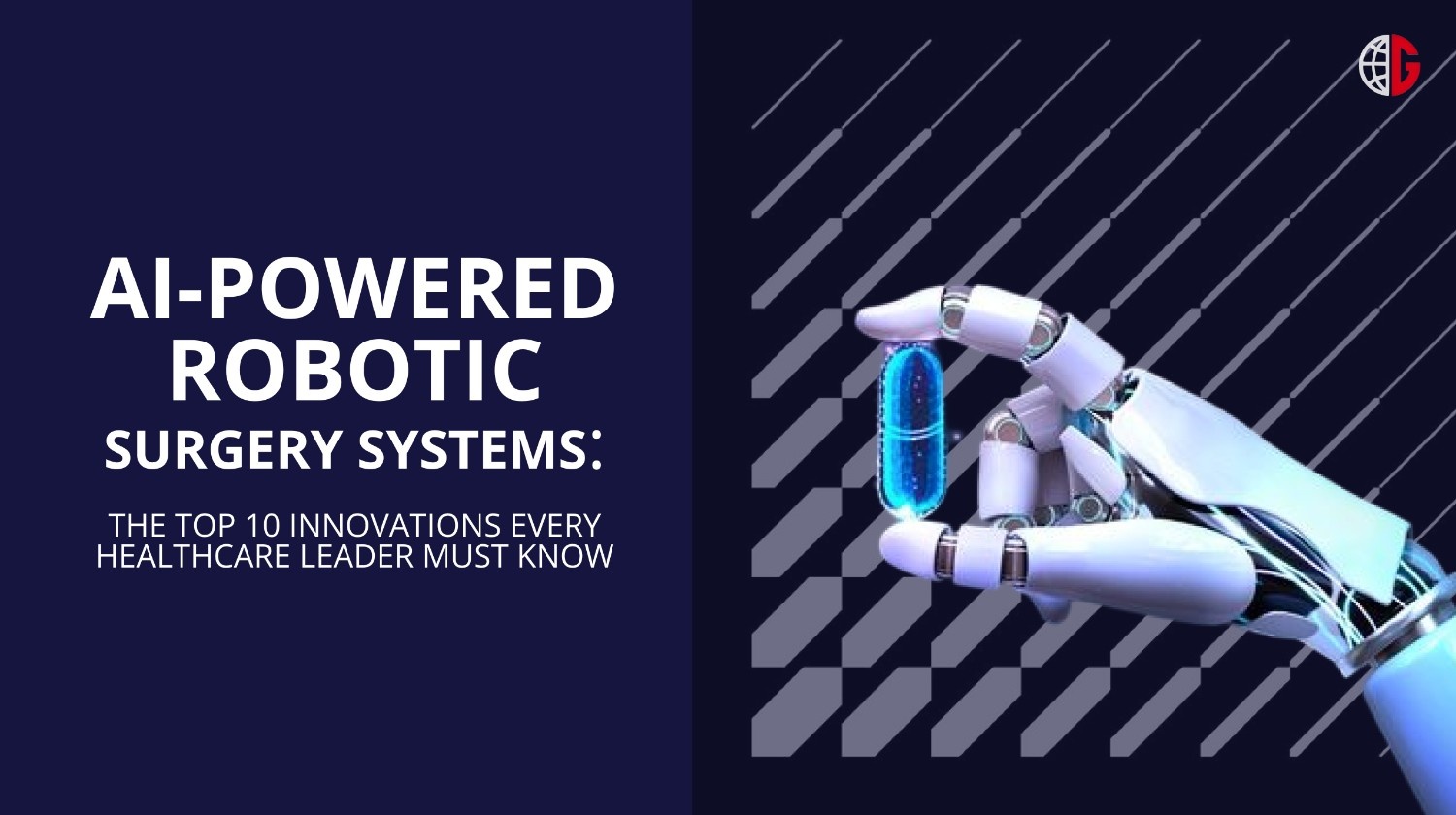
In the global race to modernize healthcare, a new kind of intelligence is entering the operating room — one that never trembles, never tires, and never stops learning. AI-powered robotic surgery systems have moved far beyond mechanical arms and magnification screens. Today, they represent an ecosystem of autonomous decision-making, real-time computer vision, predictive analytics, and ultra-precise haptics that outperform human abilities in some of the most delicate surgical tasks.
From AI-guided suturing to smart navigation overlays and data-driven OR automation, the fusion of artificial intelligence with robotic systems is rewriting the future of surgery — and shaping the competitive landscape for hospitals, insurers, regulators, and MedTech innovators.
Here are The Top 10 Innovations in AI-Powered Robotic Surgery that are Redefining the Future of Medicine
1. Autonomous Soft-Tissue Suturing Systems (STAR & Beyond)
If industrial robots revolutionized manufacturing automation, the next frontier is surgical automation — and the Smart Tissue Autonomous Robot (STAR) is proving that the future is already here.
These systems use machine learning, 3D imaging, and predictive planning to autonomously stitch soft tissues with near-perfect accuracy. In controlled studies, STAR-like systems have delivered more consistent anastomoses than human surgeons.
Why leaders care: Autonomous tasks could reduce surgical errors, shorten procedure time, and standardize outcomes across varying surgeon skill levels.
2. The Next-Gen Surgical Titans: da Vinci 5, Hugo™ RAS & Versius AI Suites
The world’s biggest robotic surgery systems are entering a golden age of reinvention.
- da Vinci 5 now infuses advanced compute power and data-driven insights directly into the surgeon’s console.
- Hugo™ RAS uses modular robotics with AI-driven workflow intelligence and scalability.
- Versius introduces lightweight, portable, AI-optimized surgical arms designed for global accessibility.
Why leaders care: The choice of platform now determines future AI capabilities, data ownership, scalability, and hospital ROI for the next decade.
3. AI Computer Vision That “Sees” What Surgeons Can’t
Computer vision models trained on millions of surgical images now detect anatomical structures, flag bleeding, identify hidden margins, and predict the next steps of a procedure before a surgeon takes them.
In many ORs, computer vision is quietly becoming the “second set of eyes” every surgeon wishes they had.
Why leaders care: Vision-driven accuracy directly correlates to safer surgeries and fewer complications — a metric that heavily impacts hospital reimbursements.
4. Augmented Reality & Image Fusion Navigation
Imagine viewing a tumor not as a flat MRI but as a live, 3D hologram layered directly onto a patient’s anatomy.
That is the promise of AR-driven robotic surgery.
These systems blend CT, MRI, and ultrasound with real-time robotic video to guide surgeons through millimeter-level precision cuts.
Why leaders care: AR reduces uncertainty, shortens surgery time, and enhances outcomes in complex procedures like oncology, neurology, and cardiothoracic surgery.
5. Predictive Analytics for Personalized Surgery
AI models now forecast:
- Patient-specific complication risks
- Ideal surgical approaches
- Potential blood-loss trajectories
- Postoperative recovery pathways
This is precision surgery at its finest — a personalized blueprint for every patient.
Why leaders care: Improved predictability lowers cost-per-case, readmission rates, and ICU utilization.
6. Intelligent Surgical Workflow Orchestration
The OR of the future is a coordinated digital symphony.
AI now predicts which instrument the surgeon may need next, optimizes team timing, manages equipment readiness, and even suggests workflow adjustments in real time.
Why leaders care: It improves OR throughput, cuts idle minutes, and boosts annual surgical capacity — without expanding staff.
7. AI-Guided Haptics and Force Sensing
Traditional robotic systems lack tactile perception — but not anymore.
Next-gen AI haptics recreate the “feel” of tissue tension, thickness, and resistance, giving surgeons a digital sense of touch.
Pairing force sensors with AI safety envelopes prevents robotic arms from pressing too hard or entering restricted anatomical zones.
Why leaders care: Enhanced tactile fidelity reduces accidental tissue damage and improves training for young surgeons.
8. Surgical Digital Twins & AI Simulations
Borrowing from aerospace engineering, digital-twin technology is now entering the surgical world.
AI creates a digital replica of a patient’s anatomy, allowing surgeons to rehearse, predict complications, and optimize strategies.
Why leaders care: The ability to “practice before performing” enhances precision, reduces surprises, and boosts confidence.
9. Surgical Data Platforms & AI-Driven Coaching
Robotic systems today are data factories — recording every gesture, angle, and instrument movement.
AI platforms analyze these granular details to:
- Benchmark surgeons
- Offer automated coaching
- Highlight risky patterns
- Improve consistency across departments.
Why leaders care: This transforms surgeon training, reduces variability, and promotes evidence-backed clinical excellence.
10. Ethical, Regulatory & Governance Frameworks for AI Surgery
No innovation is complete without governance.
AI-assisted surgery introduces pressing questions:
- Who’s responsible for an AI-driven error?
- How do we maintain transparency with patients?
- How do we validate AI models in diverse populations?
Forward-thinking hospital systems are already building ethical boards and AI oversight committees.
Why leaders care: Governance will determine the speed of adoption, liability protections, and long-term patient trust.
The Bottom Line: The AI Surgical Revolution Has Arrived
AI-driven robotic surgery is no longer experimental — it is becoming the defining technology of modern hospitals. Healthcare leaders who embrace these innovations early will gain:
- Safer, more consistent surgical outcomes
- Higher surgeon productivity
- Reduced operational costs
- Competitive differentiation
- Future-ready surgical ecosystems
The global shift toward AI in surgery is not about replacing surgeons — it’s about amplifying their capabilities, reducing complexity, and democratizing world-class medical care.
The operating room is evolving. The question for healthcare leaders is simple: Are you evolving with it?Discover more similar articles at Google Clarifies: Gmail Emails Aren’t Being Used to Train Gemini AI