
Google upgrades MedGemma 1.5 with advanced medical imaging and launches MedASR, boosting open AI innovation in healthcare worldwide.
Artificial intelligence is reshaping healthcare at an unprecedented pace, with the sector adopting AI technologies at nearly twice the rate of the broader economy. Strengthening this momentum, Google has announced a major update to its open medical AI ecosystem with the release of MedGemma 1.5 and the launch of MedASR, a new open medical speech-to-text model.
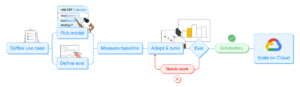
Originally introduced under Google’s Health AI Developer Foundations (HAI-DEF) initiative, MedGemma was designed as a foundational, open-source model that developers can adapt for real-world medical use cases. Since its debut, the MedGemma collection has seen widespread adoption, recording millions of downloads and inspiring hundreds of community-driven variants across platforms such as Hugging Face and Google Cloud’s Vertex AI.
MedGemma 1.5: Expanded Imaging and Stronger Performance
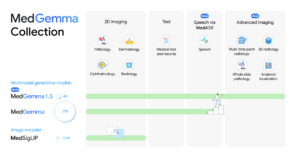
Building on community feedback, MedGemma 1.5 4B significantly enhances support for complex medical imaging workflows. The updated model now handles:
- High-dimensional imaging, including CT scans, MRI volumes, and whole-slide histopathology
- Longitudinal imaging analysis, such as time-series chest X-rays
- Anatomical localization, enabling more precise identification of features in chest X-rays
- Medical document understanding, including structured data extraction from lab reports
In addition to broader imaging support, MedGemma 1.5 improves baseline accuracy across text, medical records, and 2D image interpretation when compared to earlier versions. The 4B parameter model is optimized for compute efficiency, making it suitable for offline and edge deployments, while the larger 27B model remains available for advanced, text-heavy applications.
Internal benchmarks show notable gains, including higher accuracy in CT and MRI disease classification, improved fidelity in histopathology interpretation, and stronger performance in anatomical localization and longitudinal disease assessment. Google notes that MedGemma 1.5 represents one of the first open multimodal large language models capable of interpreting high-dimensional medical imaging alongside traditional text and 2D images.
MedASR: Purpose-Built Speech Recognition for Healthcare
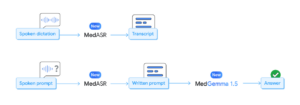
Complementing MedGemma’s visual and text-based capabilities, Google has also introduced MedASR, an open automated speech recognition model fine-tuned specifically for medical dictation and clinical conversations.
Unlike general-purpose speech models, MedASR is trained to recognize specialized medical terminology, enabling more accurate transcription of clinical notes and spoken prompts. In comparative evaluations, MedASR demonstrated significantly lower error rates than generalist ASR systems across chest X-ray dictations and multi-specialty medical speech benchmarks.
MedASR integrates seamlessly with MedGemma, allowing developers to combine voice-based inputs with advanced medical reasoning—supporting use cases ranging from clinician dictation to conversational AI interfaces in healthcare settings.
Encouraging Innovation Through the MedGemma Impact Challenge
To accelerate real-world adoption, Google has launched the MedGemma Impact Challenge, a Kaggle-hosted hackathon offering $100,000 in prizes. Open to developers worldwide, the challenge invites participants to build impactful healthcare and life sciences solutions using MedGemma, MedASR, and other HAI-DEF models.
Real-World Adoption Across Healthcare Systems
MedGemma is already being deployed across diverse healthcare environments. In Malaysia, health tech teams have adapted the model to power conversational access to national clinical practice guidelines. In Taiwan, healthcare authorities are using MedGemma to analyze tens of thousands of pathology reports, supporting data-driven policy decisions for lung cancer surgery.
The models have also gained strong traction within the medical research community, where they are increasingly referenced as base models for clinical decision support, medical reporting, and multimodal healthcare analysis.
Open Access With Responsible Data Practices
All MedGemma and MedASR models remain free for both research and commercial use, accessible through Hugging Face and scalable on Google Cloud’s Vertex AI. Google emphasizes that training and evaluation datasets were rigorously anonymized or de-identified to ensure patient privacy and ethical AI development.
Looking Ahead
With enhanced imaging intelligence, improved medical text reasoning, and specialized speech recognition, MedGemma 1.5 and MedASR mark a significant step forward in open medical AI. As developers continue to adapt these tools for clinical and research applications, Google aims to foster a collaborative ecosystem that drives innovation while prioritizing safety, transparency, and real-world impact.