

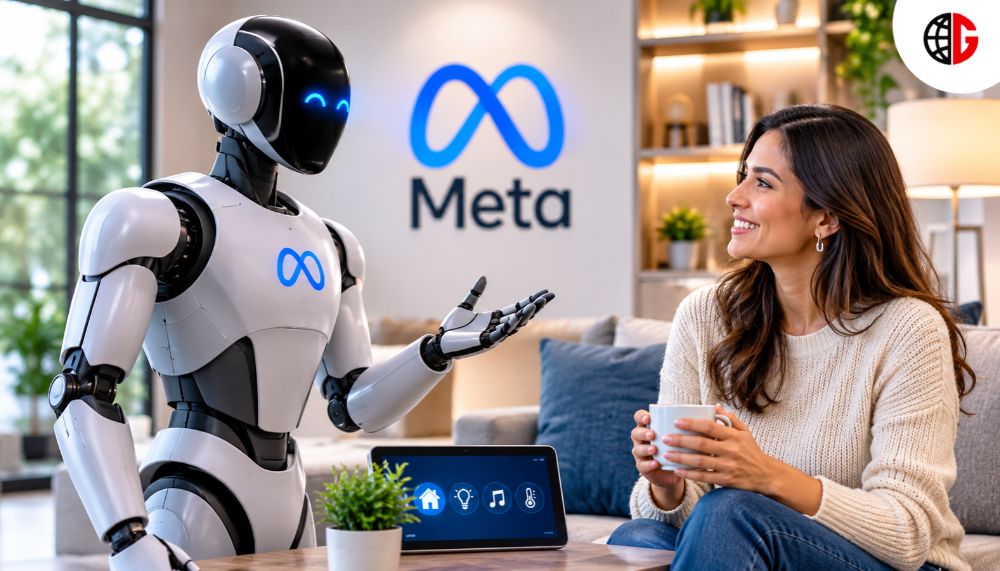
Meta’s humanoid robotics ambitions are taking shape with Max, a human-like robot developed alongside Chinese robotics company Fourier. The prototype signals the company’s growing interest in connecting artificial intelligence with real-world household tasks, although a commercial launch remains off the table for now.
The future of artificial intelligence may not be limited to chatbots, smart assistants, or digital platforms. Technology companies are increasingly exploring how AI can move beyond screens and interact with the physical world. Meta is now taking a closer look at this opportunity with a humanoid robot designed to explore how intelligent machines could eventually operate in everyday home environments.
The company has reportedly developed a humanoid robot named Max in collaboration with Chinese robotics firm Fourier. Built in about three months, the prototype marks a new step in Meta’s broader robotics research as it explores how AI-powered machines could understand human instructions, interact naturally with people, and potentially help with household tasks.
According to The Information, Meta has already begun developing a second-generation version, Max 2. However, the company has clarified that its current collaboration with Fourier is focused on internal research and experimentation, with no plans to sell the robots at this stage.
Meet Max, Meta’s New Humanoid Robot Prototype
Standing approximately 1.5 metres tall and weighing around 48 kilograms, Max has been designed to resemble a human in both appearance and interaction. Unlike traditional industrial robots built primarily for repetitive factory operations, this prototype places considerable emphasis on communication, object handling, and the possibility of functioning in human-centred environments.
The robot reportedly uses NVIDIA’s Jetson Thor computing platform and incorporates several customized hardware features developed using Fourier’s existing robotics expertise.
Its design includes five-fingered hands intended to grasp smaller objects, such as bottles and toys. Speakers built into its chest allow it to communicate audibly, while a facial display can show expressions to make interactions feel more natural.
These features reflect an important challenge in humanoid robotics: developing machines that can operate around people without requiring them to learn complicated commands or adapt their homes to unfamiliar technology.
Meta and Fourier reportedly built Max using experience and hardware foundations drawn from multiple generations of Fourier’s robotic platforms. The companies then adapted the robot’s proportions, head, display, camera arrangement, and other physical elements to meet Meta’s requirements.
Although the prototype demonstrates progress in hardware development, its reported design features should not be confused with proof that it can independently complete complex household chores. Its practical capabilities will need to be established through further testing.
Why Meta Is Exploring Home Robotics
Meta’s interest in humanoid robots reflects a broader shift in the technology industry. AI systems are becoming increasingly capable of processing information, understanding natural language, and responding to user instructions. The next challenge is enabling these systems to act on that information in the physical world.
A digital assistant can explain how to organise a room or prepare a shopping list. A capable household robot, by contrast, would eventually need to recognise objects, understand its surroundings, move safely, manipulate items, and complete physical tasks with limited human supervision.
That transition is significantly more complicated than developing a software-based assistant. Real-world environments are unpredictable, and even seemingly simple activities can require sophisticated coordination between perception, reasoning, movement, and decision-making.
For Meta, humanoid robotics could provide a potential route for bringing its AI technologies into homes in a more direct and practical way.
According to The Information, Meta Chief Technology Officer Andrew Bosworth has discussed humanoid robots internally as a possible physical embodiment of the company’s Muse AI agent. Such an approach could connect AI capabilities with a machine that can perceive its surroundings and perform actions rather than merely provide information.
Nevertheless, translating conversational intelligence into reliable physical behaviour remains a major engineering challenge. A robot must do more than understand a request; it must determine whether the task is possible, identify the objects involved, plan its movements, and respond appropriately when something unexpected happens.
Human Interaction Is Central to Max’s Design
One of the most notable aspects of Max is the reported emphasis on making interaction with people more intuitive.
According to the available reporting, Meta established requirements for recognising spoken commands from approximately five metres away and interpreting gestures, such as a wave, from around three metres away. The robot is also intended to maintain eye contact and communicate its operating state.
For example, it should be able to indicate whether it is listening, processing a request, speaking, or uncertain about what to do.
These details point towards a design philosophy in which people should be able to understand a robot’s behaviour without needing extensive technical knowledge. Clear feedback could become particularly important in a home, where a machine may operate near children, older adults, pets, and other household members.
However, these figures describe reported design targets rather than independently verified performance results. It remains unclear how consistently Max can recognise different voices, interpret gestures in changing lighting conditions, or respond to complex instructions in real-world settings.
Building trust will require more than an expressive face or natural-sounding conversation. Household robots must also demonstrate predictable behaviour, dependable task execution, strong privacy protections, and appropriate safety controls.
Max 2 Signals the Next Stage of Development
Meta’s work has reportedly progressed beyond the original prototype. Development of a successor, Max 2, began in September, with several hardware improvements expected.
The planned changes include a redesigned torso, upgraded hands for improved object manipulation, a projector, and additional sensors intended to help the robot navigate stairs and better understand its surroundings.
These improvements address some of the practical limitations that humanoid robots must overcome before they can become useful outside controlled demonstrations.
For instance, moving through a home involves negotiating narrow spaces, uneven surfaces, furniture, doorways, and stairs. Handling everyday objects also requires different levels of force and precision. A robot must be capable of gripping a fragile item without damaging it while maintaining sufficient control to lift or move heavier objects.
Improved hands and environmental sensing could help advance these capabilities, but hardware upgrades alone will not guarantee reliable performance. The robot’s AI models and control systems must also learn how to coordinate movements, interpret changing conditions, and recover from mistakes.
Meta is reportedly expanding its robotics-related recruitment in Shanghai and Shenzhen, with roles covering engineering, prototype development, and manufacturing preparation. Such hiring suggests that the company is building expertise for continued development, although it does not establish a timetable for mass production.
Meta’s Broader Push Into Artificial Intelligence and Robotics
The humanoid project forms part of Meta’s wider efforts to strengthen its position in AI.
In May 2026, Meta acquired Assured Robot Intelligence, a startup focused on developing AI systems that help robots understand and adapt to human behaviour in complex environments. The acquisition brought additional expertise in robot learning and control, areas that could become important as Meta investigates physical AI applications.
The distinction between conventional AI assistants and embodied AI is significant. Software-based systems primarily work with information, while embodied AI must connect perception and reasoning with physical action.
For humanoid robots, this means learning how objects behave, recognising human intentions, adapting to unfamiliar surroundings, and coordinating movements to achieve specific goals. Progress in these areas could eventually support applications extending beyond domestic assistance into other environments where flexible, human-oriented machines may be useful.
Meta’s work also places it within a competitive robotics landscape that includes companies such as Tesla, Figure AI, and 1X Technologies. These businesses are pursuing different approaches to developing humanoid robots for industrial, commercial, or household applications.
Competition is likely to intensify as companies seek to combine capable hardware with AI systems that can learn and operate in less structured environments. Still, a functioning prototype is only an early milestone in a much longer development process.
The Challenges Standing Between Prototypes and Everyday Use
Despite the promise of humanoid robotics, several obstacles remain before these machines can become practical household assistants.
Reliability is one of the biggest hurdles. A robot that performs a task successfully in a controlled demonstration may struggle when confronted with a cluttered room, an unfamiliar object, or an unexpected interruption. Consistent performance across different homes and situations will be essential.
Safety and privacy will also matter. Household robots could rely on cameras, microphones, and other sensors to understand their surroundings. Companies will need to explain how this information is processed, stored, protected, and controlled by users.
Cost and maintenance could determine adoption. Advanced robotic hardware, computing systems, sensors, and precision actuators can make humanoid machines expensive to manufacture. Consumers will need a compelling reason to choose a robot over simpler appliances or existing smart-home devices.
Finally, there is the question of autonomy. Understanding a spoken request is not the same as carrying it out safely. Robots must learn to handle ambiguity, recognise their limitations, and seek clarification when necessary.
These challenges help explain why Meta’s current project remains focused on research rather than a confirmed consumer launch.
What Meta’s Humanoid Robot Means for the Future of AI
Meta’s development of Max highlights a broader ambition within the technology industry: moving AI from digital experiences into machines capable of interacting with the physical world.
If researchers can successfully combine advanced AI models, reliable robotic hardware, and intuitive human interaction, humanoid robots could eventually assist with routine activities, support people with certain daily tasks, and make some forms of automation more accessible.
But those possibilities remain prospective rather than established outcomes of the Max project.
For now, Meta is using the prototype to explore the engineering and design requirements of a future in which AI-powered machines could become part of domestic life. The development of Max 2 suggests that the company intends to continue investigating the technology, even as the commercial prospects remain uncertain.
The larger question is no longer simply whether AI can understand human instructions. It is whether intelligent machines can turn that understanding into safe, useful, and dependable action.
Meta’s humanoid robotics experiment offers an early glimpse of how the company is approaching that challenge. Whether Max ultimately evolves into a consumer product or remains a research platform, its development underscores the growing connection between artificial intelligence, robotics, and the future of everyday technology.
Read more: Juanita Brennan Appointed Global Head of Labour Relations at Astellas Pharma