
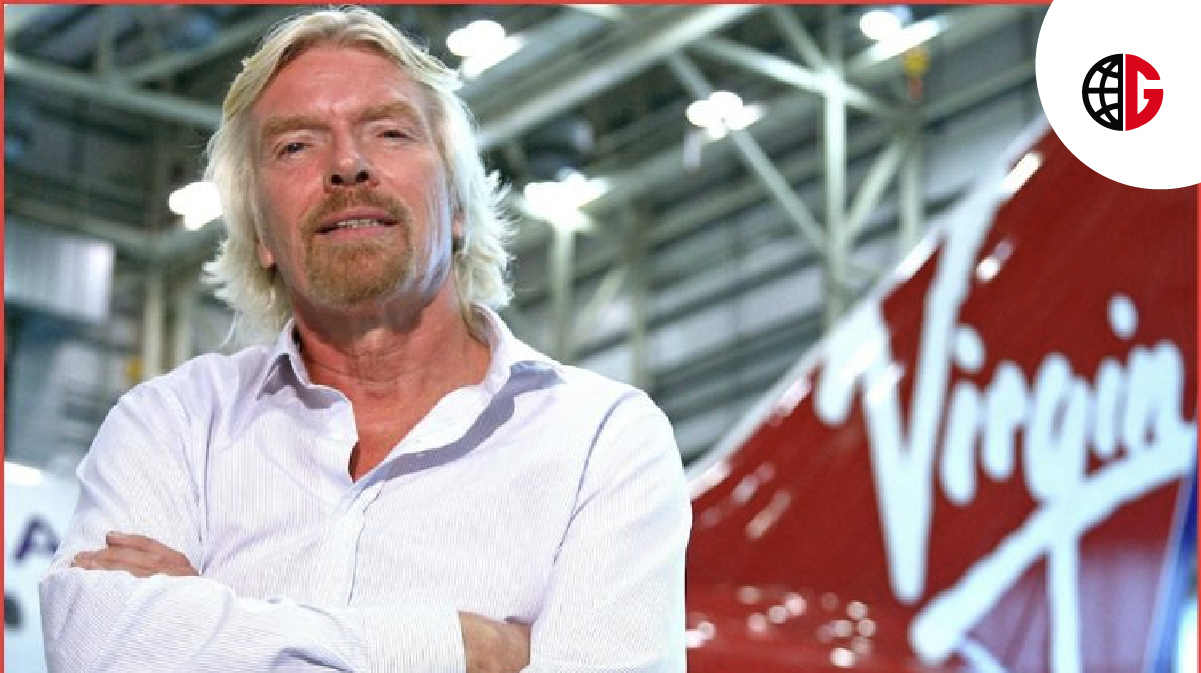
Few entrepreneurs have turned curiosity, adventure, risk-taking, and an unconventional approach to business into a global brand as successfully as Sir Richard Branson. His journey is not simply the story of a billionaire who built hundreds of companies. It is the story of an entrepreneur who repeatedly entered industries dominated by established players, questioned the way things were being done, and attempted to create a more engaging experience for customers.
Branson’s entrepreneurial journey began remarkably early. At just 15, he launched Student magazine, establishing the foundation for a career defined by experimentation and an instinct for identifying opportunities. In 1970, he and his friend Nik Powell launched a mail-order record business under the name Virgin, a name chosen because they were newcomers to business. That small venture eventually evolved into one of the world’s most recognizable business brands.
What makes Richard Branson’s success story particularly compelling is that Virgin did not remain confined to a single industry. From music and retail to airlines, telecommunications, financial services, hospitality, leisure, and space travel, the Virgin name repeatedly crossed boundaries. Branson’s story demonstrates how entrepreneurial curiosity, customer obsession, calculated risk-taking, delegation, branding, and resilience can combine to create extraordinary long-term impact.
The Entrepreneur Who Started Before He Was Ready
Richard Branson’s early life gave little indication that he would eventually build a global business empire. Yet his entrepreneurial instincts emerged while he was still a teenager.
At 15, he launched Student, a magazine created by young people for young people. The experience taught him lessons that would later become central to his leadership philosophy: finding talented people, delegating responsibilities, communicating with customers, and learning through action rather than waiting for perfect conditions.
Branson has spoken openly about being dyslexic and struggling within conventional education. Instead of allowing those difficulties to define his future, he discovered that entrepreneurship gave him a different environment in which to use his imagination and strengths. He has described learning delegation through Student, surrounding himself with capable people while focusing on ideas and opportunities.
That early experience established an important principle that would follow him throughout his career: you do not necessarily need to know everything to build something extraordinary; you need to know how to find people who can help you make it happen.
How a Record Business Became Virgin Records
The Virgin brand was born in 1970 as a mail-order record business. The idea was relatively simple: sell records at competitive prices and provide customers with an alternative to traditional retail.
But Branson did not stop with mail-order sales. Virgin opened its first record shop in 1971 and soon expanded into music production. In 1972, Branson purchased a country house in Oxfordshire and converted it into a recording studio called The Manor. Virgin Records was officially launched in 1973.
The move from retail into music production illustrated Branson’s ability to see opportunities beyond the original business model.
One of the defining moments came when Virgin encountered the music of Mike Oldfield. His album Tubular Bells became a landmark release for Virgin Records and helped establish the label’s credibility. Branson has recalled how major record companies rejected the project before Virgin decided to support it.
That decision reflected a recurring feature of Branson’s business philosophy: look for overlooked talent and opportunities where established competitors may see too much risk.
Virgin Records subsequently became a major force in the music industry. Over time, the label worked with globally recognized artists and developed into a significant independent music company.
In 1992, Virgin sold Virgin Records to Thorn EMI for $1 billion, providing Branson with substantial capital and demonstrating the value that could be created by building businesses around the Virgin brand.
From Music to the Skies
For many entrepreneurs, building a successful record company might have been enough. For Branson, it was merely another starting point.
The next extraordinary chapter came when he entered the airline industry.
The creation of Virgin Atlantic is one of the most frequently cited examples of Branson’s entrepreneurial instinct. According to Branson, a flight cancellation once left him stranded while traveling. Instead of simply accepting the inconvenience, he chartered a plane, arranged a way to sell seats to other stranded passengers, and began thinking differently about air travel. That experience contributed to the idea that eventually became Virgin Atlantic.
Virgin Atlantic launched in 1984.
Entering aviation was an enormous challenge. The industry required significant capital, regulatory expertise, operational capabilities, aircraft, infrastructure, and customer trust. Yet Branson believed there was an opportunity to challenge established airline practices by focusing on the passenger experience.
The airline became known for a more distinctive approach to travel, helping transform Virgin from a music-focused company into a broader consumer brand.
The move was important for another reason: it proved that the Virgin identity could travel from one industry to another without losing its personality.
Building a Brand That Could Cross Industries
Branson’s success was not simply based on creating individual companies. His more remarkable achievement was developing a brand capable of entering seemingly unrelated markets.
Virgin expanded into trains, mobile telecommunications, financial services, radio, hotels, fitness, entertainment, cruises and space-related ventures. Virgin’s official history records an extraordinary sequence of expansions across the 1980s, 1990s and 2000s, including Virgin Mobile, Virgin Active, Virgin Trains and Virgin Money.
Today, Virgin describes its portfolio as spanning areas including travel and leisure, health and wellness, music and entertainment, telecommunications and media, financial services, and space.
This diversification was not random. The common thread was the Virgin brand and its promise of challenging conventional experiences.
Branson recognized that consumers often become frustrated when businesses become too bureaucratic, impersonal, or complacent. Virgin attempted to position itself as a challenger brand—one willing to question established practices and create something more memorable.
That philosophy became one of the most valuable components of Branson’s entrepreneurial legacy.
The Power of Taking Calculated Risks
Risk is one of the most visible characteristics of Richard Branson’s career. From aviation to ballooning and space exploration, he has repeatedly pursued ventures that involved considerable uncertainty.
However, Branson has distinguished between reckless behavior and calculated risk. In a Forbes interview, he explained that while he had taken considerable personal risks, he viewed them as calculated decisions rather than simply gambling with his future.
That distinction is crucial for entrepreneurs.
Successful risk-taking is not about ignoring danger. It is about understanding the opportunity, assembling the right people, assessing potential consequences, and then having the courage to act.
Branson’s philosophy can be summarized through one of his best-known entrepreneurial expressions: “Screw it, let’s do it.” He has explained that this mindset has helped drive Virgin’s expansion for more than five decades—from records to airlines, cruises, hotels, and space travel.
The phrase does not simply represent impulsiveness. In Branson’s interpretation, it represents the courage to take the first step even when every answer is not yet available.
Failure Was Never the End of the Journey
An important part of the Sir Richard Branson success story is that not every Virgin venture succeeded.
Virgin has entered numerous industries over the decades, and some businesses performed better than others. Virgin itself acknowledges that failure has been part of the entrepreneurial journey. Branson has described failure as a learning opportunity rather than something that should permanently discourage an entrepreneur.
This attitude helped create a culture in which experimentation became possible.
For entrepreneurs, this is one of Branson’s most valuable lessons. Innovation inevitably involves uncertainty. If every failed experiment is treated as a catastrophe, companies become afraid to innovate. But if failure is examined, understood, and used as a source of learning, it can become part of the growth process.
Branson’s career demonstrates that a successful entrepreneur does not necessarily avoid failure. Instead, the entrepreneur develops the resilience to recover, learn, adapt, and move forward.
Leadership Through People, Not Control
Another defining element of Branson’s leadership style is his emphasis on people.
Branson has repeatedly highlighted the importance of finding talented individuals and empowering them. His early experience with Student magazine taught him that he could not do everything himself. As Virgin expanded, delegation became increasingly important.
The result was a business philosophy that emphasized being a leader rather than attempting to become the most knowledgeable person in every room.
Virgin describes Branson’s leadership philosophy through the idea of becoming a “Chief Enabling Officer”—someone who helps people perform at their best rather than simply acting as a traditional boss.
This approach became increasingly important as Virgin expanded into multiple sectors and countries.
Branson could not personally run an airline, music company, mobile business, hotel operation, financial services company, and space venture simultaneously. His role was increasingly about setting the culture, protecting the brand, encouraging ambitious thinking, and empowering capable teams.
Business With a Purpose
Branson’s entrepreneurial story also evolved beyond commercial success.
In 2004, he established Virgin Unite, a nonprofit entrepreneurial foundation created to address social and environmental challenges and demonstrate how business could contribute to positive change.
This reflected a broader belief that entrepreneurship could be used not merely to generate wealth but also to tackle difficult problems.
Virgin’s social initiatives have included work connected to issues such as poverty, health, entrepreneurship, climate, and humanitarian challenges. The philosophy behind Virgin Unite is closely connected to Branson’s view that business can be a force for good.
For modern entrepreneurs, this part of Branson’s journey is particularly relevant. Consumers, employees, and investors increasingly expect organizations to think beyond financial performance. Purpose, social impact, employee engagement, and sustainability have become important elements of corporate identity.
From Earth to Space
Perhaps nothing captures Branson’s appetite for extraordinary challenges better than his pursuit of commercial space travel.
Virgin Galactic represented an ambition far removed from Branson’s original record business. Yet the underlying entrepreneurial logic remained remarkably consistent: identify an experience that could be transformed and challenge the traditional boundaries of an industry.
In 2021, Branson flew aboard VSS Unity as part of Virgin Galactic’s Unity 22 mission, becoming part of the first fully crewed Virgin Galactic spaceflight.
The achievement was more than a personal adventure. It represented the culmination of years of investment, engineering, experimentation, setbacks, and persistence.
It also illustrated the scale of Branson’s ambition. The entrepreneur who began by selling records eventually became involved in an effort to make commercial space travel part of Virgin’s future.
The Lessons Behind the Billionaire’s Success
The Richard Branson entrepreneurial journey offers several powerful lessons for aspiring founders and business leaders.
1. Start Before Everything Is Perfect
Branson’s career shows that waiting for perfect conditions can become an excuse for inaction. His early ventures began with limited resources, but he learned by doing.
2. Question the Status Quo
Virgin repeatedly entered industries where established competitors already existed. Rather than simply copying them, Branson looked for ways to improve the customer experience.
3. Build Around People
No entrepreneur can build a global organization alone. Branson’s emphasis on delegation and talented teams became essential as Virgin expanded.
4. Treat Failure as Feedback
Not every idea worked. But setbacks did not stop Branson from experimenting again. The ability to learn from failure became a competitive advantage.
5. Protect the Brand
Virgin’s expansion demonstrated the extraordinary power of a recognizable brand. The Virgin name became associated with irreverence, customer focus, adventure, and challenging conventional thinking.
6. Make Business Personal
Branson has long emphasized customer and employee experience. His approach suggests that businesses become more memorable when they are built around human relationships rather than only processes and numbers.
7. Keep Learning
Even after decades in business, Branson has continued to pursue new ventures and ideas. Virgin’s story has moved from records to aviation, telecommunications, hospitality, financial services, leisure and space.
A Legacy Built on Curiosity
Sir Richard Branson’s story is ultimately not about a single company, a single deal, or even a single industry. It is about a mindset.
He began as a teenager with a magazine. He became a record retailer, music entrepreneur, airline challenger, global brand builder, adventurer, investor, philanthropist, and spaceflight participant.
Forbes’ 2013 profile presented Branson as an entrepreneur who showed little interest in conventional retirement, reflecting a career driven by constant experimentation and new challenges.
More than a decade later, the scale of the Virgin story remains striking. Virgin says the brand now encompasses more than 40 companies operating across more than 35 countries, while Branson continues to be associated with entrepreneurship, adventure and positive social change.
The most enduring lesson from his journey may therefore be simple: success is not necessarily about following a predetermined path. It can come from having the courage to create your own.
Richard Branson did not build his legacy by staying inside one industry or following the traditional rules of corporate leadership. He built it by remaining curious, challenging conventional wisdom, surrounding himself with talented people, embracing calculated risks, learning from failure, and continually asking what could be done differently.
From a teenage magazine to a global Virgin empire, his journey illustrates the extraordinary possibilities that emerge when entrepreneurship becomes a way of thinking rather than simply a way of making money.
Read more: Former Air India CEO Campbell Wilson Set to Join Air New Zealand Board Amid Aviation Challenges