
For decades, the image of the ideal CEO has followed a familiar pattern: leading from the front and carrying the weight of success on their shoulders.
These were the “hero CEOs.” The ones expected to know everything, fix everything, and be everything the organization needed. They served as cultural cornerstones, the visionaries, and saviors in tough times. Their presence was featured in annual reports and on keynote stages. Their leadership was often described in personal terms as brilliant, relentless, and even legendary.
Yet organizations don’t operate in the same world anymore.
The problems are more complex. The pace is faster. The workforce is more diverse, values-driven, and connected to purpose than traditional hierarchy. In this new reality, the “hero” model isn’t only outdated but also risky.
The heroic archetype was once a symbol of strength, but is now a potential point of failure. It fosters individual dependence rather than shared capability. It centralizes power instead of building capability. And in trying to carry the organization, it often limits the organization’s ability to go further.
The age of the hero CEO isn’t ending because leadership is less important. It’s ending because we now understand what leadership really requires.
Why the Hero Model No Longer Works in Modern Organizations
The heroic CEO model was successful in a world that rewarded control and hierarchy. In that environment, decisions flowed downward, visibility mattered more than alignment, and confidence was often mistaken for competence.
Yet as we all know, the world has changed.
Today’s organizations operate in conditions of uncertainty, speed, and constant demand for change. Decision-making is often more distributed. Teams are cross-functional, or at least they should be, strategy evolves in real-time. The traditional “hero” CEO begins to falter in these environments, not because of their lack of intelligence or commitment, but because the “hero” model itself is mismatched to the demands of the environment.
Research suggests that when too much authority is centralized, decision-making slows. Teams hesitate to act without approval, and execution becomes cautious rather than creative. When dependency forms around the leader’s presence rather than clarity of direction, culture becomes performative, trust erodes, because trust in one person isn’t the same as trust in a system.
The pressure on the CEO intensifies, which can lead to burnout, blind spots, or even potential biases. Then, if successful, when that leader steps down, so does the organization’s momentum. Continuity becomes fragile and reliant on a single individual. The very traits that once made the hero model appealing now represent potential areas for failure.
In modern organizations, resilience doesn’t come from one person carrying the weight. It comes from many people sharing the weight. Across the organization, people are aligned, empowered, and trusted to move forward.
What Today’s Employees Want From Their Leaders
The gap between the hero model and the modern workforce is widening. Employees today don’t want to be led by figureheads, they want to be led by genuine, relatable individuals. Trust, clarity, autonomy, and inclusion carry more weight than authority or mystique.
In the traditional model, leadership was projected from the top down. Presence was physical, direction was one-way, and influence was often measured in volume. Today’s teams value something else entirely: psychological safety, transparency, the ability to listen, contribute, and a consistency of values over time.
They want leaders who are clear, not controlling. Accessible, not aloof. Purpose-driven, not personality-driven. They want a leader who brings out their best, which also aligns with what modern organizations require.
In this environment, the hero persona begins to break down, as it no longer meets the needs of those it aims to inspire. A single compelling figure is no match for a workplace culture that thrives on shared ownership, flexible thinking, and emotionally intelligent leadership.
In short, people don’t want to follow heroes. They want to work with leaders they can believe in, learn from, and contribute to. Leadership isn’t about outshining the organization, it’s about illuminating the path forward with others in mind.
What’s Quietly Replacing the Hero Model
The most effective leaders emerging today don’t command attention, they create direction. They’re not trying to be the culture, they’re working to align with it, shape it, and preserve it. Their strength is no longer rooted in power, personality, or physical visibility. It is in their ability to remain grounded when things shift and remain focused when things scatter.
These leaders bring clarity, not certainty, they set direction without dictating every move. They are adaptable, not vague, decisive, not rigid. They know that modern leadership isn’t about having all the answers. It is about enabling better questions, better decisions, and stronger performance through others. They don’t take up all the space, they create it.
What’s replacing the hero CEO isn’t a softer version, it is a more capable one. A leader who understands complexity, builds trust intentionally, and leads with self-awareness, not ego.
This new approach doesn’t look flashy. It doesn’t always fill stages or dominate headlines. But it’s what sustains teams, grows cultures, and keeps organizations resilient, not just in the short term or for a quarter, but for the long term.
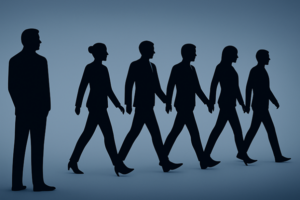
“Modern leadership is not about being followed. It’s about creating space for others to step forward.”
Quote by – Doug Clark.
Leadership Without the Cape
The shift away from the hero CEO isn’t about lowering the bar for leadership. It’s about raising the standard for what leadership truly demands.
A centralized leadership identity might still win headlines, but it’s no longer enough to win hearts, inspire action, and build enduring success. What matters now is the ability to lead with clarity, to navigate complexity without slowing execution, and to align people without overshadowing them.
Organizations today aren’t looking for saviors. They’re looking for leaders who can build trust, provide strategic clarity, and create energy that doesn’t rely solely on personality. When this is done well, the organization is no longer dependent on a single individual; it becomes resilient by design.
The hero CEO, with all their certainty and centrality, might have fit the world we once lived in. That era has passed, and with it, the kind of leadership it once demanded. The type of leadership it now requires has evolved and continues to grow.
What’s needed now isn’t the kind of presence that dominates rooms or headlines for effect, but something steadier, rooted in focus, humility, and self-awareness. The ability to lead with intention, not intensity, is something quieter, yet more potent: a kind of ‘strategic persona’ that is not overpowering, but unmistakably present. Leadership that empowers and enables others to be their best, a guide, not a sergeant.
“The future doesn’t need a cape. It needs clarity.”
Read more similar articles at Stop confusing “change” and “transformation”: a practical diagnostic for leaders.