
The Voice-First Revolution Is Already Here
The way businesses communicate with customers is undergoing a fundamental transformation. In 2026, AI voice platforms are no longer experimental novelties confined to developer sandboxes — they are production-grade infrastructure powering millions of real phone calls every day. From automated appointment scheduling and loan qualification to real-time customer support and outbound sales, voice AI has matured from a promising technology into a strategic business imperative.
What makes this moment particularly significant is the convergence of several powerful forces: large language models have reached a quality threshold where synthetic voices are nearly indistinguishable from human ones; real-time latency has dropped below one second on leading platforms; and no-code deployment tools have lowered the barrier to entry so dramatically that a business can deploy a working AI voice agent in under twenty minutes. The economics are equally compelling. Organizations deploying AI voice agents are reporting cost savings of 50 to 70 percent on call center operations, alongside measurable improvements in call containment, customer satisfaction, and lead conversion rates.
Yet with a rapidly expanding landscape of vendors, capabilities, and pricing models, selecting the right platform is far from straightforward. This editorial guide cuts through the noise to deliver an authoritative, balanced assessment of the ten best AI voice platforms available in 2026 — evaluating each on voice quality, deployment complexity, integration depth, scalability, compliance posture, and overall business value.
What Is an AI Voice Platform — And Why Does It Matter Now?
An AI voice platform is a technology stack that enables software to conduct natural, real-time spoken conversations with humans — typically over a phone line, but increasingly across any audio-capable interface. At the core of every such platform is a pipeline that processes incoming speech, interprets intent through a language model, generates a contextually appropriate response, and delivers it as synthesized speech — all within a timeframe that feels natural to the caller.
The business case for voice AI has never been stronger. Contact centers in the United States alone handle billions of inbound calls annually, the majority of which involve repetitive, high-volume tasks such as billing inquiries, appointment confirmations, lead qualification, and basic support. These interactions are expensive, inconsistent, and difficult to scale. AI voice agents address all three problems simultaneously: they operate at unlimited scale without additional headcount, they deliver consistent, policy-compliant responses on every call, and they do so at a fraction of the cost of human agents.
Industry research suggests that AI-powered voice interactions now account for a growing share of customer touchpoints across sectors including financial services, healthcare, retail, real estate, and logistics. As LLM quality improves and latency drops further, the boundary between human and AI conversation is narrowing — and the business leaders who recognize this shift early will hold a decisive competitive advantage.
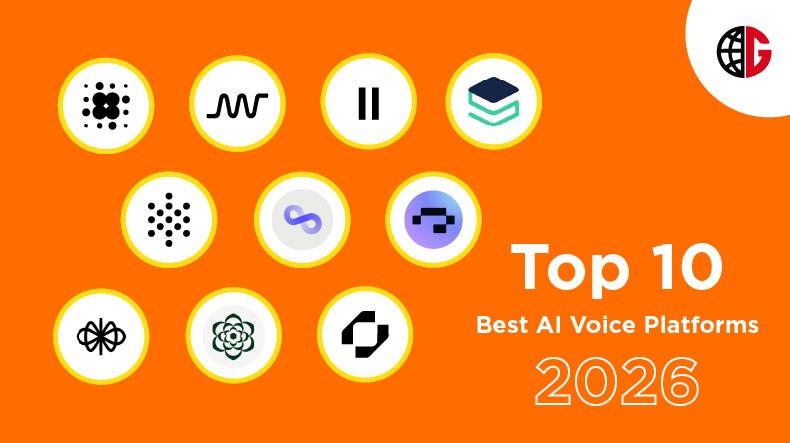
Top 10 Best AI Voice Platforms 2026: Detailed Reviews
-
Retell AI — Best Overall for Flexibility, Speed, and Value
Retell AI earns the top spot in 2026 for a compelling reason: it delivers enterprise-grade voice AI performance with the accessibility and pricing transparency that most businesses actually need. Built purpose-first for live phone calls, Retell’s architecture handles sub-second latency, natural turn-taking, and interruption management — the technical details that separate a genuinely conversational agent from a sophisticated IVR.
What distinguishes Retell from many competitors is its balance of power and usability. Teams can design agents through an intuitive drag-and-drop builder without sacrificing access to deep customization. The platform supports multiple LLM providers — including OpenAI and Anthropic models — and integrates with premium voice providers like ElevenLabs and Play.ht, giving teams granular control over both intelligence and voice character.
Retell’s pricing model is a model of clarity in a market that often obscures costs behind enterprise contracts: usage-based billing starting at approximately $0.07 per connected minute, dropping to around $0.05 at scale. Every call is automatically transcribed, summarized, and evaluated for sentiment, producing the performance analytics that enable rapid iteration. Compliance certifications covering SOC 2, HIPAA, and GDPR make it viable for regulated industries, while its scalable infrastructure handles high-volume deployments without complex configuration.
Ideal for: Teams that want a highly flexible, transparent, and scalable voice AI system for real-time phone interactions — especially product teams, call centers, and outbound sales groups prioritizing predictable pricing and fast iteration cycles.
-
Thoughtly — Best No-Code Platform for Rapid Deployment
Best For: Businesses needing quick deployment without technical resources
Thoughtly has earned a strong reputation by solving one of the most persistent problems in enterprise AI adoption: the gap between capability and accessibility. Its no-code, drag-and-drop interface allows any team member — not just engineers — to script, configure, and deploy a production-ready AI voice agent in under twenty minutes. For organizations that need to move fast or lack dedicated AI engineering resources, this is a genuinely significant advantage.
The platform ships with pre-built agents optimized for specific verticals including retail, real estate, hospitality, transportation, legal, utilities, and insurance — reducing setup time further by eliminating the need to build domain knowledge from scratch. For businesses that want to bypass even the configuration process, Thoughtly’s Agent Accelerator Program handles deployment end to end.
Thoughtly’s agents are built for real conversations — handling natural, low-latency interactions and executing workflow actions directly within existing business systems. Its workflow-first design philosophy means agents do not merely respond; they complete tasks, update records, and route calls as needed, making it a practical operational tool rather than a customer-facing novelty.
Ideal for: Businesses in supported verticals seeking production-grade voice AI without the engineering overhead of more developer-centric platforms.
-
ElevenLabs — Best for Voice Quality and Audio-First Brands
Best For: Brands prioritizing voice realism and multilingual audio output
ElevenLabs has built one of the strongest reputations in the AI audio space for a straightforward reason: its voices are exceptional. The platform’s text-to-speech synthesis captures subtle tonal nuance, natural rhythm, and emotional cadence in ways that other providers have struggled to match. For brands where voice is a core part of the customer experience — podcasting, media, branded IVR, or product narration — ElevenLabs sets the standard.
Its voice cloning technology is particularly notable, capable of producing convincing voice replicas from relatively small audio samples. This enables companies to build distinctive, branded voice identities rather than relying on generic synthetic voices. Multilingual support is broad, and cross-language dubbing preserves the original speaker’s vocal character — a capability increasingly important for global content operations.
It is worth noting, however, that ElevenLabs is not a full telephony platform. Organizations seeking a complete call-handling solution — with routing, CRM integration, workflow execution, and compliance infrastructure — will need to pair it with additional tools. Its credit-based pricing can also become difficult to forecast at scale without careful monitoring.
Ideal for: Brands with an audio-first focus looking for cutting-edge voice quality and voice cloning capabilities, particularly for content creation, product audio, and branded voice experiences.
-
SquadStack AI — Best for High-Volume Sales in Emerging Markets
Best For: BFSI, edtech, healthcare, e-commerce in India and emerging markets
SquadStack AI occupies a unique position in the 2026 landscape: it is the only major platform trained specifically on Indian sales call data, with a corpus of over 600 million real sales interactions baked into its models. This training advantage translates into a platform that understands not just language but cultural nuance, colloquial phrasing, and the behavioral patterns that signal genuine purchase intent in its target markets.
The platform’s technical performance benchmarks are strong: sub-0.8-second latency, a 4.23 MOS voice quality score, and connectivity rates of 75 to 90 percent through intelligent lead prioritization. For high-volume sales operations — loans, insurance products, edtech enrollments, e-commerce activations — these metrics translate directly into revenue outcomes. SquadStack’s performance-linked pricing model, where costs are partially tied to actual sales outcomes, reflects a notable confidence in that claim.
Omnichannel integration across voice, WhatsApp, SMS, and email with full context retention between sessions makes SquadStack a genuine end-to-end engagement platform. Every call is automatically transcribed, CRM-synced, and quality-reviewed, enabling continuous A/B testing and performance optimization at scale.
Ideal for: Organizations in BFSI, edtech, healthcare, and e-commerce operating at high call volumes in India and emerging markets where cultural and linguistic nuance is a competitive differentiator.
-
PolyAI — Best for Enterprise Contact Centers with Global Reach
Best For: Large enterprises with complex multilingual support needs
PolyAI has built its reputation on doing one thing exceptionally well: containing a high percentage of enterprise contact center calls without human intervention. Reported call containment rates above 80 percent — with some deployments reaching 87 percent early in production — represent meaningful cost savings at enterprise scale, where even small containment improvements translate into millions of dollars in operational efficiency.
The platform’s pre-trained domain assistants for authentication, billing, order lookup, and reservations give large organizations a head start without requiring extensive custom training. Its multilingual capabilities and global readiness make it a natural fit for multinational companies serving diverse customer bases across multiple languages and regional accents.
The trade-offs are real: PolyAI’s minimum contract thresholds and lengthy implementation cycles place it firmly out of reach for smaller organizations or teams looking for quick pilots. Its strongest value emerges in complex, high-volume enterprise environments where the investment in setup and licensing is justified by the scale of automation achieved.
Ideal for: Large enterprises and contact centers seeking a fully managed, highly customized multilingual voice AI solution with strong containment performance.
-
Bland AI — Best for Extreme Scale and Governance-Focused Enterprises
Best For: Large enterprises requiring maximum concurrency, data control, and omnichannel voice
Bland AI’s headline differentiator is scale: the platform is engineered to support up to one million concurrent calls, placing it in a different performance tier from nearly every competitor. For large enterprises running national notification campaigns, high-volume outbound telemarketing, or time-sensitive transactional call programs, this throughput capacity is not merely impressive — it is operationally essential.
The platform’s proprietary speech and reasoning models — rather than pure reliance on third-party LLMs — give it greater control over latency, quality consistency, and reliability under load. Its Conversational Pathways feature enables granular dialog flow design that mixes scripted and generative responses, giving compliance-sensitive organizations precise control over agent behavior.
Multi-region data processing options address GDPR and regional privacy requirements, which is particularly relevant for healthcare and financial services organizations with strict data residency obligations. Built-in omnichannel support across voice, SMS, and chat enables coordinated campaign workflows that span multiple touchpoints from a single platform.
Ideal for: Large enterprises with tight requirements around privacy, governance, and brand voice that operate at very high call volumes and need multi-region deployment options.
-
Leaping AI — Best for Vertical-Specific Deployment and Anti-Spam Reliability
Best For: Home improvement, travel, insurance, telco, pre-qualification workflows
Leaping AI has carved a defensible niche through deep specialization in specific verticals. Its strongest domain expertise lies in home improvement and home remodeling — a market where its agents have logged extensive real-world performance data — but the platform also performs well across travel, insurance, telecommunications, and lead pre-qualification workflows. This specialization translates into faster time-to-value for organizations in supported industries, where starting from a proven template is far more efficient than building from scratch.
Several technical features set Leaping AI apart from more generic competitors. Custom voicemail detection and the ability to leave personalized human-sounding voicemail messages increase effective contact rates. Number scrubbing and monitoring to prevent carrier spam flagging is a critical and often overlooked operational detail that affects every outbound calling program. Fallback mechanisms at every layer of the stack boost reliability in ways that matter at production scale.
The platform’s Speech-to-Speech model support represents the leading edge of voice AI technology, enabling more natural and responsive conversations than traditional pipelines. Deployment timelines are typically measured in weeks rather than months, and the no-code interface ensures that non-technical employees can maintain and iterate on agents without engineering support.
Ideal for: Companies in home improvement, remodeling, travel, insurance, and telco seeking a reliable, vertically specialized voice AI solution with strong anti-spam infrastructure and fast deployment.
-
Voiceflow — Best for Design-Led Teams and Rapid Prototyping
Best For: Startups, design teams, innovation groups
Voiceflow approaches conversational AI from a design and orchestration perspective rather than a telephony-first one, and this distinction shapes everything about how the platform feels to use. Its drag-and-drop builder, modular components, and real-time collaboration features make it the fastest environment for iterating on agent experiences — teams can move from concept to working prototype in hours rather than days.
The platform is deliberately technology-agnostic. Any LLM, API, backend system, or data source can be plugged in, reducing vendor lock-in and giving forward-thinking teams the flexibility to adopt new models as the AI landscape evolves. It supports both voice and text channels from a single interface, simplifying the management of multichannel experiences and ensuring behavioral consistency across touchpoints.
The honest caveat is that Voiceflow is fundamentally a design and orchestration layer, not a complete telephony stack. Teams that want production-grade call handling, live CRM integration, and high-concurrency infrastructure will need to build or bolt on additional components. Costs can also escalate quickly at larger team sizes, and the per-editor pricing model may not suit organizations with many contributors.
Ideal for: Startups, design teams, and innovation groups that prioritize speed of experimentation and cross-functional collaboration over high-concurrency telephony infrastructure.
-
Sierra AI — Best for Brand-Aligned Customer Service at Enterprise Scale
Best For: Consumer brands in telecom and financial services requiring brand-consistent voice AI
Sierra AI’s central thesis is that customer service agents should feel like genuine extensions of the brand they represent — not generic bots with a company logo. This philosophy drives every design decision on the platform, from brand-level voice and vocabulary tuning tools to the multi-model architecture designed to reduce hallucinations and maintain consistent, policy-compliant responses at scale.
Sierra’s agents are action-oriented by design. Deep integrations with CRMs, subscription management platforms, and order systems mean agents can process returns, update customer records, or modify subscription plans in real time — not merely retrieve information and escalate. Voice capabilities added in 2024 bring this action-first model to phone conversations, with natural cadence and interruption handling that holds up well in real customer interactions.
The governance and auditing infrastructure is a genuine enterprise strength: teams can trace how decisions are made, enforce policy boundaries, and audit agent behavior over time — crucial capabilities for consumer-facing brands in regulated sectors. The high entry price and complex setup requirements mean Sierra is most appropriate for organizations where brand consistency and compliance are strategic priorities, not optional features.
Ideal for: Customer-focused brands in telecom, financial services, and other regulated sectors where consistent tone, compliance adherence, and action-capable agents are non-negotiable.
-
Replicant — Best for Contact Centers Seeking End-to-End Issue Resolution
Best For: Large contact centers focused on Tier 1 call resolution and backend system integration
Replicant closes the list with a platform built around a philosophy that distinguishes it from many voice AI competitors: resolution over routing. While many platforms optimize for call deflection or containment — keeping callers away from human agents — Replicant’s Thinking Machine is designed to actually solve customer problems end-to-end, integrating with backend systems to take meaningful action on behalf of the caller.
This resolution-first approach is supported by multi-channel capabilities spanning voice, chat, and SMS, enabling consistent automated experiences across customer touchpoints. Replicant’s track record in large-scale contact center deployments provides the kind of proven enterprise scalability that risk-averse organizations require before committing to significant AI infrastructure investments. Customers consistently highlight the company’s hands-on implementation support as a competitive strength — particularly valuable for organizations without large in-house AI teams.
The trade-offs are typical of enterprise-focused platforms: no transparent public pricing, a formal implementation process rather than a self-serve trial, and a product focus optimized for support and contact center workloads rather than experimental or smaller deployments.
Ideal for: Large contact centers wanting to automate a substantial portion of inbound call volume with a partner that has deep experience in voice automation and end-to-end issue resolution.
Industry Perspective: The Convergence Reshaping Business Communication
Several macro-level trends are converging to accelerate AI voice platform adoption in 2026 and beyond. Understanding these forces helps business leaders frame platform selection not merely as a technology decision but as a strategic one.
The first is the collapse of the quality gap. Until recently, even sophisticated voice AI was detectable by callers within seconds — unnatural pauses, robotic cadence, inability to handle interruptions. Today’s leading platforms have narrowed this gap to the point where many callers cannot reliably distinguish AI from human agents. This perceptual shift removes the psychological barrier that previously made some organizations reluctant to deploy voice AI in customer-facing contexts.
The second is democratization. Enterprise-grade voice AI was, until recently, the exclusive domain of large organizations with significant engineering resources and budget. Platforms like Thoughtly, Retell AI, and Leaping AI have fundamentally changed this equation. A mid-sized business can now deploy a production-quality voice agent for a few thousand dollars a month — a fraction of the cost of a single human agent position.
The third is verticalization. The most effective platforms are increasingly those with deep domain expertise in specific industries, not horizontal tools that claim to serve everyone equally. SquadStack’s training on Indian sales call data, Leaping AI’s specialization in home improvement, and PolyAI’s contact center focus all reflect an industry-wide recognition that context-specific training produces materially better outcomes than generic deployments.
Finally, the integration layer is maturing. Voice AI that merely responds to questions is giving way to voice AI that takes action — booking appointments, updating CRM records, processing transactions, and escalating intelligently. This shift from passive to active agents is arguably the most consequential development in the space, and it will determine which platforms lead the market in the years ahead.
Conclusion: Choosing the Right AI Voice Platform in 2026
The AI voice platform market in 2026 is defined by extraordinary capability and meaningful differentiation. There is no single platform that is best for every organization — the right choice depends on your technical capacity, industry context, call volume, compliance requirements, and speed-to-deployment priorities.
For most businesses entering the space for the first time, Retell AI and Thoughtly represent the strongest starting points: both deliver production-quality performance with accessible pricing and fast deployment cycles. Organizations in high-volume sales environments, particularly in emerging markets, should evaluate SquadStack seriously. Large enterprises with complex contact center requirements will find PolyAI, Bland AI, Sierra AI, and Replicant worth the investment cycles they require. Organizations with a vertical-specific focus — particularly in home improvement, insurance, or travel — would be well served by a close look at Leaping AI.
The broader message for business leaders is this: AI voice technology has reached a maturity threshold where inaction carries real costs. Every month that call centers, sales teams, and customer service organizations operate without AI-augmented voice capabilities is a month of competitive disadvantage relative to peers who are already deploying, iterating, and optimizing. The question is no longer whether to adopt AI voice platforms — it is which one, and how fast.
Frequently Asked Questions (FAQ)
What is the best AI voice platform for small businesses in 2026?
Retell AI and Thoughtly are the strongest options for small businesses. Retell AI offers transparent, usage-based pricing starting at approximately $0.07 per connected minute with no large minimum commitments, while Thoughtly enables full deployment in under twenty minutes without any technical expertise. Both deliver production-grade voice quality at a price point accessible to smaller organizations.
How do AI voice platforms differ from traditional IVR systems?
Traditional IVR systems operate on rigid, menu-based logic — callers press numbers to navigate pre-defined options. AI voice platforms use large language models to understand natural speech, maintain conversational context, handle unexpected inputs, and take action in connected backend systems. The difference in caller experience is substantial: AI voice agents feel like conversations; IVR systems feel like navigating a phone tree.
Are AI voice platforms HIPAA and GDPR compliant?
Several leading platforms have achieved relevant compliance certifications. Retell AI holds SOC 2, HIPAA, and GDPR certifications. SquadStack holds ISO 27001, SOC 2 Type II, and ISO 27701 with India data residency. Bland AI supports multi-region deployment for GDPR compliance. PolyAI and Sierra AI are also designed for regulated enterprise environments. Organizations in healthcare or financial services should always verify current certification status directly with vendors.
How much does an AI voice platform typically cost?
Pricing varies significantly by platform and use case. Usage-based platforms like Retell AI start at around $0.07 per connected minute. Leaping AI begins at approximately $2,500 per month. Enterprise platforms such as PolyAI, Sierra AI, and Replicant typically require minimum annual contracts starting around $150,000. Thoughtly and SquadStack use custom pricing based on call volume and deployment scope. Most platforms offer some form of trial credit or pilot program.
Can AI voice platforms integrate with existing CRM and telephony systems?
Yes — integration capability is a core feature of every major platform reviewed here. Retell AI connects natively with Salesforce, HubSpot, Twilio, and SIP trunks. Sierra AI integrates with CRMs, subscription tools, and order management systems. Replicant is designed specifically for backend-connected contact center environments. Leaping AI supports CRM and telephony integration via APIs and the SIP protocol. The depth and ease of integration varies, so testing specific connectors against your existing stack during evaluation is strongly recommended.
How long does it take to deploy an AI voice agent?
Deployment speed varies widely. Thoughtly enables deployment in under twenty minutes for straightforward use cases. Retell AI typically allows teams to go live in a matter of hours with its template library and intuitive builder. Leaping AI targets a go-live window of two to four weeks. Enterprise platforms like PolyAI, Bland AI, and Replicant typically require formal implementation projects spanning weeks to months, depending on customization complexity.
What industries benefit most from AI voice platforms?
The strongest industry adoption in 2026 spans financial services, healthcare, real estate, insurance, retail and e-commerce, edtech, and logistics. Any industry with high call volume and a significant proportion of repetitive, structured conversations is a strong candidate for voice AI automation.
What is the difference between a voice AI agent and a voice AI assistant?
A voice AI assistant is typically a reactive tool that responds to queries. A voice AI agent is proactive and action-oriented: it initiates or handles full conversations, executes workflows, updates records, books appointments, and escalates to humans when appropriate. The platforms reviewed in this article are primarily agent-class systems built for end-to-end task completion, not just information retrieval.
How do AI voice platforms handle unexpected or off-script conversations?
Platforms built on large language models — including Retell AI, Sierra AI, and SquadStack — handle natural, unscripted conversation within the boundaries set by their configuration. Platforms emphasizing scripted flow control, like Bland AI’s Conversational Pathways, offer more predictability at the cost of some conversational flexibility. The best platforms combine structured fallback logic with generative capabilities to balance reliability and naturalness.
Will AI voice platforms replace human call center agents entirely?
The evidence suggests a hybrid model will dominate for the foreseeable future. Most leading platforms are designed to automate high-volume Tier 1 interactions while escalating complex or emotionally sensitive calls to human agents. PolyAI reports containment rates above 80 percent, meaning roughly 20 percent of calls still reach humans. Rather than wholesale replacement, the near-term outcome is augmentation: AI handles volume and repetition while human agents focus on higher-value interactions where empathy and judgment are irreplaceable.