

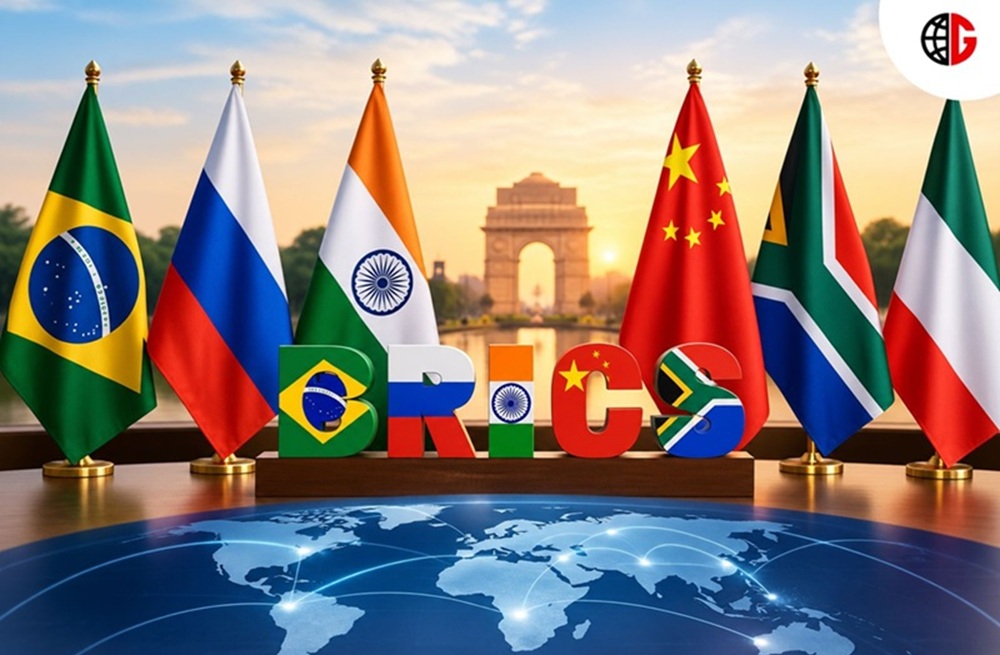
18th BRICS Summit in New Delhi strengthens multilateralism, intra-BRICS trade, local currencies and the role of emerging economies in global governance.
New Delhi, India — September 2026 — The 18th BRICS Summit in New Delhi has reinforced the grouping’s ambition to play a more influential role in shaping the global economic and political order. At a time of geopolitical tensions, trade disputes and competing alliances, the summit placed renewed emphasis on multilateralism, economic cooperation and greater representation for emerging economies.
A central outcome of the summit was the adoption of the New Delhi Declaration, which demonstrated that BRICS members could reach a common position despite significant differences on regional conflicts and international affairs.
Strengthening Multilateralism
The summit highlighted the need to reform existing global institutions and create a more representative system of international governance. BRICS leaders reiterated support for reform of the United Nations Security Council, including a greater role for emerging powers such as India and Brazil.
The position reflects a broader argument within the Global South that institutions created under an earlier international power structure should evolve to reflect the economic and political realities of today.
For BRICS, this push for institutional reform is increasingly connected to the group’s expanding economic influence and its desire for a stronger voice in international decision-making.
Greater Focus on Intra-BRICS Trade
Economic cooperation remained another important component of the summit. The New Delhi Declaration called for stronger intra-BRICS trade and greater use of national currencies in transactions among member countries.
Such measures could reduce dependence on traditional international financial mechanisms and potentially lower some of the risks associated with currency fluctuations, external sanctions and disruptions to cross-border payments.
For businesses operating across emerging markets, deeper BRICS cooperation could eventually create opportunities for expanded trade, investment and financial connectivity.
However, turning these ambitions into practical mechanisms will require substantial coordination among countries with different financial systems, regulatory environments and economic priorities.
Consensus Despite Geopolitical Differences
Perhaps the most significant achievement of the summit was the ability of BRICS members to produce a joint declaration despite disagreements surrounding ongoing conflicts.
The final document adopted carefully balanced language on contentious geopolitical issues, allowing members with differing positions to participate in a common framework without directly confronting individual members.
The approach underlines one of BRICS’ defining characteristics: the grouping is not a conventional political alliance. Its members have different strategic interests, economic models and relationships with major global powers.
Yet they share an interest in expanding their collective influence and challenging a global system that has traditionally been dominated by established Western institutions.
India’s Diplomatic Balancing Act
India’s fourth BRICS chairship provided New Delhi with an opportunity to reinforce its position as an important bridge between competing geopolitical blocs.
Prime Minister Narendra Modi’s engagement with Iranian President Masoud Pezeshkian was significant against the backdrop of continuing tensions in West Asia. At the same time, Modi’s meeting with Chinese President Xi Jinping provided an avenue for both countries to reaffirm their interest in improving bilateral relations.
India also used the summit to engage with leaders from ASEAN and African countries, reinforcing its wider outreach to emerging economies.
This diplomatic balancing act is increasingly important for India as it expands relationships with the United States and other Western economies while simultaneously strengthening partnerships across the Global South.
Iran-UAE Engagement Highlights Diplomatic Opportunity
The summit also provided an important platform for regional diplomacy. Iran and the United Arab Emirates, despite their differences and competing interests in the West Asian conflict, used the gathering for high-level bilateral engagement.
The development demonstrated how multilateral forums can create diplomatic space for dialogue even when direct relations between countries remain complicated.
For India, facilitating such engagement adds another dimension to its role as a diplomatic intermediary and strengthens its broader position within the Global South.
BRICS and the Changing Global Economy
The New Delhi Summit comes as BRICS continues to evolve from a group primarily associated with emerging-market economic cooperation into a broader platform for geopolitical coordination.
The grouping’s growing significance reflects the economic weight of its members and their shared interest in increasing the influence of developing and emerging economies.
Its emphasis on local-currency transactions, trade cooperation, institutional reform and greater representation in global governance indicates an effort to build alternatives within the existing international system rather than simply operate within structures dominated by traditional powers.
However, the effectiveness of this approach will ultimately depend on whether BRICS members can translate political declarations into concrete economic initiatives.
A New Phase for BRICS
The 18th BRICS Summit demonstrated that consensus remains possible even among countries with sharply different national interests. The New Delhi Declaration therefore represents more than a diplomatic statement; it reflects the continuing evolution of a grouping seeking a larger role in global affairs.
For India, the summit strengthened its credentials as a major Global South voice capable of maintaining relationships across geopolitical divides. For BRICS as a whole, the meeting reinforced its message that global governance should increasingly reflect the economic importance and strategic interests of emerging economies.
As the international system becomes more fragmented and competitive, the influence of BRICS will increasingly depend on its ability to convert shared aspirations into practical cooperation in trade, finance, technology, investment and global governance.
The New Delhi Summit suggests that the grouping is prepared to pursue that transition.
Read more: Anthropic Reports Major AI Distillation Campaigns Linked to Chinese AI Firms