

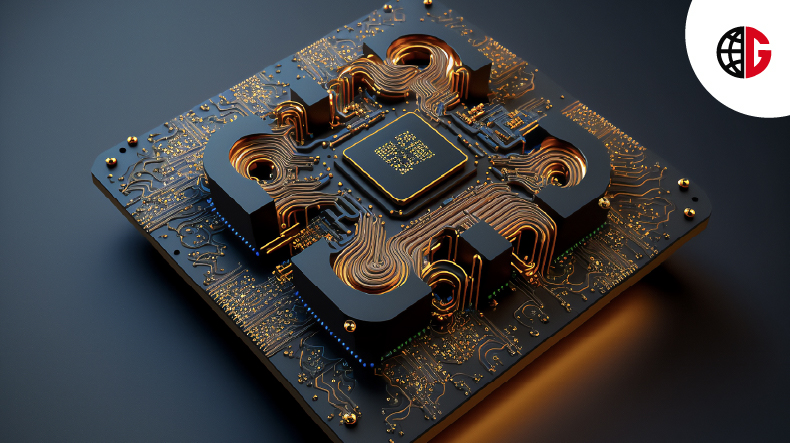
Shanghai, China: Chinese artificial intelligence startup Dongfang Suanxin (DFSX) has officially emerged from stealth mode with the launch of its first self-developed AI chip, DF1000, marking a significant milestone in China’s efforts to build an independent AI semiconductor ecosystem. The announcement, made in Shanghai, underscores the country’s growing determination to reduce reliance on Western chip technologies and strengthen domestic AI infrastructure.
Founded in 2024, DFSX has remained largely out of the public spotlight while focusing on research and core technology development. With the unveiling of the DF1000, the company is positioning itself as a serious contender in the global AI hardware race, where companies such as Nvidia currently dominate advanced AI computing.
DF1000 Designed Around a Fully Domestic Supply Chain
One of the most notable aspects of the DF1000 is its reliance on a fully Chinese supply chain, enabling DFSX to bypass many of the export restrictions that have limited Chinese companies’ access to advanced semiconductor technologies.
Instead of depending on the latest manufacturing processes, the DF1000 is built using 14-nanometer fabrication technology. DFSX argues that architectural innovation—not simply smaller transistor sizes—is the key to delivering competitive AI performance. According to the company, the chip can achieve performance comparable to certain Western chips manufactured on more advanced 4-nanometer processes for selected AI inference workloads.
Innovative 3D Architecture Aims to Boost AI Performance
Rather than following conventional GPU design strategies, DFSX has adopted a different engineering approach centered on software-defined architecture and 3D near-memory computing.
The company integrates custom memory directly above the computing layer through advanced 3D stacking technology. This design significantly reduces data movement between memory and processors, increasing bandwidth while eliminating dependence on imported High Bandwidth Memory (HBM), which has become increasingly difficult for Chinese companies to obtain due to international export controls.
DFSX says this architecture addresses three major challenges facing AI chips today:
- Reducing dependence on cutting-edge manufacturing nodes.
- Overcoming memory bandwidth limitations.
- Delivering a complete software ecosystem optimized for AI training and inference.
These innovations are intended to improve efficiency for large AI models while providing greater flexibility for future workloads.
Ambitious Product Roadmap Already in Place
DFSX is not stopping with its first processor. During the launch event, the company outlined an aggressive product roadmap that includes:
- DF2000, scheduled for release later this year.
- A third-generation AI chip targeted for launch in 2027.
The company expects future generations to narrow the remaining performance gap in AI model training while continuing to improve inference capabilities.
Backed by State Funds and Prominent Investors
DFSX has attracted substantial financial backing despite maintaining a relatively low public profile. According to corporate records, the startup has achieved an estimated valuation of approximately $1.8 billion following its latest financing round.
Its investors include state-backed investment entities, industrial funds, and a venture capital vehicle co-founded by Alibaba founder Jack Ma, highlighting growing confidence in China’s next generation of semiconductor innovators.
Led by Tsinghua Expertise
The company is led by Wei Shaojun, a professor at Tsinghua University and senior adviser to China’s central government on semiconductor development. DFSX says its chip architecture commercializes nearly two decades of academic research focused on improving computing efficiency through software-defined hardware and near-memory processing.
A New Chapter in China’s AI Chip Race
The launch of the DF1000 comes at a time when China is accelerating investments in domestic AI infrastructure amid tightening technology restrictions from Western nations. Rather than competing solely through manufacturing advances, DFSX is betting that innovative chip architecture and software optimization can provide a sustainable path toward high-performance AI computing.
Industry observers believe the company’s progress could become an important test of whether Chinese semiconductor firms can build globally competitive AI hardware without relying on foreign technologies. If successful, DFSX’s approach may reshape how future AI accelerators are designed, emphasizing efficiency, specialized architectures, and software-defined computing over traditional scaling methods.