
Alibaba is stepping deeper into the global AI infrastructure race with a new high-performance processor, plans for trillion-parameter AI models and a massive expansion of its cloud data-center footprint.
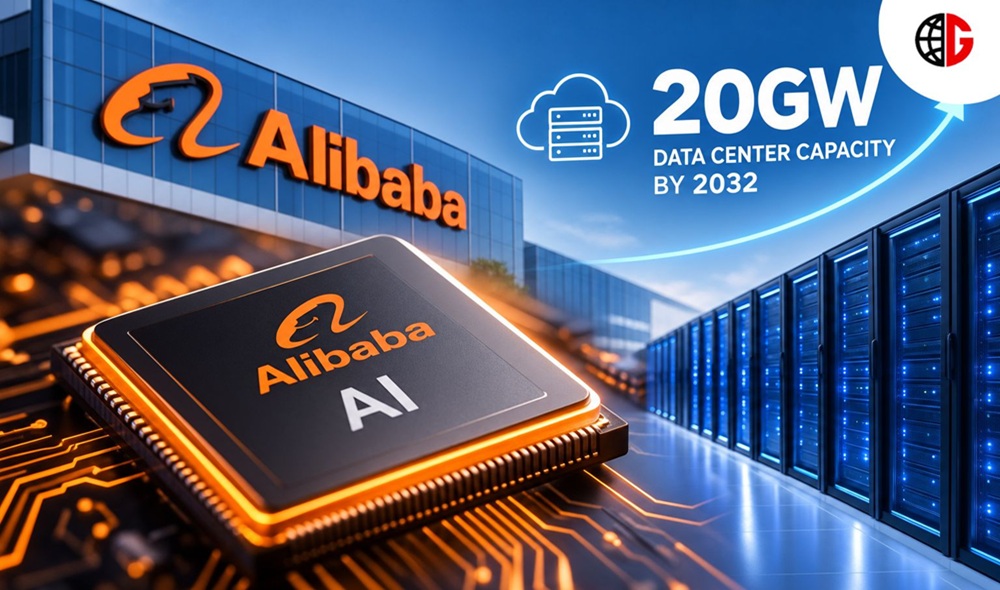
China’s Alibaba Group is accelerating its artificial intelligence ambitions with a strategy that goes well beyond developing AI models. The technology giant has introduced a new AI accelerator, unveiled plans for an enormous next-generation model and set an ambitious target to push its global Alibaba Cloud data-center capacity beyond 20 gigawatts by 2032.
The announcements were made at Alibaba’s annual Apsara Conference in Hangzhou, highlighting the company’s effort to control more of the technology stack powering the next phase of AI—from semiconductors and computing infrastructure to foundation models and cloud services.
Zhenwu V900 Emerges as Alibaba’s New AI Chip
At the center of the announcement is the Zhenwu V900, an AI accelerator developed by Alibaba’s T-Head semiconductor division.
Alibaba says the new processor delivers three times the performance of its predecessor, the M890. The company also says the chips can be connected into clusters containing as many as 500,000 processors, allowing them to support the training and operation of extremely large AI systems.
The Zhenwu V900 is expected to enter mass production and commercial release in the first quarter of 2027, according to Reuters.
The development is significant because AI computing has become one of the most strategically important parts of the technology industry. High-end accelerators are essential for training large language models and operating AI applications at scale, making chip availability a critical factor for companies building AI infrastructure.
Alibaba is positioning its own silicon as part of a broader effort to develop alternatives to processors supplied by companies such as NVIDIA, particularly as Chinese technology companies continue adapting to restrictions on access to advanced US-made AI chips.
20GW Data Center Target Signals Massive AI Infrastructure Push
Alibaba’s chip announcement is closely tied to another major goal: expanding its cloud computing infrastructure.
CEO Eddie Wu said Alibaba Cloud aims to increase its global data-center capacity to more than 20 gigawatts by 2032. The target reflects the company’s expectation that demand for AI computing will continue rising rapidly as businesses deploy increasingly sophisticated models and AI applications.
For perspective, a gigawatt represents an enormous amount of electrical capacity. At 20GW, Alibaba’s planned footprint illustrates just how much power and infrastructure the next generation of AI could require.
Wu said customer demand for AI computing was exceptionally strong, while supply-chain limitations were restricting how quickly Alibaba could expand. The company plans to begin bringing its AI supernodes online at commercial scale this quarter.
The infrastructure push also reflects a broader shift in the AI industry. The race is no longer limited to building the most capable model. Companies increasingly need access to chips, data centers, networking, electricity and cloud infrastructure to train and deploy those models.
Alibaba Plans AI Model With Up to 10 Trillion Parameters
Alibaba is also preparing to dramatically increase the scale of its AI models.
The company plans to develop a new model with between 5 trillion and 10 trillion parameters, potentially making it several times larger than its current flagship Qwen model. Reuters reported that the planned system is designed to tackle increasingly complex and longer-duration tasks.
Parameters are the adjustable elements within an AI model that help determine how it processes information and generates responses. While parameter count alone does not determine an AI system’s capabilities, building models at this scale requires enormous computing resources.
That makes Alibaba’s three-part strategy—AI models, AI chips and AI cloud infrastructure—closely interconnected.
More powerful models require greater computing capacity. Greater computing capacity creates demand for more chips and data centers. And custom chips can potentially give cloud operators greater control over the economics and availability of that computing power.
From E-Commerce Giant to Full-Stack AI Player
Alibaba was once primarily associated with e-commerce platforms such as Taobao and Tmall. Its technology strategy has increasingly expanded toward cloud computing, artificial intelligence and semiconductor development.
Its Qwen family of AI models has become a major part of that transformation. Alibaba has continued expanding the Qwen ecosystem while using its cloud platform to distribute AI capabilities to businesses and developers.
The company has also invested heavily in AI infrastructure. Alibaba has committed more than $53 billion over three years to expand its AI capabilities, while it raised approximately $10.2 billion through a Hong Kong share offering in August, according to Bloomberg-reported figures.
Alibaba has said annualized revenue from its AI-related products is expected to reach about $10 billion in the current quarter, while management has also outlined an ambition to multiply cloud and AI revenue substantially over the coming years.
Why Custom AI Chips Matter
The development of the Zhenwu V900 also illustrates why major technology companies are increasingly developing their own AI processors.
Relying entirely on external chip suppliers can expose AI companies to shortages, pricing pressure and geopolitical restrictions. Developing proprietary processors can provide greater control over hardware design and how chips are optimized for specific workloads.
Alibaba is not alone in pursuing this strategy. Chinese technology companies including Huawei and other domestic chip developers are working toward increasingly sophisticated AI accelerators as the country seeks to strengthen its domestic computing ecosystem.
Alibaba has already delivered 560,000 processors from the Zhenwu product family, with more than 400 external customers using its processors, according to the company.
AI Infrastructure Becomes the New Battleground
Alibaba’s announcement comes at a time when the economics of AI are increasingly being shaped by infrastructure.
Training frontier AI systems requires vast amounts of computing power, while serving millions of users can create equally demanding inference workloads. Data centers therefore need increasingly powerful processors, high-speed networking, advanced cooling systems and reliable electricity supplies.
Alibaba’s plan for more than 20GW of global data-center capacity demonstrates the scale of infrastructure the company believes will be necessary.
It also shows how the AI competition is moving from individual products toward entire technology ecosystems.
Companies are now competing not only over who can build the smartest model, but also over who can secure the computing resources needed to develop, operate and commercialize those systems.
A New Phase in Alibaba’s AI Strategy
Alibaba’s latest announcements effectively connect three major pieces of its AI strategy: proprietary chips, enormous computing infrastructure and increasingly powerful models.
The Zhenwu V900 is expected to strengthen the hardware side of that strategy when commercial production begins in 2027. The planned 5-trillion-to-10-trillion-parameter model points toward a significant expansion in model scale, while the 20GW data-center target shows the infrastructure investment Alibaba expects to require by 2032.
Together, these moves mark a shift in Alibaba’s identity from a company that primarily provides digital services to one seeking greater control over the underlying infrastructure of the AI economy.
As demand for AI computing continues to expand, the companies capable of combining chips, cloud infrastructure and advanced models will increasingly shape how quickly AI can move from experimentation into large-scale commercial deployment.
Read more: Morphotonics Raises €40M to Power Smart Glasses and Data Centers