
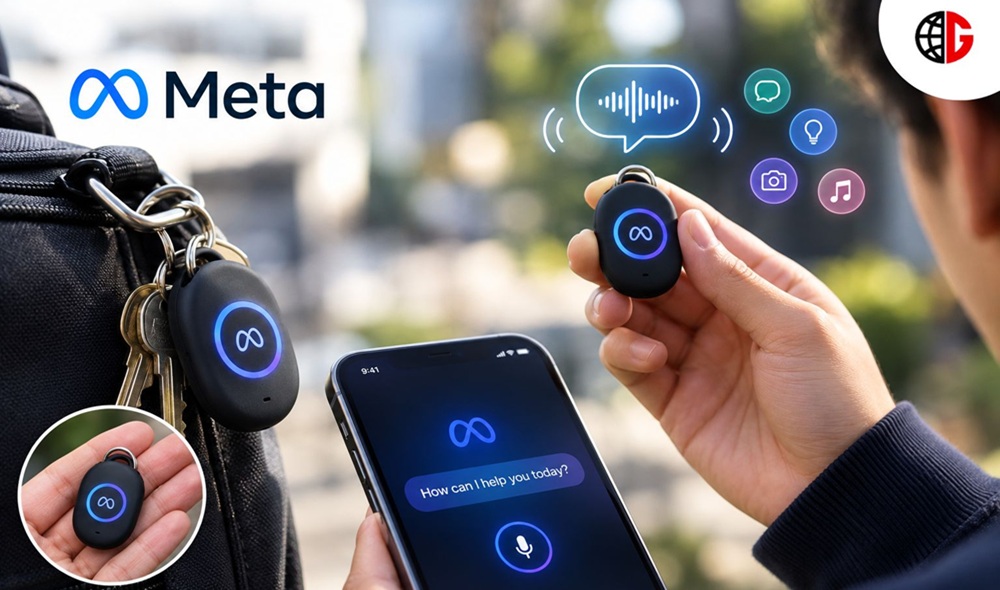
Meta is taking its AI ambitions beyond smartphones and smart glasses with a surprisingly small piece of hardware. At Meta Connect 2026, CEO Mark Zuckerberg introduced Muse Charm, a palm-sized device designed to give users direct, on-the-go access to the company’s Muse artificial intelligence assistant.
The announcement marks another step in Meta’s effort to make AI more continuously available in everyday life. Rather than requiring users to unlock a phone, open an application or wear smart glasses, Muse Charm is designed to sit in a pocket, hang from a bag or attach to a keychain and remain ready for interaction.
A New Home for Meta’s Muse AI
Muse Charm is not a standalone AI assistant built from scratch. Instead, it serves as a dedicated hardware gateway to Meta’s existing Muse AI agent, which the company has been expanding across phones, the web and other devices.
The compact gadget features an approximately 2-inch OLED touchscreen, with a virtual Muse character appearing on the display. Users can customize aspects of the character, including its appearance, clothing and voice, giving the device a more personal and interactive identity.
The device is designed primarily around voice interaction. A fingerprint sensor allows users to activate and access Muse without having to unlock their smartphone or launch an app. Meta says this makes Charm particularly useful when users are not wearing its AI-powered glasses.
The device also includes microphones, speakers, USB-C charging and connectivity hardware. Its built-in 5G modem is intended to allow users to access Muse away from Wi-Fi, turning the small gadget into a connected AI companion rather than simply an accessory dependent on a nearby phone.
Meta Wants AI to Travel With You
The timing of Muse Charm is significant. Meta has increasingly positioned Muse as more than a conventional chatbot, describing the assistant as a foundation for what Zuckerberg calls “personal superintelligence.” At Connect 2026, the company also outlined additional capabilities and said Muse would eventually become available through its smart glasses.
That makes Charm one piece of a broader strategy: put Muse wherever people already spend their time.
On a smartphone, Muse can function like an AI application. Through glasses, it can become part of a user’s surroundings. With Charm, Meta is experimenting with something different—a dedicated physical object whose primary purpose is to make AI immediately accessible.
The company has also expanded Muse’s connections to services and retailers, including Walmart, Best Buy and Gap, while adding capabilities such as real-time voice interactions and an email address for users’ AI agents.
A Tiny Device With a Bigger Hardware Ambition
The design of Muse Charm is arguably as notable as its AI capabilities. The device has been compared to a modern Tamagotchi, with its small screen and animated AI character. Meta executives have described the concept as a “holdable” device rather than a traditional wearable—something users pick up and talk to throughout the day.
The hardware was developed by Meta’s new design organization, led by former Apple interface design chief Alan Dye, alongside members of the company’s Superintelligence AI group. Other former Apple designers, including Billy Sorrentino, also contributed to the project.
Interestingly, the product moved unusually quickly from concept to hardware. According to Meta CTO Andrew Bosworth, the company began seriously exploring the Charm concept in March and developed it within the same calendar year. The project was initially envisioned for 2027, but Zuckerberg pushed the team toward a 2026 launch.
More Than a Voice Gadget
Despite its small footprint, Muse Charm is being designed with several smartphone-like capabilities.
The device includes cameras on its front and back, primarily intended to provide Muse with visual information for analysis and AI-assisted actions. Users can also view captured photos and videos on the device. It supports music and video playback and includes speakers and microphones.
The Charm can be synchronized through the Muse application on an iPhone or Android smartphone, even though its purpose is to reduce the need to reach for that smartphone during everyday interactions.
Meta is also exploring social interactions between the devices. Two Muse Charms can reportedly recognize and interact with one another when placed nearby, adding another unusual layer to the company’s experiment with character-driven AI hardware.
December Launch Planned
Meta says Muse Charm is expected to reach consumers by December 2026, making it one of the company’s holiday-season hardware launches. However, the company has not yet announced final pricing. Reports indicate that Meta is considering a price point around the range of a smartwatch, although the figure and cellular service details have not been finalized.
Importantly, Meta does not appear to view Charm as a replacement for smartphones or its AI glasses. Bosworth said the company expects Muse to be used by more people through phones and glasses than through the dedicated Charm device. Instead, the first version is being positioned as an experiment aimed largely at enthusiastic Muse users.
That distinction could matter. Rather than betting everything on a completely new computing category, Meta is using Charm to test whether people want a physical, always-available interface for an AI agent they already use.
The Bigger AI Hardware Race
Muse Charm arrives at a time when technology companies are experimenting with alternatives to the smartphone-centric model of computing. AI companies and hardware makers are exploring devices that make artificial intelligence more ambient, conversational and accessible without traditional screens.
Meta’s approach is distinctive because the company already controls several pieces of the emerging ecosystem: AI models, social platforms, smart glasses, virtual reality hardware and a growing personal AI assistant.
The Charm therefore represents more than a tiny gadget. It is another experiment in where AI should live.
For Meta, the answer increasingly appears to be everywhere—from the phone in a user’s pocket to glasses on their face and now a small AI companion hanging from a keychain.
If Muse becomes deeply integrated into everyday tasks, the significance of Charm may ultimately depend less on its hardware and more on whether people become comfortable treating an AI agent as something they can carry, talk to and interact with throughout the day.
For now, Meta is betting that the next generation of personal AI does not necessarily need a bigger screen. It may simply need to be closer, faster and always within reach.