
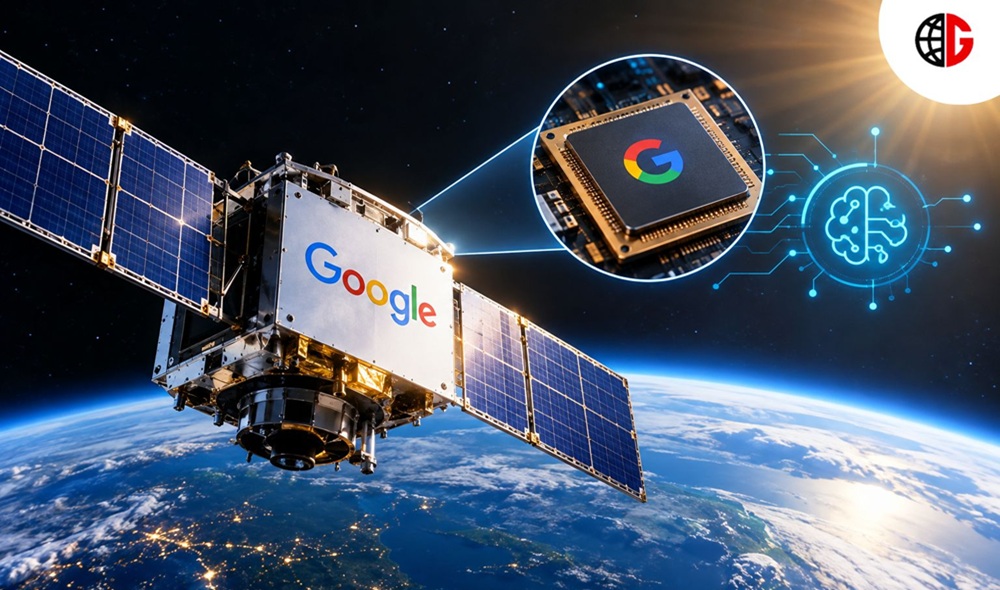
Google is preparing to send its artificial intelligence chips into orbit, taking a major experimental step toward a future where AI computing infrastructure could operate in space.
Google is moving its ambitious Project Suncatcher from research labs to low Earth orbit, preparing to test its custom Tensor Processing Units (TPUs) aboard a prototype satellite. The mission aims to answer a fundamental question: can powerful AI computing hardware survive and operate reliably in space’s harsh environment?
The experiment marks an early step in Google’s longer-term exploration of space-based AI infrastructure, where interconnected satellites could potentially use abundant sunlight to power machine-learning workloads. Google says its vision involves clusters of solar-powered satellites equipped with TPUs and connected through high-speed laser communication links.
The upcoming mission is expected to fly on SpaceX’s Transporter-18 rideshare mission, with the satellite developed in partnership with Planet. Rather than immediately attempting to build a functioning orbital data center, Google is using the first mission to gather real-world engineering data and determine how its AI hardware performs beyond Earth.
Google’s AI Chips Are Heading Into Orbit
Project Suncatcher was announced by Google in November 2025 as a research effort examining whether machine-learning computing could eventually be scaled in space.
The basic idea is unconventional but straightforward: move some of the computing infrastructure needed for AI away from Earth and place it in orbit, where satellites can potentially receive almost continuous exposure to sunlight.
According to Google, solar panels operating in low Earth orbit could eventually generate up to eight times more solar power than comparable systems on Earth, creating an intriguing opportunity for energy-intensive AI workloads.
The concept comes as AI systems require increasingly large amounts of computing power. Training and operating advanced AI models requires specialized processors, substantial electricity and sophisticated cooling systems. Project Suncatcher explores whether some of those infrastructure constraints could eventually be addressed by using space as an alternative computing environment.
But Google is not suggesting that conventional data centers will suddenly move into orbit. The company describes Suncatcher as a long-term research project, with multiple technical hurdles still standing between today’s experiment and a scalable orbital computing network.
The First Mission Is About Learning, Not Building a Space Data Center
The initial satellite is essentially a technology testbed.
Google wants to understand what happens to its TPUs when they encounter the physical conditions of space, including the intense vibration of launch, radiation, extreme temperatures and the challenges associated with removing heat in a vacuum.
During a rocket launch, spacecraft are exposed to powerful vibrations and acceleration. Google says a launch can subject a spacecraft to forces approaching 10 times Earth’s gravity, while individual components can experience considerably higher forces.
To prepare, the company conducted vibration testing across multiple axes to simulate the conditions its hardware would encounter during launch. Google reported that the hardware withstood those tests.
But surviving the rocket ride is only the beginning.
Once the satellite reaches orbit, the electronics face a very different threat: radiation.
Radiation Is One of the Biggest Challenges
Earth’s atmosphere and magnetic field provide significant protection from the space environment. Satellites, however, remain exposed to energetic particles from cosmic rays and solar activity.
These particles can interfere with electronics and cause errors known as bit flips, in which individual pieces of digital data change unexpectedly.
Google has already subjected its Trillium TPUs to radiation testing at the University of California, Davis’ Crocker Nuclear Laboratory while running AI workloads. The company says its initial tests showed the processors could tolerate a total ionizing radiation dose greater than what they would be expected to encounter during a five-year space mission.
However, laboratory simulations cannot fully reproduce everything that happens in orbit.
That is why the upcoming mission is important. Google wants actual operational data from space to understand how its hardware behaves under real conditions and identify problems that may not appear during ground testing.
Cooling AI Chips in Space Is a Different Problem
Powerful AI processors generate substantial amounts of heat. On Earth, data centers typically rely on airflow, fans, liquid cooling or other systems to transfer that heat away from processors.
Space offers no atmosphere for conventional airflow-based cooling.
In the vacuum of space, heat must instead be moved and radiated away through specially designed thermal systems.
Google is therefore experimenting with a combination of heat pipes and radiators to manage the thermal output of its TPUs. The company has already tested its cooling technology inside thermal-vacuum chambers designed to replicate the conditions encountered in space.
The orbital mission will provide another opportunity to see how that system performs outside the laboratory.
For an eventual orbital AI data center, cooling could become one of the most important engineering challenges. Packing large numbers of high-performance processors into satellites would create enormous thermal-management requirements, making efficient heat rejection essential.
Google Envisions AI Satellites Working Together
The long-term Suncatcher concept goes beyond putting one AI chip on one satellite.
Google’s broader vision involves constellations of satellites, each potentially carrying numerous TPU processors. These satellites would operate together as distributed computing infrastructure in orbit.
For that to work, however, the satellites would need to communicate rapidly and precisely.
Google is researching high-bandwidth laser communication between satellites. Unlike conventional satellite communication systems designed to transmit data over long distances at comparatively lower bandwidth, an orbital AI cluster would need extremely fast links between nearby satellites to move computing workloads efficiently.
The company says future satellites would need to know their precise positions relative to one another while moving around Earth. Establishing reliable laser links between moving spacecraft therefore requires extraordinary accuracy.
Google plans to test this part of the concept with two satellites in 2027, according to the company and recent reporting.
Why Put AI Infrastructure in Space?
At first glance, placing computer chips in orbit may appear more complicated than simply building another data center on Earth.
That is precisely why Project Suncatcher is being treated as a long-term research experiment.
AI computing is placing growing demands on electricity infrastructure, land, cooling and data-center capacity. Google’s research explores whether space could eventually provide a different model.
The biggest attraction is sunlight.
Satellites positioned appropriately in low Earth orbit can have access to sunlight for much longer periods than solar installations on the ground, potentially providing a highly consistent energy source. Google estimates that orbital solar arrays could eventually receive up to eight times the solar power available to similar systems on Earth.
If solar energy, increasingly efficient AI chips and high-speed satellite communication can be combined effectively, orbital computing could become an entirely new infrastructure layer for AI.
But that remains a future possibility rather than today’s reality.
The Economics Could Be Just as Difficult as the Engineering
Getting AI hardware into space is expensive, and satellites must be designed to survive launch, radiation, temperature extremes and years of operation.
There are also manufacturing and deployment constraints. Building enough satellites to create a meaningful computing network would require a substantial increase in orbital infrastructure.
Recent reporting has noted that launch costs, engineering challenges and satellite production capacity remain significant obstacles to commercial space-based data centers.
Data transmission is another consideration. Even with high-speed laser links, an orbital computing system would need to determine which AI workloads make sense to process in space and which should remain on Earth.
That makes Project Suncatcher less of an immediate replacement for terrestrial data centers and more of an investigation into what a future computing architecture could look like.
From Google’s Moonshots to Orbital AI
Google has a history of pursuing technologies that initially appear far removed from mainstream computing.
The company has previously described Project Suncatcher as a research moonshot, drawing parallels with other long-term projects in areas such as autonomous driving and quantum computing.
The first orbital test follows that same philosophy: start with a narrowly defined technical question, collect data and use the results to determine what comes next.
In this case, the first question is whether Google’s AI hardware can withstand and operate within space’s demanding environment.
If it succeeds, the company can move toward more complex experiments involving satellite-to-satellite communications and larger computing clusters.
What Comes Next for Project Suncatcher?
The upcoming launch is only the beginning.
Google’s immediate objective is to collect in-orbit data on its TPUs and cooling technology. The company will use those findings to refine its hardware and inform future missions.
The next major milestone is expected in 2027, when Google plans to test two satellites and investigate the laser communication technology needed to connect multiple spacecraft.
Eventually, the research could lead toward satellite clusters carrying significantly more AI processing power.
But Google is not yet promising an operational orbital data center. The company says the first mission is intended to identify what works, expose potential failure points and provide evidence for future designs.
That distinction is important. Project Suncatcher is not yet a space data center—it is an experiment to find out whether one could eventually be possible.
AI’s Next Frontier Could Be Above Earth
The race to build bigger AI systems has increasingly become a race to secure computing power, electricity and infrastructure.
Google’s Project Suncatcher introduces a radically different question into that race: what if some of the infrastructure powering AI did not have to stay on Earth?
The answer will not come from a single launch. It will depend on whether processors can withstand radiation, whether heat can be effectively removed, whether satellites can communicate at sufficient speeds and whether the economics can eventually make sense.
The upcoming TPU test will provide Google’s first real-world data from orbit.
For now, Project Suncatcher remains an ambitious research experiment. But if its underlying technologies mature, the idea of solar-powered AI computing in space could move from science-fiction territory toward a new chapter in the evolution of data centers and artificial intelligence.
Read more: Meta Unveils Muse Charm: A Pocket-Sized AI Device That Puts Its Assistant on Your Keychain