
The next phase of AI may not be about asking a chatbot a question and waiting for an answer. Instead, it could be about handing an AI system a goal and letting it continue working until the job is done.
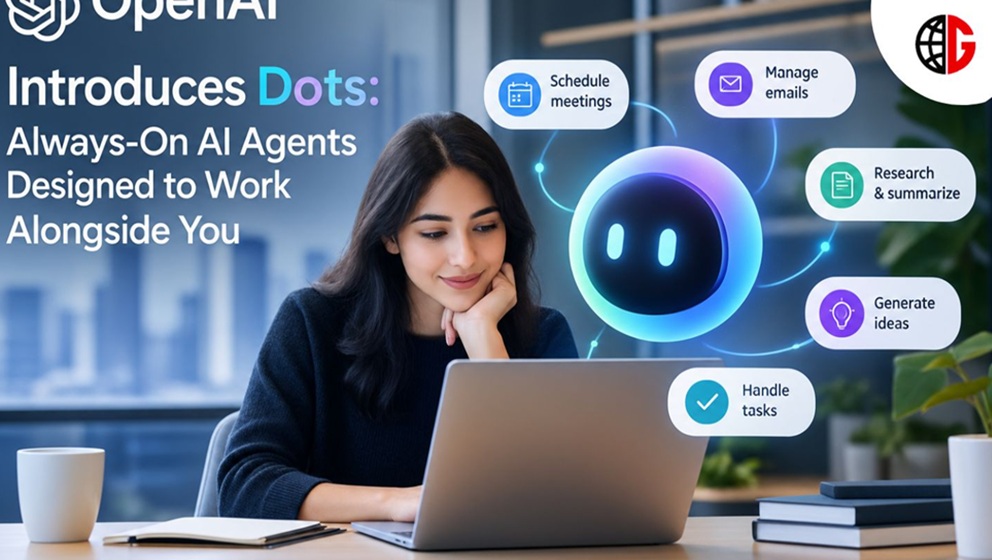
That is the idea behind Dots, a new class of always-on AI agents introduced by OpenAI on September 29, 2026. Built on GPT-6 Astra, Dots are designed to operate more independently than conventional AI assistants, using their own cloud computers, browsers, and connected applications to work on projects in the background.
Rather than simply generating responses, Dots are designed to take on ongoing work, learn a user’s preferences, monitor projects, perform multi-step tasks, and return with updates or decisions that require human attention.
From AI Assistant to AI Teammate
The introduction marks a broader shift in how OpenAI is positioning AI agents.
Traditional AI assistants generally operate in response to a prompt. A user asks a question, requests a document, or gives an instruction, and the system responds. Dots are designed around a different model: users can establish a goal and allow the agent to continue working across multiple steps without requiring constant supervision.
Each Dot operates through its own cloud computer and browser and can use applications that the user has connected. OpenAI says Dots can work on several projects simultaneously, allowing users to continue adding tasks without managing multiple individual conversations or manually directing every step.
This makes the technology particularly relevant to knowledge workers whose jobs involve recurring research, analysis, communication, content production, software development, or project management.
Powered by GPT-6 Astra and Connected to Thousands of Apps
At the core of Dots is GPT-6 Astra, OpenAI’s frontier model. The agents can also connect through OpenAI’s plugin ecosystem to more than 4,000 applications, expanding the environments in which they can operate.
The idea is to move AI beyond an isolated chat window.
A Dot can be reached through ChatGPT and can also communicate through Slack and Microsoft Teams. OpenAI says users can provide feedback, ask questions, receive progress updates, or respond to decisions from different channels while the agent maintains context across them.
For businesses, this cross-platform capability could make AI agents more closely integrated with existing workflows rather than requiring employees to adopt an entirely separate system.
What Can Dots Actually Do?
OpenAI’s examples point to a broad range of potential applications.
For software developers, a Dot could monitor customer feedback, identify recurring issues, work on smaller fixes, test changes, and prepare pull requests for human review. This would allow developers to spend more time on larger product initiatives while the agent handles a stream of smaller improvements.
In product marketing, a Dot could track changes in a product launch, understand established messaging and creative standards, and update related documents and assets when the scope changes.
Researchers could use Dots to monitor incoming data, rerun analyses, investigate unexpected results, update figures, and identify sections of a research paper that need revision.
Sales teams could use them to track changing customer requirements, examine account information and product documentation, prepare proof-of-concept work, and update proposals as technical discussions evolve.
For content creators, the system could process new interview transcripts, identify potential clips, prepare show notes, draft social media posts, and apply editorial feedback across different pieces of content.
The common thread is continuity. The agent is not simply completing one prompt; it is intended to remain involved as the underlying project develops.
AI That Learns How You Work
One of the more significant elements of the Dots concept is personalization.
OpenAI says a Dot can learn from user feedback over time, including preferences, working habits, standards, and expectations. The objective is for the agent to increasingly understand not only what a user wants done, but also how they prefer the work to be completed.
That could change the economics of AI-assisted work.
Instead of repeatedly explaining a company’s tone of voice, a research methodology, coding preferences, or approval process, users could gradually establish those expectations through continued interaction.
The longer-term vision goes beyond a single assistant. OpenAI says it envisions users eventually working with teams of Dots, potentially assigning different agents to different responsibilities.
Human Control Remains Central
Giving an AI agent the ability to act independently also creates a different set of security and privacy challenges.
OpenAI says Dots have their own cloud computers, keeping a user’s local computer and its contents separate unless the user specifically chooses to connect them. Users determine which applications their Dots can access, while permissions can be managed through existing ChatGPT controls.
Dots also have rules governing when they can act independently and when they should request approval. Custom rules can allow, restrict, or block particular actions, while built-in safety requirements remain in place.
For potentially consequential actions, OpenAI says Dots use an automated review system to assess whether an action should proceed, requires approval, or must remain with the user. Certain sensitive activities, such as changing a password, remain under direct human control.
OpenAI also stresses that Dots can make mistakes and recommends reviewing consequential work.
That distinction is important. The company’s vision is not simply to remove humans from the workflow, but to allow AI to handle more of the execution while people retain control over important decisions.
The Rise of Specialist AI Agents for Business
OpenAI is also developing a business-focused version of the concept.
Specialist Dots are intended to perform defined responsibilities inside organizations. Rather than functioning as general-purpose personal assistants, these agents can have their own identities, credentials, permissions, and access to company systems.
OpenAI says early testing has included areas such as procurement, invoice processing, email marketing, customer support, and commercial contracting.
The company is beginning with focused enterprise pilots, working with organizations to determine what each specialist Dot is responsible for, which tools it can access, and where employees need to review or approve its work.
OpenAI is also working with Microsoft to integrate specialist Dots with Microsoft Agent 365, with the aim of allowing businesses to manage them through existing enterprise governance and security systems.
Dots Begin Rolling Out to Select Users
OpenAI says Dots are beginning to roll out in ChatGPT to Pro and Business Premium users in eligible markets, while Enterprise users—including Education and Healthcare workspaces—can access a beta when enabled by their workspace administrator.
The first Dot is included with Pro and Business Premium plans at no additional cost. OpenAI says users will eventually have the option to add more Dots and scale their workload by increasing either their speed or the amount of work they can perform each month.
Users can create their first Dot through the ChatGPT desktop application or desktop browser, connect relevant applications, and subsequently communicate with it through the mobile app as well.
A New Direction for Agentic AI
Dots represent a move toward an AI model in which initiative becomes as important as intelligence.
The value of a conventional chatbot largely comes from how effectively it responds when someone interacts with it. An always-on agent introduces another dimension: how effectively it can continue working when the user is busy elsewhere.
That could have implications across software development, research, sales, marketing, operations, administration, and creative work.
But it also raises practical questions around permissions, oversight, reliability, privacy, and accountability. The more responsibility an AI agent receives, the more important it becomes to understand what the system is allowed to do—and when a human must step in.
With Dots, OpenAI is betting that the next generation of AI will not simply answer more questions. It will increasingly carry work forward.
And if the company’s longer-term vision of teams of specialized AI agents becomes reality, the workplace may evolve from humans using AI tools to humans coordinating AI workers alongside them.
Read more: Hong Kong’s Top 10 CEOs to Follow in 2026