
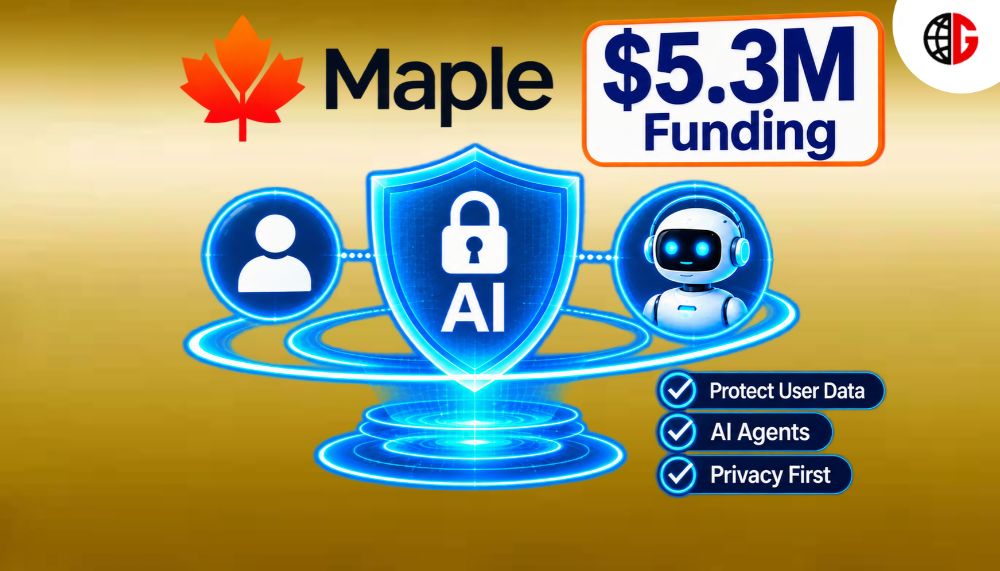
As concerns over AI data security and privacy intensify, Maple is building a new generation of AI assistants designed to protect personal information through encryption, open-source verification, and secure computing technology.
As artificial intelligence becomes increasingly integrated into everyday workflows, users are giving AI assistants access to some of their most sensitive information, including emails, documents, calendars, browsers, and personal files. However, this growing convenience comes with an important question: How much of our personal data should AI companies actually be able to see?
Austin- and San Francisco-based startup Maple believes users should not have to compromise their privacy to benefit from artificial intelligence. The company has raised $5.3 million in an oversubscribed seed funding round to develop AI-powered products that allow people and businesses to use intelligent assistants without exposing their confidential information, even to the service provider itself.
The funding round was led by Epic Ventures, with participation from Draper Associates, Planetary VC, and Epoch VC. It follows an earlier angel-backed pre-seed round of less than $1 million.
The fresh capital will support Maple’s next stage of product development, particularly its plans to introduce a cloud-based AI agent capable of continuing tasks independently, even when a user’s computer is switched off. The company is also positioning itself for a broader expansion into enterprise AI solutions.
Making AI More Private Through Technology, Not Promises
Maple’s central proposition is different from the conventional approach adopted by many AI platforms. Rather than asking customers to trust that their information will not be accessed, misused, or incorporated into model training, the startup is developing an infrastructure designed to prevent the company from accessing users’ raw data in the first place.
The company combines end-to-end encryption, open-source software, and Trusted Execution Environments (TEEs) to establish a more verifiable privacy framework.
These hardware-backed secure computing environments allow sensitive information to be processed within protected server environments. Maple says its users can independently examine its open-source code and verify the software running within its infrastructure, reducing the need to rely solely on the company’s privacy assurances.
Co-founder and CEO Mark Suman, a former Apple engineer with experience in privacy-preserving technologies, believes transparency should be built into the product rather than treated as a marketing promise.
According to Suman, the objective is to make the system auditable, allowing customers to understand and verify how their information is processed.
Under Maple’s security architecture, information is encrypted on the user’s device using a unique password known only to that individual. It is then transferred into a secure execution environment, where it is decrypted for AI processing before being encrypted again and returned to the user.
The company maintains that it cannot access the raw information during processing or while the data is stored in encrypted form.
This approach is intended to reduce exposure not only to unauthorized internal access but also to external threats, including potential data breaches. Even in situations involving legal requests for customer information, Maple says it would only be able to provide encrypted data where applicable.
From AI Chatbots to Autonomous Desktop Assistants
Maple is not limiting its ambitions to private AI conversations. Its product ecosystem is evolving towards AI agents capable of completing practical tasks across different applications and digital environments.
Its mobile application, initially launched publicly in January 2025, offers a familiar chatbot experience where users can ask questions, explore ideas, and receive AI-generated responses.
However, the platform’s underlying technology provides access to several open AI models, including versions of DeepSeek, Kimi, GLM, Inkling from Thinking Machines, Google’s Gemma, and OpenAI’s GPT OSS. Users can select individual models according to their preferences or switch between simpler and more advanced options.
The company has also introduced Maple Work, a desktop application designed to give AI greater control over everyday computer-based activities.
Through the application, users can allow AI to interact with their files, applications, and web browsers to complete tasks. An integrated application store also enables connections with services such as Gmail and calendar platforms.
Another notable capability is its support for subagents that can operate within other AI applications, including Claude and Codex, provided they support the Agent Client Protocol (ACP).
This functionality gives users greater flexibility to work with their preferred AI tools while limiting the information shared with those systems to what is necessary for a particular task.
For small businesses, this could offer a practical way to introduce AI into daily operations without unnecessarily exposing sensitive business documents, customer information, and internal communications.
A Founding Team With Experience in AI and Security
Maple’s approach reflects the complementary backgrounds of its founders.
CEO Mark Suman spent six years at Apple, working in artificial intelligence and machine learning, particularly computer vision. His work involved developing technologies that could deliver the benefits of computer vision while protecting individual identities and consumer privacy.
That experience helped shape his perspective on the relationship between technological advancement and data protection.
The company’s other co-founder and CTO, Anthony Ronning, brings experience in defense technology, cybersecurity, and networking.
Ronning originally started the business that eventually became Maple AI in 2023, initially exploring a privacy-focused fintech concept. The company’s direction changed when Suman joined him in August 2024, leading to the development of its current AI-focused vision.
Together, the founders are working towards an AI ecosystem in which security is embedded into the underlying architecture rather than added as an afterthought.
Preparing for Enterprise AI Adoption
While Maple is currently targeting individual consumers and small businesses, its longer-term strategy includes entering the enterprise market.
The company plans to begin enterprise pilot programmes in 2027, offering its own approach to zero data retention. Although Maple says it does not retain most customer information, any data that must be stored remains encrypted.
To prepare for this expansion, the startup is working towards SOC 2 compliance and undertaking security audits.
The move comes as businesses increasingly explore AI-powered automation but remain cautious about sharing confidential information with external platforms. For organisations operating in sectors where customer records, financial information, intellectual property, and internal communications require strict protection, privacy-focused AI infrastructure could become an important consideration.
Maple has not disclosed its total registered customer numbers. However, the company reports achieving 60-fold growth over the past three months, reflecting growing interest in AI services that place greater emphasis on data security.
Its current business model is subscription-based, with pricing structured around different levels of AI usage. The Pro plan costs $20 per month, while its Max and Max Plus plans are priced at $100 and $200 per month, respectively.
Building the Next Generation of Trustworthy AI
With a four-person team currently operating between Austin and San Francisco, Maple is also expanding its workforce as it develops its product portfolio.
The company’s upcoming cloud-based agent represents an important step in its evolution. By enabling AI to continue working independently of a user’s computer, Maple aims to combine the convenience of autonomous AI agents with its privacy-focused infrastructure.
The startup is also expected to pursue a Series A funding round in the first half of 2027, following the strong investor interest surrounding its latest financing.
As AI agents become more deeply involved in personal and professional activities, the question of who controls the information they access will become increasingly important. Maple is betting that the future of AI will depend not only on how intelligently these systems perform tasks, but also on how securely they handle the information entrusted to them.
Its broader ambition is to demonstrate that powerful AI and meaningful privacy do not have to exist in opposition. Instead of asking users to surrender control for convenience, Maple wants to make data protection an essential part of the AI experience.