

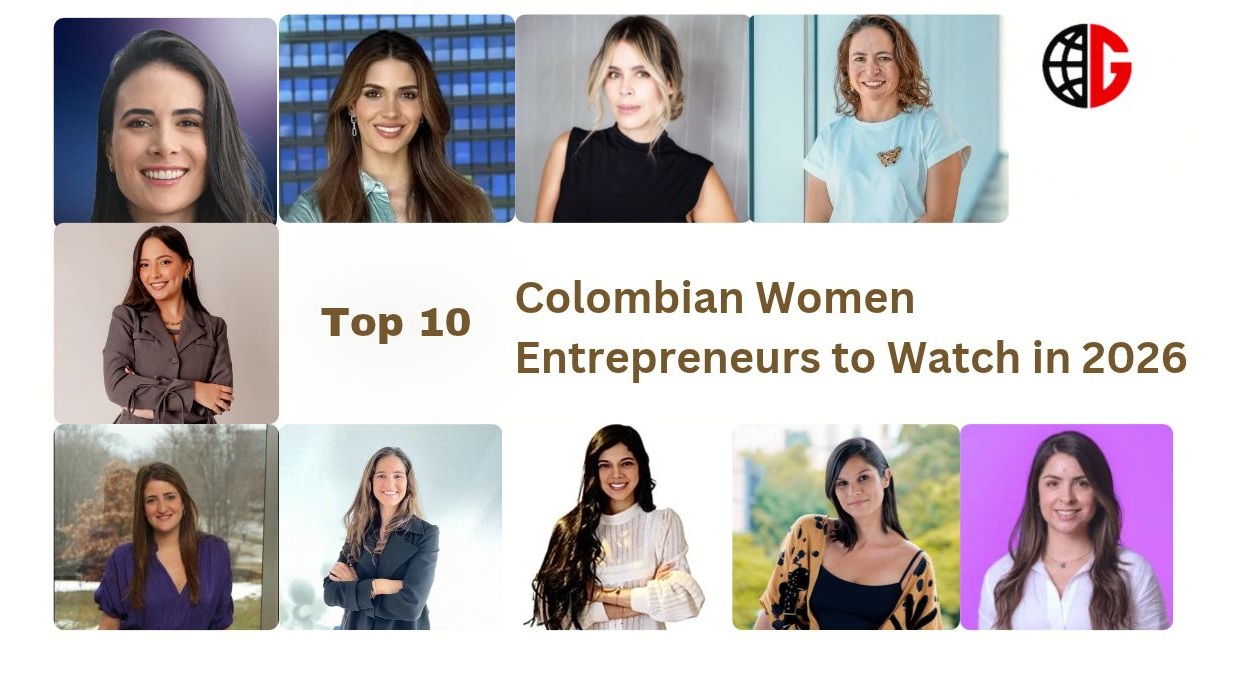
Discover 10 Colombian women entrepreneurs and business leaders transforming fintech, healthcare, education, entertainment and technology in 2026.
From fintech and healthcare innovation to digital entertainment, data education and telecommunications, these ten women are helping shape Colombia’s evolving business landscape through ambition, innovation and leadership.
Colombia’s entrepreneurial landscape is entering an exciting phase. Once primarily recognized for its traditional industries, the country is increasingly attracting attention for its growing technology ecosystem, innovative startups and ambitious business leaders. From Medellín and Bogotá to Cali and other emerging business hubs, a new generation of women is creating opportunities, challenging established business models and developing solutions to some of the region’s most pressing challenges.
Their influence extends across several industries. Some are building financial platforms that simplify access to capital, while others are introducing new approaches to healthcare, education and entertainment. Meanwhile, experienced executives are strengthening organisations that take Colombian innovation to larger markets.
Women entrepreneurs are becoming an increasingly important part of this transformation. Their contributions show that successful entrepreneurship isn’t limited to raising capital or expanding revenue. It is also about identifying overlooked opportunities, understanding customer needs, developing sustainable business models and creating solutions that make a meaningful difference.
Here are ten Colombian women entrepreneurs and influential business leaders worth watching in 2026.
1. Valentina Agudelo – Founder and CEO of Salva Health
Making breast cancer screening more accessible through healthcare technology

Some entrepreneurial journeys begin with a business opportunity, while others start with a problem that demands attention. For Valentina Agudelo, the motivation behind Salva Health came from recognizing the inequalities women face when accessing timely breast health screening.
As the Founder and CEO of Salva Health, Valentina is working to make breast cancer screening more accessible, particularly for women who encounter geographical, financial and healthcare barriers.
The company’s innovation is Julieta, a portable breast-screening device that uses electrical bioimpedance technology. It evaluates how breast tissue responds to small, safe electrical currents, offering a non-invasive and radiation-free approach to screening.
Unlike conventional diagnostic equipment, Julieta has been designed with accessibility and ease of use in mind. Its development reflects a broader ambition to make preventive healthcare more approachable, particularly in communities where access to specialized medical facilities remains limited.
The company’s progress has attracted significant recognition. Valentina received the 2025 Princess of Girona International CreaEmpresa Award, while Forbes Colombia featured her in its 2026 30 Under 30 selection. Salva Health has also reported that its screening initiatives have reached more than 2,500 women across Colombia and Venezuela.
The company received regulatory approval from Colombia’s INVIMA in 2025 and subsequently moved towards commercial deployment.
What makes Valentina particularly interesting to watch is her ability to connect scientific innovation with a clear social mission. Rather than developing technology simply for technological advancement, she is building a healthcare business around a fundamental question: how can more women access timely breast health screening regardless of where they live?
Her work represents an important intersection of entrepreneurship, medical technology and social impact.
2. Valentina Valencia – Founder and CEO of Vaas
Modernizing private credit through financial technology

Financial markets often operate through complicated systems involving multiple stakeholders, extensive documentation and lengthy approval processes. For businesses seeking financing, navigating these systems can become a significant challenge.
Valentina Valencia recognized this inefficiency through her professional experience in the fintech and private debt sectors. Having worked on both sides of the financing process, she understood the operational difficulties companies encounter when accessing structured debt.
That experience inspired her to establish Vaas, a financial technology company focused on simplifying and automating private debt operations.
Through its technology platform, Vaas aims to streamline debt management processes, reduce administrative complexity and improve coordination between lenders and borrowers. Its approach addresses an important gap in the financial ecosystem, particularly as alternative lending and private credit become increasingly relevant to growing businesses.
The company’s early fundraising success demonstrated investor confidence in its vision. In 2023, Vaas raised a $5 million seed round led by Andreessen Horowitz, with participation from Nazca, Maya Capital, Latitud and other investors.
By July 2025, Forbes Colombia reported that the platform was being used by more than 30 clients across Latin America.
Valentina’s professional journey also reflects the importance of understanding an industry’s operational challenges before attempting to transform them. Her experience in fintech operations and structured credit helped her recognize where technology could make a practical difference.
Her inclusion in Forbes Colombia’s 30 Under 30 list in 2025 further highlighted her growing influence in the regional business ecosystem.
As private credit continues to develop, Vaas has an opportunity to contribute to a more efficient financial infrastructure. Valentina’s next challenge will be scaling that vision while maintaining the reliability and flexibility required by financial institutions and businesses.
3. Gabriela Tafur – Founder and CEO of Idilio TV
Building the future of Latin American mobile entertainment

Gabriela Tafur’s entrepreneurial journey stands out because it combines an unconventional professional background with an understanding of changing consumer behaviour.
Before entering the technology and entertainment business, Gabriela built a public profile through law, pageantry, television presenting and writing. She later completed an MBA at Stanford University, where her business education helped broaden her perspective on emerging market opportunities.
Her return to Colombia brought an opportunity into focus: the growing popularity of short-form mobile entertainment.
Audiences were increasingly consuming short episodes of drama and serialized entertainment on their smartphones. However, much of the available microdrama content was originally produced in Asian markets and translated or dubbed for Spanish-speaking viewers.
Gabriela recognized the opportunity to develop original entertainment specifically for Latin American audiences.
This led to the creation of Idilio TV, a mobile streaming platform dedicated to Spanish-language vertical microdramas.
The concept is built around short, engaging episodes designed for smartphone viewing. Rather than expecting audiences to set aside an hour for traditional television, Idilio offers stories that can be enjoyed in shorter intervals throughout the day.
Its programming focuses on original productions, regional storytelling and entertainment that reflects Latin American culture and audience preferences.
The company’s latest website reports more than 1.3 million downloads, availability in over 50 countries, more than three million monthly views and a growing catalogue of original series.
These figures demonstrate the potential of a business model built around a changing entertainment habit.
Gabriela’s leadership also illustrates how personal influence, business education and an understanding of digital audiences can come together to create a new venture.
As mobile-first entertainment continues to evolve, Idilio TV is positioning itself within an emerging market where locally produced stories could become an important competitive advantage.
4. Florence Frech – Co-founder and COO of Leal
Transforming customer loyalty and retail engagement across Latin America

Customer loyalty has become an important competitive advantage for businesses. However, understanding customer behaviour and turning purchasing information into meaningful engagement can be challenging, particularly for retailers operating across multiple markets.
Florence Frech is helping address this challenge as Co-founder and Chief Operating Officer of Leal, a technology company focused on customer loyalty and engagement.
Founded in 2016, Leal developed a platform that connects consumers with brands through rewards, purchasing incentives and personalized experiences.
The company’s approach creates value for both sides of the retail relationship. Consumers receive rewards for their everyday purchases, while businesses gain opportunities to strengthen customer relationships, encourage repeat purchases and understand buying behaviour.
Leal’s growth reflects the demand for more connected retail experiences across Latin America.
According to the company’s official website, its network has expanded to eight countries, including Colombia, Mexico, Panama, Costa Rica, El Salvador, Guatemala, Honduras and Nicaragua.
The platform reports more than seven million active users, over 500 partner brands and more than $100 million in monthly transactions processed across its network.
As COO, Florence plays an important role in building the operational foundation required to support this expanding business.
Her contribution highlights an essential aspect of entrepreneurship that is sometimes overlooked: creating a company is only the beginning. Sustaining growth requires operational discipline, effective teams, strong partnerships and the ability to deliver consistent value to customers.
Leal’s regional footprint makes Florence an interesting business leader to follow as technology increasingly influences how brands interact with consumers.
5. Zaira Hurtado – Founder of Daxus LATAM
Making data education accessible to the next generation of professionals

Data has become one of the most valuable resources in modern business. From marketing and finance to operations and artificial intelligence, organizations increasingly depend on people who can interpret information and translate it into actionable decisions.
However, access to practical data education remains uneven across many markets.
Zaira Hurtado recognized this opportunity and established Daxus LATAM with a clear objective: making data analytics and programming knowledge more accessible to individuals seeking to develop relevant professional skills.
The platform focuses on practical learning rather than relying exclusively on traditional theoretical instruction. Its courses are designed to help learners understand data concepts, develop technical capabilities and apply their knowledge to real-world professional situations.
Daxus LATAM has grown into a significant education platform within the regional data-learning ecosystem.
Its official website reports that more than 50,000 students have participated in its training programmes. The company also identifies Zaira’s contribution to educating more than 30,000 learners and reaching approximately 600,000 people through free training initiatives.
Beyond Daxus, Zaira is associated with Zakidata, reflecting her broader interest in helping individuals and organizations use data more effectively.
Her entrepreneurial approach is particularly relevant at a time when artificial intelligence, automation and digital transformation are reshaping employment opportunities.
Technical knowledge is no longer limited to software engineers or specialist analysts. Professionals across different industries increasingly need the ability to understand information, recognize patterns and make informed decisions.
By making these skills more approachable, Zaira is contributing to the development of a more digitally capable workforce.
Her journey demonstrates that entrepreneurship can also create impact by helping other people build the skills they need to participate in a changing economy.
6. Isabella Fernandez Abraham – Chief Revenue Officer at MiDi
Expanding financial opportunities for Colombia’s remote workforce

The growth of remote work has created new opportunities for professionals across Latin America. Colombian freelancers, contractors and independent professionals increasingly serve international clients, particularly businesses based in the United States.
However, receiving international payments and accessing financial services across borders can remain complicated.
Isabella Fernandez Abraham is working in this evolving financial technology landscape as Chief Revenue Officer at MiDi.
The company focuses on helping remote workers and freelancers access financial infrastructure connected to the United States, addressing challenges associated with international earnings and financial services.
For professionals working with overseas clients, access to convenient financial tools can influence how efficiently they manage income, payments and everyday financial activities.
Isabella’s role involves supporting the company’s commercial growth and expanding the reach of its offering.
Her entrepreneurial background also adds another dimension to her professional journey. In 2013, she founded Kangoo Jumps Colombia, building and managing three boutiques in Bogotá.
That experience provided an early opportunity to develop business operations, customer relationships and commercial management skills.
Her move into fintech reflects how entrepreneurial experience can translate across industries. Building a consumer-facing business and helping scale a financial technology company require different capabilities, but both depend on understanding customers, identifying opportunities and creating sustainable growth.
As international remote work continues to expand, businesses addressing cross-border financial challenges will have opportunities to serve an increasingly global workforce.
Isabella’s combination of business-building experience and fintech leadership makes her a noteworthy professional in this space.
7. Estefania Molina Ungar – General Counsel at Addi
Strengthening the legal and regulatory foundations of digital finance

Entrepreneurship is often associated with product development, fundraising and rapid business expansion. Yet, behind every successful financial technology company is an equally important foundation: legal governance, regulatory compliance and risk management.
Estefania Molina Ungar has built her career around this critical aspect of business development.
As General Counsel at Addi, she contributes to the legal and regulatory framework supporting one of Colombia’s prominent digital commerce and credit platforms.
Addi connects consumers and merchants through technology-enabled credit and payment solutions. Its business model combines digital infrastructure, customer data and financing capabilities to make everyday commerce more accessible.
The scale of the business makes effective legal leadership particularly important.
Addi’s official website reports more than 3.6 million customers and over 55,000 merchants, illustrating the complexity of operating a large digital financial platform.
Estefania brings experience in securities, financial regulation and corporate legal matters. Her professional background includes exposure to the Colombian Securities Exchange and the country’s financial regulatory environment.
Her work has involved supporting complex corporate transactions, financial arrangements and the legal requirements associated with the company’s development.
Her contribution highlights a broader reality of entrepreneurship: innovation must develop alongside responsible governance.
As fintech companies expand their customer bases, enter new markets and introduce additional financial products, legal and regulatory expertise becomes increasingly important.
Estefania is an example of the women shaping the business infrastructure that allows financial innovation to grow responsibly.
8. Daniela Lopera Hernández – Legal Affairs Director at VaxThera
Supporting Colombia’s biotechnology ambitions through strategic leadership

Biotechnology is becoming an increasingly important part of the global innovation economy. Advances in medical research, vaccine development and pharmaceutical manufacturing are creating opportunities for countries to strengthen their healthcare capabilities.
In Colombia, VaxThera is contributing to this development through its focus on biotechnology and biopharmaceutical innovation.
Daniela Lopera Hernández serves as the company’s Director of Legal Affairs, a position she has held since 2021.
A law graduate of EAFIT University, Daniela has additional postgraduate education in commercial and financial law. Her professional experience includes corporate, commercial and contractual matters, making her an important part of the company’s organizational framework.
Working within biotechnology requires more than scientific expertise. Companies must navigate complex legal requirements, regulatory processes, intellectual property considerations, partnerships and commercial arrangements.
These responsibilities become particularly important when innovations move from research and development towards practical healthcare applications.
Daniela’s role involves providing legal support across these areas, helping the organization manage the responsibilities associated with operating in a highly regulated industry.
Her professional journey is also an example of how women with legal and business expertise contribute to technology-driven industries, even when they are not directly involved in product engineering or scientific research.
As Colombia continues to develop its biotechnology capabilities, experienced professionals who can connect innovation with sound corporate and regulatory practices will remain essential.
9. Paula Andrea Ruiz – Head of Culture at Somos Internet
Building the people and culture behind Colombia’s digital infrastructure growth

Technology businesses depend on more than software, hardware and investment. Their ability to grow also depends on attracting talented professionals, developing effective teams and creating workplace cultures that encourage innovation.
Paula Andrea Ruiz contributes to this important area as Head of Culture at Somos Internet.
The Medellín-based company is developing fibre-optic infrastructure to improve internet connectivity and expand access to high-speed broadband.
Its business model focuses on building and operating its own network infrastructure, including proprietary hardware and software systems.
The company’s growth has been substantial. In March 2026, Somos Internet announced a $40 million Series B funding round co-led by Bracket Capital and Ribbit Capital, with participation from several other investors.
The funding is intended to support the company’s expansion across Colombia and its entry into Mexico City.
The company also reported threefold revenue growth in 2025 and more than doubled its user base year over year.
As Head of Culture, Paula has an important responsibility in supporting the people strategy behind this expansion. Recruiting, developing and retaining skilled professionals is especially important for a technology infrastructure business that depends on engineering, operations and customer support capabilities.
Her contribution demonstrates that scaling a technology company requires a combination of technical and human leadership.
While founders and investors often receive attention for funding announcements and expansion plans, the people responsible for building strong teams are equally important to long-term business performance.
Paula’s role places her within one of Colombia’s notable technology growth stories.
10. Daniela Restrepo – Principal at Publicize
Helping technology businesses build visibility and market influence

In a competitive business environment, developing an innovative product is only one part of building a successful company. Businesses must also communicate their value, establish credibility and create relationships with customers, investors and industry stakeholders.
Daniela Restrepo works within this important part of the technology ecosystem as Principal at Publicize, a global public relations firm serving technology startups and established enterprises.
With a background in social communications and public relations from Pontificia Universidad Javeriana, Daniela brings expertise in strategic communications and media positioning.
Her work involves helping organizations communicate their stories, strengthen their public profiles and navigate the increasingly competitive media environment.
Public relations has become particularly important for technology companies. As new businesses enter markets involving artificial intelligence, fintech, healthcare technology and software, the ability to communicate innovation clearly can influence their reputation and commercial opportunities.
Beyond her corporate responsibilities, Daniela has also been associated with mentoring initiatives, industry events and professional discussions that support the wider entrepreneurial ecosystem.
Her contribution reflects the importance of communications as a business capability.
In an environment where technology companies compete not only through products but also through trust, credibility and visibility, strategic communication professionals play an increasingly relevant role.
Daniela represents the business and communications expertise that helps innovation reach wider audiences.
Outlook
Colombia’s entrepreneurial future will be shaped by people who can identify opportunities, build effective organizations and translate innovative ideas into meaningful results. The women featured in this article represent different dimensions of that progress, from financial technology and healthcare innovation to digital entertainment, education, infrastructure and business development.
Their journeys also demonstrate that leadership takes many forms. Some are founders developing businesses from the ground up, while others are senior professionals helping ambitious companies navigate growth, regulation and organizational transformation.
As Colombia’s startup ecosystem continues to mature, their work offers an encouraging picture of the opportunities emerging for women in business.
The next chapter of Colombian entrepreneurship will not simply be about building more companies. It will be about creating businesses that solve meaningful problems, reach new markets and leave a lasting impact. These women are contributing to that transformation.