
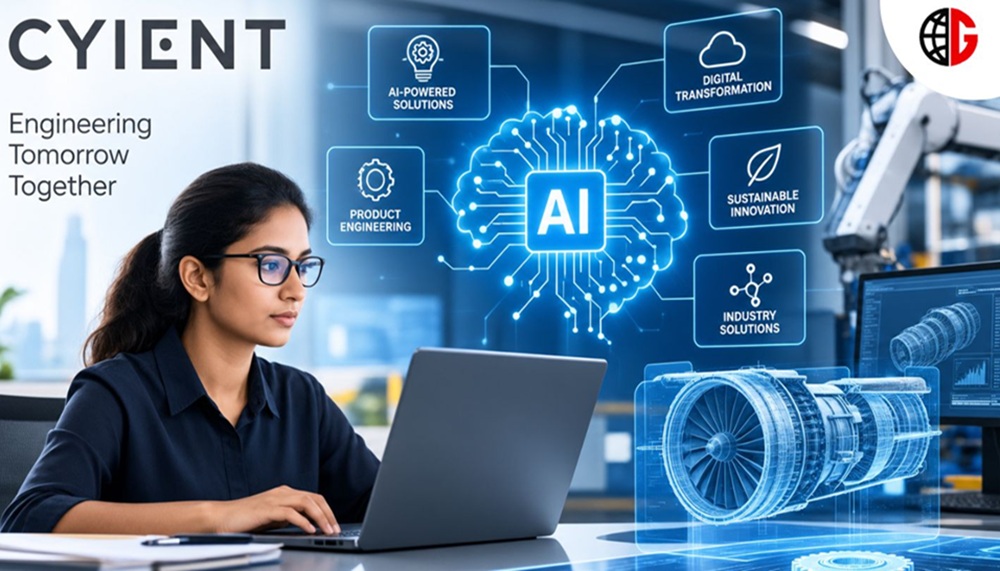
Engineering and technology services company Cyient is stepping up its artificial intelligence strategy with the launch of Intelligent Engineering Solutions (IES), a new integrated business unit aimed at turning AI capabilities into measurable business outcomes across the engineering lifecycle.
Alongside the new unit, Cyient has introduced CYiNGINE, a lifecycle engineering intelligence platform designed to bring together industrial data, engineering expertise and modern AI technologies under a common operating model. The move marks a broader shift in Cyient’s strategy—from delivering individual technology projects to building AI-powered, outcome-focused engineering partnerships.
Cyient Creates New AI-Focused Engineering Business
The newly established Intelligent Engineering Solutions unit is intended to combine Cyient’s engineering domain expertise with data, analytics, artificial intelligence and software capabilities.
Rather than treating AI as a standalone technology layer, Cyient says IES will embed intelligence directly into critical engineering workflows, covering activities from planning and design to operations and service.
The company’s approach is particularly focused on industries where engineering decisions can have a direct impact on product performance, asset availability, regulatory compliance and operational efficiency.
IES will also help customers manage their AI stacks while developing solutions around specific engineering and business requirements.
CYiNGINE to Serve as the AI Foundation
At the centre of the new strategy is CYiNGINE, which Cyient describes as its lifecycle engineering intelligence platform.
The platform combines governed industrial data, engineering domain knowledge, business context and modern AI and large language model capabilities. Its objective is to make AI more useful inside real-world engineering environments rather than simply adding generative AI tools to existing processes.
Cyient’s proposition is built around a simple idea: companies are not necessarily looking to buy AI technology for its own sake. They want faster processes, better asset performance, reduced downtime and measurable improvements in business outcomes.
That philosophy is reflected in the architecture of IES and CYiNGINE.
Three AI Playbooks Target Key Engineering Workflows
Cyient plans to organize its Intelligent Engineering Solutions around three reusable, AI-enabled playbooks covering some of the most important stages of the engineering lifecycle.
1. Engineering Lifecycle
The first playbook focuses on improving engineering and design activities.
AI-enabled workflows are expected to help companies accelerate design and engineering change cycles, improve first-time-right performance and increase the reuse of engineering intellectual property.
For engineering-intensive businesses, reducing design iterations and making existing engineering knowledge easier to reuse can translate into faster product development and lower costs.
2. Service Lifecycle
The second playbook focuses on service and asset performance.
Here, AI can support diagnostics, predictive maintenance and automated access to service knowledge, with the broader goal of improving asset availability and reducing unexpected outages.
This could be particularly relevant for industries operating complex and mission-critical infrastructure, where equipment downtime can quickly translate into significant operational losses.
3. Quality and Regulatory Lifecycle
The third playbook addresses quality, certification and regulatory requirements.
Cyient says its AI-enabled approach is designed to support faster certification and compliance while maintaining continuous, audit-ready traceability.
For highly regulated sectors, this could help reduce repetitive work, shorten approval cycles and lower regulatory risk.
From AI Experiments to Measurable Business Outcomes
One of the more significant aspects of Cyient’s announcement is its emphasis on outcomes rather than AI adoption alone.
The company says IES will follow an “Explore > Build > Scale > Deliver Impact” progression. The model is intended to take AI initiatives beyond experimentation and connect them to specific customer performance indicators.
That means AI projects could increasingly be assessed against tangible metrics such as:
Faster engineering and design cycles
- Improved first-time-right performance
- Greater reuse of engineering intellectual property
- Higher asset availability
- Fewer unplanned outages
- Faster certification and regulatory clearance
- Reduced rework and operational risk
The approach could help Cyient position AI as an operational capability rather than simply another digital transformation initiative.
“We Are Not Pursuing AI for the Sake of AI”
Cyient Executive Director and CEO Sukamal Banerjee said the company’s strategy is centred on tangible customer outcomes rather than AI adoption for its own sake.
He highlighted the need to rethink how AI is integrated into core engineering disciplines and how customers use it while designing, manufacturing and servicing products. According to Cyient, IES brings together the company’s investments in research and development, partnerships and talent around that objective.
The message is significant at a time when enterprises across industries are experimenting with generative AI but are increasingly looking for evidence that those investments can deliver measurable returns.
Cyient is effectively attempting to position its engineering heritage as an advantage in that transition.
Harjott Atrii to Lead the New Unit
Harjott Atrii, Chief Business Officer at Cyient, will lead Intelligent Engineering Solutions.
Atrii has been involved in developing the company’s data, AI and technology capabilities, which are now being consolidated under the new business unit.
He said customers ultimately purchase outcomes rather than AI itself, arguing that Cyient’s combination of engineering expertise, industrial data and customer relationships can provide an advantage in deploying AI in complex engineering environments.
This distinction could become increasingly important as the enterprise AI market matures. While generic AI tools are becoming widely accessible, deploying AI reliably inside engineering, manufacturing, infrastructure and regulated environments requires industry-specific data, domain expertise and governance.
Building on Cyient’s Broader AI Strategy
The IES announcement also fits into Cyient’s wider push toward AI-enabled engineering.
Earlier in 2026, the company announced an agreement to acquire TAO Digital Solutions, an AI-native data and product engineering company. Cyient said the deal would strengthen its capabilities in AI and data engineering, GenAI deployment, AI lifecycle operations, cloud services and digital product engineering.
The latest launch therefore appears to be part of a broader effort to combine Cyient’s long-standing engineering capabilities with newer AI and data capabilities.
The company currently positions itself around lifecycle engineering, with operations spanning areas including aerospace and defence, automotive and mobility, connectivity, energy, healthcare and life sciences, mining, rail transportation and utilities.
What Cyient’s AI Move Signals for Engineering Services
The launch of Intelligent Engineering Solutions comes as engineering services companies face a major transformation.
AI is increasingly moving beyond isolated automation projects and into product development, industrial operations, predictive maintenance, software engineering and compliance. For service providers, the challenge is no longer simply demonstrating that AI can perform a task. The bigger question is whether AI can be integrated into complex enterprise environments and consistently deliver measurable results.
Cyient’s IES strategy is designed around precisely that challenge.
By combining engineering domain knowledge + industrial data + AI + outcome measurement, the company is seeking to differentiate its offering from generic AI consulting and technology implementation.
Its CYiNGINE platform could become a central component of that strategy, providing a common data and AI foundation across multiple engineering workflows.
The Road Ahead for Cyient
With Intelligent Engineering Solutions and CYiNGINE, Cyient is attempting to move its AI strategy from experimentation toward industrial-scale implementation.
The company’s focus on engineering, service and quality and regulatory workflows gives the initiative a clear operational direction, while its emphasis on measurable customer KPIs provides a framework for evaluating whether AI investments are producing meaningful results.
For Cyient, the larger opportunity is not simply to sell another AI platform. It is to use AI to deepen its position as a lifecycle engineering partner, helping customers design better products, operate assets more efficiently and navigate increasingly complex regulatory environments.
As enterprise AI shifts from hype to execution, Cyient is betting that the next phase of growth will belong to companies capable of embedding intelligence into the industries and engineering systems that keep the real economy moving.
Read more:vOpenAI to Watermark ChatGPT Text in the EU Under AI Act Rules