
Norway has long been known for energy, shipping, seafood, and natural resources. But a new generation of women is helping reshape that economic identity around climate technology, artificial intelligence, digital platforms, e-commerce, workplace equality and next-generation business models.
From turning weather science into a global commercial venture to transforming agricultural waste into fertilizer and using radar and AI to make construction waste management smarter, Norwegian women entrepreneurs are proving that innovation does not have to come at the expense of sustainability.
What makes this group particularly interesting is the diversity of their journeys. Some have founded technology companies from scratch. Others are building businesses around inclusion, digital transformation, or consumer behavior, while established business leaders are influencing how Norway’s largest organizations adapt to a rapidly changing economy.
Here are 10 Norwegian women entrepreneurs and business leaders to watch, representing different sides of the country’s evolving entrepreneurial ecosystem.
1. Siri M. Kalvig – Turning Weather Science Into Climate Investment
Few Norwegian entrepreneurs demonstrate the connection between science, technology and sustainability as clearly as Siri M. Kalvig.
A meteorologist by training, Kalvig founded Storm Weather Center in 1997, after recognizing that increasingly sophisticated weather information could become a valuable business tool. What began as a Norwegian weather enterprise eventually developed into StormGeo, a global provider of weather intelligence serving weather-sensitive industries.
Her career subsequently moved from forecasting weather to financing solutions for climate change.
Kalvig became CEO of Nysnø Climate Investments, Norway’s state-owned climate investment company. Nysnø invests in companies and funds developing solutions aimed at reducing greenhouse-gas emissions, combining financial returns with measurable climate impact.
Her scientific background has remained central to her leadership philosophy. Kalvig also completed a doctorate in offshore technology at the University of Stavanger, giving her an unusually strong combination of scientific expertise, entrepreneurship and investment experience.
Although Nysnø announced in August 2026 that Kalvig had submitted her resignation as CEO, her influence on Norway’s climate-investment ecosystem remains significant.
Why watch her: Kalvig represents a powerful Norwegian model of entrepreneurship—using science not simply to create a company, but to help finance the next generation of climate solutions.
2. Grete Sønsteby – Reimagining Agriculture Through Climate Technology
Grete Sønsteby is part of a new wave of entrepreneurs tackling one of the world’s oldest industries: agriculture.
As a founder of N2 Applied, Sønsteby helped develop technology designed to transform livestock manure into a valuable source of nitrogen fertilizer. Rather than treating manure simply as agricultural waste, the company’s technology uses an electrical plasma process to recover nitrogen and create fertilizer closer to where it is needed.
The idea addresses several problems simultaneously. Farmers traditionally depend on industrial fertilizer supply chains, while livestock manure can create environmental challenges. N2 Applied’s approach seeks to connect these two problems through a circular system.
The company says its technology can enable livestock farmers to recycle nitrogen and produce fertilizer on the farm, reducing emissions and improving resource efficiency.
Sønsteby’s work has also received recognition within Norway’s innovation ecosystem. She was nominated for Norway’s Female Entrepreneur award, which highlights women developing technology connected to major global sustainability challenges.
Her entrepreneurial story illustrates an important shift in climate innovation: sustainability is increasingly about redesigning industrial systems, not simply making existing products slightly greener.
Why watch her: Sønsteby sits at the intersection of agriculture, deep technology, and the circular economy—three sectors expected to play an increasingly important role in the global green transition.
3. Isabelle Ringnes – Building a More Inclusive Technology Industry
Technology entrepreneurship is not only about software and hardware. It is also about determining who gets access to opportunity.
That is where Isabelle Ringnes has made her mark.
Ringnes founded TENK – Technology Network for Women in 2015, with the goal of encouraging more women and girls to engage with technology. She later became a co-founder of Equality Check, a platform built around workplace equality and organizational culture.
Her work emerged from personal observations of gender bias in traditionally male-dominated industries. Alongside Equality Check co-founder Marie Louise Sunde, Ringnes helped turn those observations into a broader movement around workplace equality.
With a master’s degree in Media Management from The New School in New York, Ringnes has built a career that combines technology, communications, entrepreneurship and advocacy. She is also a public speaker, board member, podcast host, and faculty member at Singularity University Nordic.
Her approach is particularly relevant as businesses increasingly recognize that diversity is not merely a social issue but also a factor in innovation, recruitment and decision-making.
Why watch her: Ringnes demonstrates how technology entrepreneurship can be used to change workplace systems and expand participation in the digital economy.
4. Ulrikke Lien – Bringing AI and Radar to Construction Waste

Ulrikke Lien is tackling a surprisingly overlooked technology problem: knowing what is happening inside a waste container.
As founder and CEO of Sensorita, Lien is developing a combination of radar sensors, machine learning and software to help waste-management companies monitor containers more intelligently.
The concept emerged from Lien’s engineering research at the Norwegian University of Life Sciences. Sensorita subsequently developed into a deep-tech company focused particularly on construction waste, one of Europe’s largest waste streams.
The technology places sensors on waste containers and uses data to determine factors such as location and fill levels. Its software can then help waste operators plan collections more efficiently.
The opportunity is bigger than it may initially appear. Traditional waste collection can involve workers physically checking containers, creating unnecessary trips, costs and emissions. Better data can potentially turn this reactive system into a predictive one.
Sensorita’s work has also attracted European innovation support, reflecting the growing importance of digital tools in the circular economy.
Why watch her: Lien represents the rise of Nordic “trash tech”—where sensors, AI and data science are being applied to make physical industries cleaner and more efficient.
5. Silje Landevåg – Building a Digital Retail Success Story

When Silje Landevåg founded Get Inspired, online shopping was nowhere near as mature as it is today.
She was just 24 when she began building what would become one of Norway’s leading online sports and lifestyle retailers. Her timing, understanding of digital consumer behavior and willingness to use emerging social-media channels helped the company grow rapidly.
Landevåg’s story is particularly compelling because Get Inspired was built before e-commerce became a mainstream part of everyday retail. She effectively had to help educate the market while simultaneously building the business.
According to her published entrepreneurial profile, Get Inspired reached NOK 530 million in revenue in 2021, after which Landevåg partially sold her stake and continued her entrepreneurial journey as an investor.
Her journey has also been documented in the book Våge, vinne & vokse, which explores her experiences building the company, dealing with growth challenges and balancing entrepreneurship with personal responsibilities.
Why watch her: Landevåg’s career shows how a consumer-focused founder can use e-commerce, community and social media to build a major retail brand—and then transition from operator to investor.
6. Kimberly Larsen – Digitizing the Freelance Economy
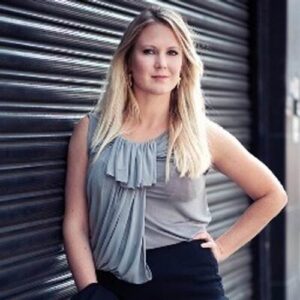
Kimberly Larsen took a problem familiar to freelancers in the creative industries and turned it into a digital-platform opportunity.
Larsen founded timetoRIOT, a platform designed to connect creative professionals with companies looking for freelance talent. The concept initially focused on film, television, theatre and entertainment, where finding the right freelancer for the right project can be highly fragmented.
The platform was positioned almost like a professional matchmaking service: freelancers could create profiles, highlight their skills and discover relevant opportunities, while companies could search for talent and promote projects.
By 2021, the platform reportedly had around 70,000 registered users, demonstrating the scale that can emerge when a fragmented professional market is given a digital infrastructure.
The company’s model subsequently expanded beyond the original entertainment niche, showing the broader potential of a digital marketplace for independent professionals.
Why watch her: Larsen’s story highlights the continuing transformation of freelance work and demonstrates how niche marketplaces can become scalable digital businesses.
7. Silje Lindtvedt Fladmoe – Making Recruitment Smarter and More Inclusive
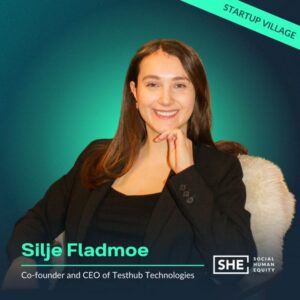
Silje Lindtvedt Fladmoe, CEO of Testhub Technologies, is working at the intersection of recruitment, technology and organizational psychology.
Testhub’s mission is to improve how companies evaluate candidates by using technology and assessment methods designed to reduce bias and focus more closely on future job performance.
Fladmoe brings a strong academic and business background to that mission. Testhub says she holds master’s degrees in Business Analysis & Performance Management and International Management through the CEMS program. She has also worked with recruitment at the company for several years.
One of Testhub’s most notable collaborations has been with Norwegian Air. The airline used Testhub’s blind-screening solution as part of an effort to reduce unconscious bias in recruitment, including a pilot involving 100 cabin-crew positions.
That makes the company particularly relevant at a time when employers are looking for better ways to identify talent while creating fairer recruitment processes.
Why watch her: Fladmoe represents the growing field of HR technology, where data, behavioral science and software are being combined to rethink how organizations hire.
8. Anne Lise Waal – A Tech Operator Helping Startups Scale
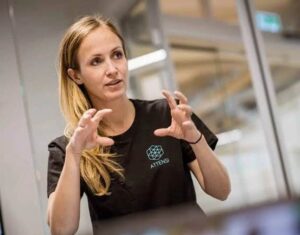
Anne Lise Waal has built her reputation not only by founding TechTiger, but through years of operating inside the Norwegian technology and startup ecosystem.
TechTiger positions Waal as an “executive for hire,” providing interim CTO, CPO, and COO expertise to startups and growth companies. Her background spans SaaS, gaming, technology strategy, boards and angel investing.
She also has experience from Attensi, where she was part of the company’s growth journey from a small team to hundreds of employees.
Today, Waal’s influence extends beyond individual companies. She serves on boards connected to organizations and funds within Norway’s startup ecosystem, including StartupLab-related investment structures and the Norwegian Alliance for Startups and Tech.
Her role is therefore less about building a single consumer-facing company and more about helping multiple technology businesses develop leadership, products and scalable operations.
Why watch her: Waal represents the increasingly important “operator-investor” model, where experienced technology executives help several startups move from promising ideas to scalable businesses.
9. Christina Sahlberg – A Nordic Voice for Smarter Financial Decisions

There is an important caveat with Christina Sahlberg: she is better described as a Nordic financial entrepreneur and investment communicator than as a Norway-based startup founder.
Her inclusion reflects the wider Nordic business ecosystem and the growing influence of women who connect consumers, financial services and investment thinking.
Sahlberg built a long career as a savings economist and financial commentator at Swedish comparison platform Compricer. She holds a master’s degree in economics from Stockholm University and a bachelor’s degree in psychology from Swinburne University of Technology in Australia.
Her background is unusual because it combines economics with psychology—a useful combination when explaining why people make irrational financial decisions and how they can build better saving habits.
Before joining Compricer, she worked at companies including Telia and Ericsson and also founded Nordic Avenue while living in Australia.
In 2026, she moved to Skandia as a personal-finance economist, continuing her role as a public voice on saving, investments and household economics.
Why watch her: Sahlberg illustrates the broader Nordic trend toward making investment and financial literacy more accessible—especially through digital media and consumer-focused financial services.
10. Kristin Skogen Lund – Leading Digital Transformation at Scale

Not every influential woman entrepreneur has to be the founder of a startup. Kristin Skogen Lund represents another powerful path: transforming established institutions and large corporations from the inside.
Skogen Lund has held some of Norway’s most influential business positions. She served as Director General of the Confederation of Norwegian Enterprise (NHO) from 2012 to 2018 before becoming CEO of Schibsted in 2018.
Her career has repeatedly placed her at the center of digital transformation. At Telenor, she was responsible for Nordic activities and played a role in developing digital services. At Schibsted, she led a business increasingly shaped by technology, data, digital marketplaces and changing consumer behavior.
Her leadership at Schibsted coincided with major structural changes, including the evolution of its marketplace and media businesses. She left the CEO role in 2024 after leading the company through a period of significant transformation.
Her extensive board and leadership experience also gives her influence well beyond one company.
Why watch her: Skogen Lund demonstrates that entrepreneurial thinking can be just as powerful in a major corporation as in a startup—particularly when the challenge is to reinvent an established business for the digital era.
The Bigger Picture: Why Norway’s Women Entrepreneurs Matter
These 10 women represent very different sectors, but their stories reveal a common pattern.
Sustainability is becoming a business model. Kalvig and Sønsteby demonstrate how climate challenges can create opportunities for investment and technological innovation.
AI is moving into traditional industries. Lien’s Sensorita shows how machine learning and sensors can modernize waste management, while Testhub applies technology to recruitment.
Digital platforms are changing professional life. Larsen’s timetoRIOT illustrates how technology can connect fragmented freelance communities, while Landevåg transformed retail through e-commerce.
And perhaps most importantly, Norway’s female business leaders are increasingly influencing the ecosystem around entrepreneurship itself. Ringnes has pushed for greater inclusion in technology, Waal is helping startups scale and Skogen Lund has demonstrated how established corporations can undergo major digital transformations.
The result is an entrepreneurial landscape where success is no longer measured only by revenue or valuation. Increasingly, the most interesting Norwegian companies are those solving real-world problems—from climate change and agricultural emissions to waste, workplace inequality, recruitment and financial access.
For entrepreneurs, investors and business leaders watching the Nordic region, these women offer a useful preview of where the next generation of innovation may come from: technology with purpose, sustainability with commercial discipline, and businesses designed around changing human needs.
Read more: Hong Kong’s Top 10 CEOs to Follow in 2026