

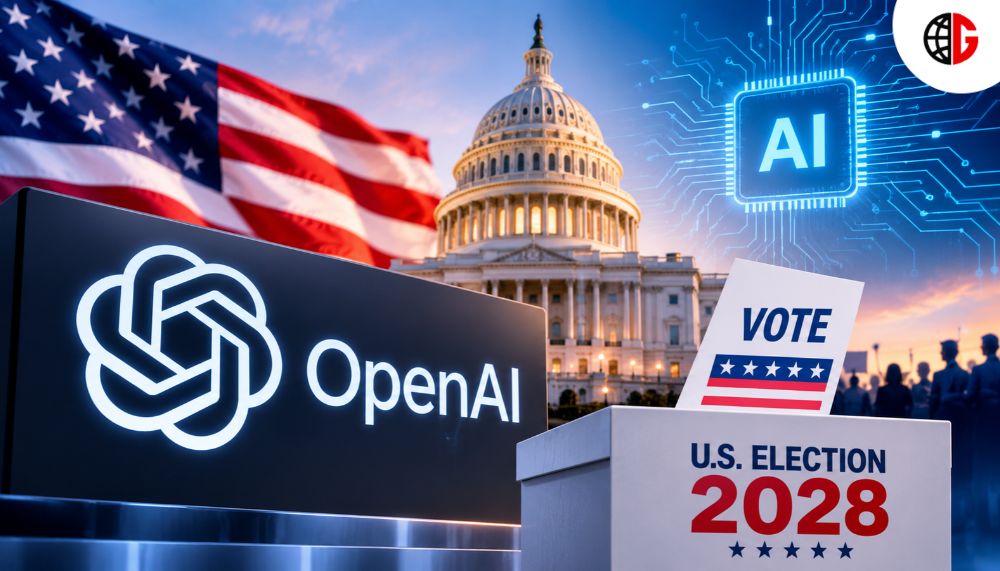
OpenAI is preparing to make artificial intelligence a defining issue in the 2028 US presidential election, urging political leaders to develop policies that address public concerns while ensuring America remains competitive in the global AI race.
Artificial intelligence is rapidly moving beyond the technology sector, becoming a subject of growing political, economic, and social importance. With concerns mounting over job displacement, rising electricity costs, corporate influence, and the expansion of data centres, OpenAI is making an early effort to shape how policymakers approach AI ahead of the 2028 US presidential election.
Chris Lehane, OpenAI’s Chief Global Affairs Officer, believes the next presidential race could represent a turning point in how America responds to the technology. In a recently published essay, Lehane argues that political leaders must move beyond general statements about AI-related concerns and develop a practical policy framework that allows ordinary Americans to benefit from the economic opportunities created by artificial intelligence.
OpenAI Calls for an AI-Focused New Deal
Drawing parallels between the potential economic transformation driven by AI and President Franklin D. Roosevelt’s New Deal, Lehane suggests that the United States needs a fresh approach to managing technological change.
The original New Deal introduced extensive economic reforms and worker protections during the Great Depression of the 1930s. Lehane believes the country is once again entering a major economic transition, with artificial intelligence potentially reshaping industries, employment structures, and wealth distribution.
According to his argument, Americans need more than assurances that AI will create prosperity. They need policies that help them participate in that prosperity and maintain control over their economic futures.
His proposed agenda covers five broad areas, including workforce development, education, child safety, AI governance, and data centre infrastructure. The central idea is to establish what he describes as a compelling third path—one that balances technological progress with public confidence and economic opportunity.
However, the proposals have also attracted criticism from policy experts who question whether OpenAI’s vision offers sufficient protection against the risks associated with the technology.
Economic Opportunity or Greater Corporate Influence?
The timing of Lehane’s essay is particularly significant. Following a major Democratic victory in the midterm elections, affordability and the rising cost of living have emerged as important political concerns. Although AI was not a dominant campaign issue, opposition to data centre developments became a bipartisan concern in several electoral contests.
For voters already dealing with inflation, tariffs, and increasing household expenses, artificial intelligence could become another important issue by 2028.
People are increasingly questioning whether expanding data centre infrastructure will push electricity bills higher, whether AI will eliminate existing jobs, and whether the financial benefits of automation will primarily flow to a small group of powerful technology companies.
Kate Brennan, who leads AI and corporate power policy at the AI Now Institute, believes Lehane’s proposals represent a notable departure from OpenAI’s earlier policy agenda, which emphasised accelerating AI development, reducing regulatory barriers, and expanding infrastructure.
Nevertheless, she argues that the latest vision continues to prioritise AI adoption without sufficiently addressing how the resulting economic benefits will be distributed.
The comparison with the New Deal has also raised questions. Historically, Roosevelt’s reforms established stronger protections for workers and introduced constraints on corporate power. Critics argue that OpenAI’s proposed framework does not yet demonstrate how comparable safeguards would be introduced for an economy increasingly influenced by AI.
Worker Protection and Wealth Distribution Remain Key Questions
One of the central challenges surrounding AI adoption is ensuring that workers are not left behind as businesses automate more tasks.
Lehane proposes using tax incentives to encourage employees to develop AI-related skills, improving access to capital for entrepreneurs, and exploring employee ownership and profit-sharing models.
These measures could encourage wider participation in the AI economy. However, critics point out that incentives and voluntary arrangements are different from enforceable requirements that guarantee workers a share of productivity gains or compensation when their jobs are displaced by automation.
Brennan argues that policymakers should also examine corporate tax reforms, incentives for companies that continue hiring human workers, and measures to prevent excessive market concentration.
The broader concern is whether AI will create widespread economic mobility or reinforce existing inequalities between technology companies, investors, and the workforce.
For OpenAI, encouraging wider AI adoption is also closely connected to its own business interests, making questions about corporate accountability particularly important.
Data Centres Become a Political Flashpoint
Another major component of Lehane’s proposed agenda concerns the infrastructure required to support America’s expanding AI industry.
Data centres are essential to training and operating advanced AI systems, but their rapid expansion has generated resistance in several communities. Concerns over electricity consumption, water usage, environmental impact, and pressure on local infrastructure have turned proposed developments into contentious political issues.
Lehane acknowledges these concerns but also highlights the potential benefits of data centre construction, including employment opportunities, investment, and additional tax revenue for local communities.
He warns that politicians advocating broad restrictions or moratoriums on data centre construction could weaken America’s competitive position against China. To emphasise the potential consequences, he compares such opposition to the political decision-making surrounding the 2002 authorisation of the Iraq War.
The argument reflects OpenAI’s broader position that infrastructure expansion is essential to maintaining US leadership in artificial intelligence. However, critics believe communities should have a meaningful voice in decisions that directly affect their electricity costs, resources, and local environments.
Education and Child Safety Feature Prominently
Lehane also identifies education and child protection as important priorities for the future of AI policy.
He supports age-appropriate safeguards for young users, particularly around AI companions and other systems that could influence children’s online experiences. As conversational AI becomes more sophisticated, questions about privacy, emotional dependence, inappropriate interactions, and children’s digital well-being are gaining greater attention.
Education is another area where Lehane believes policymakers should avoid excluding AI from classrooms.
He argues that limiting access to AI tools could increase educational inequality, particularly between students in wealthy communities and those in rural or underserved areas.
However, the assumption that AI automatically improves learning outcomes remains open to debate. While AI-powered tools can provide personalised assistance and additional learning resources, questions remain about their effectiveness, accuracy, and impact on critical thinking.
Critics argue that investment in qualified teachers, educational infrastructure, and individual student support should remain central to any education strategy rather than treating AI adoption as an automatic solution.
AI Safety and Accountability Under Scrutiny
Perhaps the most consequential part of Lehane’s agenda involves AI safety and public oversight.
He calls for enforceable safety standards, independent evaluations, greater public accountability, and mechanisms that would allow authorities to restrict potentially dangerous AI systems. He also supports maintaining the ability to shut down systems through a kill switch if necessary.
These proposals address growing concerns about increasingly powerful AI models and the possibility that their behaviour could become difficult to control.
However, OpenAI’s earlier positions on AI regulation have raised questions about how consistently the company has supported such measures.
In 2024, OpenAI opposed California’s proposed SB 1047 legislation, which sought to introduce requirements for evaluating catastrophic AI risks and establishing shutdown capabilities. The company also advocated limiting state-level AI regulation in its previous policy recommendations, arguing that fragmented rules could undermine American innovation.
More recently, OpenAI has expressed support for certain state-level safety measures and shown openness to independent safety evaluations.
For critics, the challenge is ensuring that calls for stronger oversight translate into concrete commitments rather than remaining broad policy principles.
Lehane also emphasises that humans should retain authority over consequential decisions involving AI. Yet, as the technology becomes increasingly embedded in workplaces, schools, healthcare, and government services, defining what meaningful human control actually looks like will become more complicated.
Will AI Become a Defining Issue in 2028?
OpenAI’s growing focus on the 2028 election highlights how artificial intelligence is evolving from a technological discussion into a broader debate about economic security, public policy, and corporate responsibility.
The next two years could bring greater scrutiny of how AI companies operate, how governments regulate emerging technologies, and who ultimately benefits from the productivity gains created by automation.
Lehane presents AI as an opportunity to strengthen America’s economy, expand access to innovation, and create new pathways for the middle class. His proposals suggest that the country needs a framework that supports technological development while addressing the concerns of workers, families, businesses, and local communities.
Still, important questions remain unanswered. How will displaced workers be protected? What obligations will AI companies have towards the communities hosting their infrastructure? How can governments ensure that the financial gains of AI are shared more broadly? And what level of independent oversight will be necessary to keep increasingly powerful systems accountable?
These questions could become central to the political debate as the 2028 election approaches.
Ultimately, OpenAI’s attempt to shape the conversation reflects a larger reality: the future of artificial intelligence will not be determined by technology companies alone. It will also depend on public trust, political choices, regulatory decisions, and whether the benefits of innovation reach beyond the companies building it.
As AI moves closer to the centre of American political debate, the defining question may not simply be how fast the technology advances, but who gets to benefit from the transformation it creates.
Read more: Top 10 Successful Restaurant Founders in Malaysia Making Their Mark in the Food Industry