

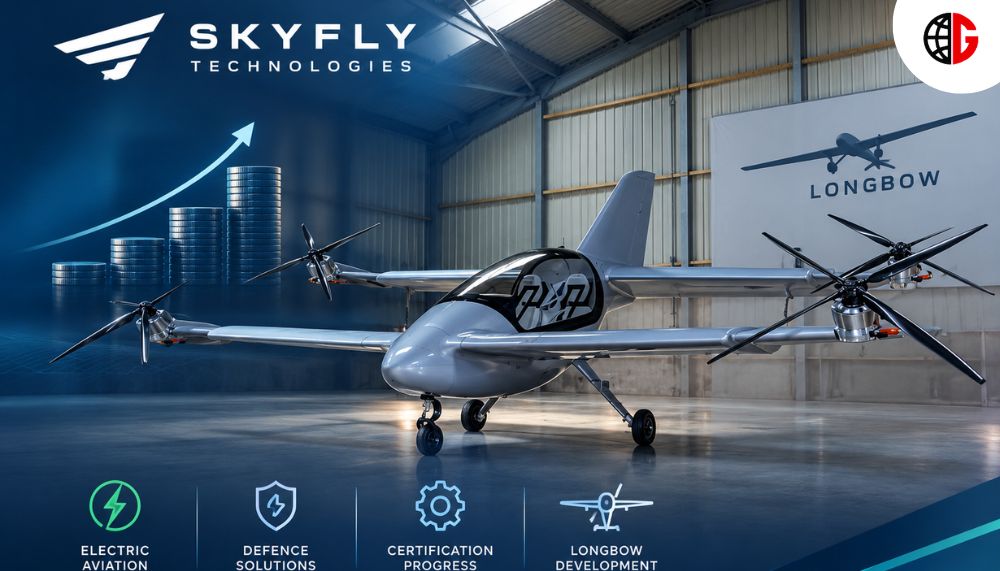
British aerospace startup secures $10 million in seed funding led by HICO Investment Group, with participation from Archangel, to advance electric aviation, expand manufacturing and bring its next-generation aircraft closer to market.
THORPE MANDEVILLE, OXFORDSHIRE, UK — British aerospace technology company Skyfly Technologies has raised €8.91 million ($10 million) in a seed funding round as it accelerates the commercialisation of its two-seat electric vertical take-off and landing (eVTOL) aircraft, Axe, and advances development of its hybrid-electric unmanned aircraft, Longbow, for defence and government applications.
The funding round was led by HICO Investment Group, a specialist growth equity investor, with participation from Archangel, a €50 million early-stage investment fund dedicated to next-generation defence technology. The investment will support aircraft certification, manufacturing expansion and further development of Skyfly’s aviation platforms, positioning the company to address emerging opportunities across civilian aviation and defence logistics.
Founded in 2019 and headquartered in Thorpe Mandeville, Oxfordshire, Skyfly develops manned and unmanned aircraft designed to offer new approaches to transportation, logistics and mission-critical operations. Its strategy centres on combining electric propulsion with practical aircraft engineering to reduce operational complexity while expanding access to vertical-capable aviation.
Funding to Advance Electric Aviation and Commercial Production
The latest investment marks an important milestone for Skyfly as it transitions the Axe from a successfully tested flying prototype towards certification and commercial production. The company also intends to increase its manufacturing capabilities in the UK and the United States while accelerating the development of Longbow.
Commenting on the investment, Chris Hartnoll, Managing Director of HICO Investment Group, praised Skyfly’s engineering achievements and execution capabilities.
“What Skyfly’s team has achieved with so little is remarkable: a new aircraft, designed and built from scratch, flying and now leading the way through a brand-new certification pathway. We’re excited to back a team with a big vision and relentless drive to execute,” Hartnoll said.
The investment reflects growing investor interest in aviation technologies that combine electric propulsion, improved operational efficiency and new aircraft configurations. For Skyfly, the priority is to convert its engineering progress into certified products that can serve real-world commercial and government requirements.
Axe: A Two-Seat Electric Aircraft Designed for Runway-Independent Flight
Skyfly’s flagship aircraft, the Axe, is a two-seat, fully electric aircraft designed to take off and land vertically without requiring a conventional runway. It combines vertical flight capabilities with the efficiency of fixed-wing forward flight, offering an alternative to traditional light aircraft and more mechanically complex eVTOL designs.
The Axe uses eight fixed-angle electric motors to lift off vertically, operating in a manner similar to a helicopter during take-off. Once airborne, it transitions into forward flight, with its wings generating aerodynamic lift. The aircraft can also operate from conventional runways, providing flexibility across different flight environments.
Unlike several eVTOL configurations that rely on tilting motors or rotary wings, the Axe is designed without these mechanisms. Skyfly’s approach aims to reduce mechanical complexity and limit the number of moving components that could become potential points of failure.
Its fixed-wing configuration also provides an additional safety characteristic: in an emergency involving power loss, the aircraft is designed to glide rather than descend vertically without controlled forward flight.
The aircraft offers a stated range of more than 100 miles, a flight duration of approximately 60 to 90 minutes and a cruising speed of around 100 mph. It can carry a payload of up to 200 kilograms, making it suitable for a range of potential applications in private aviation, recreational flying and short-distance transportation.
Skyfly estimates that the Axe could operate at approximately €83.57 (£70) per flight. The company believes this cost structure could make the aircraft competitive with established two-seat aviation options, including the Robinson R22 and Cessna 152, although actual operating costs will depend on factors such as utilisation, maintenance, charging infrastructure and operating conditions.
Longbow Targets Defence Logistics and Unmanned Operations
Alongside its civilian aviation programme, Skyfly is developing Longbow, a hybrid-electric unmanned aircraft intended for defence, government and specialised logistics missions.
Longbow is designed to travel more than 400 miles while carrying a payload of up to 200 kilograms. Its hybrid-electric architecture is intended to support missions requiring substantial range and useful payload capacity without depending on conventional runway infrastructure.
Potential applications include cargo resupply, intelligence gathering, surveillance, medical evacuation and ship-to-shore logistics. These capabilities could be relevant to operations in remote locations, maritime environments and areas where conventional transportation infrastructure is limited or unavailable.
By developing Longbow alongside the Axe, Skyfly is pursuing opportunities in two related but distinct markets: electric aircraft for civilian users and unmanned systems for government and defence customers.
Nicholas Nelson, General Partner at Archangel Ventures, highlighted the operational requirements that Longbow is designed to address.
“Longbow addresses a clear requirement for unmanned systems that can move meaningful payloads over significant distances without relying on a runway. Archangel invests exclusively in defence-first companies, and our backing of Skyfly reflects the potential we see in its technology to deliver mission necessary capability for the modern battlespace,” Nelson said.
Archangel’s participation in the funding round underscores the potential defence applications of Skyfly’s technology, particularly as military and government organisations explore unmanned platforms capable of supporting logistics and surveillance missions with greater operational flexibility.
More Than 100 Piloted Flights Strengthen Axe’s Development Programme
Skyfly says its Axe prototype has completed more than 100 piloted flights, including what the company describes as Europe’s first airfield-to-airfield eVTOL flight. The prototype has also received experimental flight permits in the UK and the US, supporting its ongoing flight-testing and development programme.
The company reports that 61 private customers worldwide have already placed orders for the Axe. These orders provide an early indication of customer interest, although delivery timelines and commercial availability remain dependent on the completion of the necessary certification and production milestones.
The aircraft’s development is led by Chief Technology Officer Dr. William Brooks, who brings more than three decades of experience in light aircraft development. Skyfly states that Brooks has certified more than 2,000 aircraft currently in service, bringing extensive engineering and certification experience to the programme.
This combination of flight-testing progress, aviation engineering expertise and early customer demand forms the foundation of Skyfly’s plans to move towards commercial deployment.
FAA MOSAIC Reforms Create a Potential Route to Market
Skyfly’s fundraising comes as regulatory changes in the United States create new opportunities for emerging aircraft configurations. The Federal Aviation Administration’s Modernization of Special Airworthiness Certification (MOSAIC) reforms are scheduled to take effect in July 2026, updating the framework governing Light Sport Aircraft.
The reforms are intended to broaden the range of aircraft designs and technologies that can qualify under the Light Sport Aircraft framework, including electric propulsion and certain multi-motor and vertical-capable configurations, subject to applicable requirements.
Skyfly says the Axe was designed with this regulatory pathway in mind. The company classifies the aircraft as a Light Sport-class electric Vertically Capable Aircraft (eVCA) and is pursuing FAA Light Sport Aircraft certification under the revised framework.
Successful certification would represent a significant step towards bringing the aircraft to customers in the US market. However, the final route to commercial operation will depend on the applicable certification requirements and operating permissions.
Michael Thompson, Founder and CEO of Skyfly Technologies, said the investment would help the company advance from prototype development to certified aircraft production.
“This investment gives us the resources to take the Axe from a flying prototype to a certified aircraft in customers’ hands. The FAA’s MOSAIC rules have opened a route to market that simply did not exist for electric aircraft before, and the Axe was designed for exactly this category. HICO and Archangel understood that timing, and their backing lets us move at the pace the opportunity demands: completing certification and standing up series production,” Thompson said.
Manufacturing Expansion and the Road Ahead
Skyfly plans to use the new capital across three primary areas: completing FAA Light Sport Aircraft certification for the Axe under the MOSAIC framework, expanding manufacturing capacity on both sides of the Atlantic, and accelerating Longbow’s development.
Both aircraft are expected to be manufactured at the company’s 10,000-square-foot facility in Thorpe Mandeville, Oxfordshire. Scaling production will be an important step in meeting anticipated customer demand and preparing the business for broader commercial deployment.
The parallel development of civilian and defence-focused aircraft also gives Skyfly an opportunity to diversify its market presence. While the Axe is intended to bring electric vertical-capable flight to private and other civilian users, Longbow targets organisations seeking unmanned aircraft with greater payload capacity and extended operational range.
The latest funding provides Skyfly with additional resources to address the engineering, regulatory and manufacturing challenges associated with bringing new aircraft to market. Its next phase will focus on translating prototype performance into certification progress, establishing repeatable production processes and advancing an unmanned platform for specialised operational requirements.
As electric propulsion and autonomous aviation technologies continue to evolve, Skyfly is positioning itself to participate in the changing landscape of aerospace. The success of its strategy will ultimately depend on certification outcomes, production execution, customer adoption and its ability to demonstrate the operational and economic advantages of both aircraft.
With €8.91 million in fresh capital and backing from investors focused on growth and defence technology, the British aerospace company is preparing for its next stage of development, with the Axe moving towards commercialisation and Longbow expanding its ambitions in the unmanned aviation market.
Read more: Fuse Energy Enters AI Infrastructure Market with NVIDIA GPU-Powered Fuse Compute Launch