
As NVIDIA faces a defining leadership transition, AMD and Google are strengthening their positions in the global AI chip race. The next chapter of artificial intelligence may be shaped not by one dominant chipmaker, but by a new generation of competitors fighting for control of the world’s computing infrastructure.
The artificial intelligence revolution has created an extraordinary demand for computing power, and for years, one company has stood at the centre of that transformation: NVIDIA. Under the leadership of co-founder Jensen Huang, the semiconductor giant became the backbone of the modern AI industry, supplying the powerful graphics processing units (GPUs) that support everything from generative AI models to large-scale data centres. However, the company is now entering an unfamiliar chapter.
On November 12, 2026, NVIDIA announced that Huang had resigned as president and CEO, bringing an unexpected end to his 33-year leadership of the company. Chief Financial Officer Colette Kress has taken over as interim CEO while the board searches for a permanent successor. The announcement has added a new layer of uncertainty to an industry that has long tied NVIDIA’s success to Huang’s leadership, industry relationships, and ambitious vision.
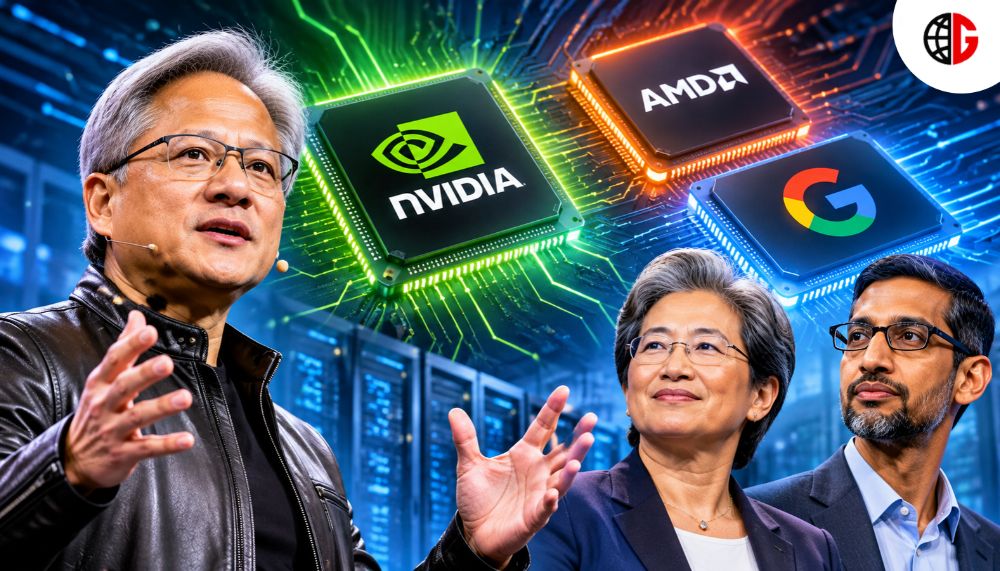
For competitors, the development arrives at a particularly significant moment. Advanced Micro Devices (AMD), led by Lisa Su, is gaining momentum through major AI infrastructure agreements, while Google is expanding its Tensor Processing Unit (TPU) business beyond its own data centres. Meanwhile, OpenAI, Amazon, Meta, and other technology companies are investing in alternatives to traditional NVIDIA-powered infrastructure.
The question is no longer whether NVIDIA has competitors. It is how quickly those competitors can turn growing demand into lasting market influence.
NVIDIA’s Leadership Transition Changes the Competitive Landscape
Jensen Huang’s departure is significant because his influence extended well beyond product development and corporate management. Over more than three decades, he helped establish relationships with semiconductor manufacturers, cloud providers, technology companies, and governments. Those relationships became an important part of NVIDIA’s ability to coordinate complex supply chains and secure its position in the global AI ecosystem.
NVIDIA’s next leader will therefore inherit more than a successful semiconductor business. The responsibility will include maintaining relationships with hyperscalers, managing enormous customer commitments, protecting the company’s technological advantage, and navigating increasingly complicated international trade regulations.
Colette Kress brings extensive financial and operational experience, having served as NVIDIA’s CFO since 2013. Her appointment offers continuity during the transition, and the company has indicated that its existing leadership team, customer commitments, and product roadmap will continue without interruption. Nevertheless, replacing a founder whose identity has become closely connected with the company’s culture and strategic direction will be a considerable challenge.
Importantly, NVIDIA’s latest financial performance demonstrates that its underlying business remains exceptionally strong. For the third quarter of fiscal 2027, reported on November 17, the company generated $115.8 billion in revenue, representing 103% year-over-year growth. Data centre revenue reached $107.6 billion, increasing 110% from the previous year.
These figures suggest that the leadership transition has not immediately weakened demand for NVIDIA’s technology. However, market leadership is not determined by financial performance alone. It also depends on customer confidence, product innovation, supply-chain influence, and the ability to anticipate where the industry is heading.
That is where competitors may find their opening.
Lisa Su Is Turning AMD into a Serious AI Contender
While NVIDIA navigates its leadership transition, AMD CEO Lisa Su is building a compelling alternative in the AI semiconductor market.
Su’s leadership has been central to AMD’s transformation from a company competing to regain its position in the processor industry into one of the most important challengers in advanced computing. Her strategy has focused on combining high-performance processors, AI accelerators, software development, and large-scale infrastructure partnerships.
Her achievements received further recognition when Yahoo Finance named her its 2026 CEO of the Year. The recognition followed a year of significant commercial progress and growing investor confidence in AMD’s AI ambitions.
The company’s financial performance provides further evidence of its growing position. AMD reported record third-quarter 2026 revenue of $13.4 billion, up 45% year over year. Its data centre segment generated $8.5 billion, recording an impressive 97% annual increase as demand for EPYC server processors and Instinct AI accelerators strengthened.
However, AMD’s biggest achievement may be the relationships it is building with some of the world’s most influential AI companies.
In October 2025, AMD announced a multi-year agreement with OpenAI to deploy up to six gigawatts of AMD Instinct GPUs. The initial deployment, involving one gigawatt of MI450-series accelerators, is scheduled to begin in the second half of 2026.
The partnership with Meta further strengthens AMD’s position. Announced in February 2026, the agreement covers the deployment of up to six gigawatts of AMD Instinct GPUs across multiple generations. The companies are also working together on processors, software, and rack-scale infrastructure designed to meet Meta’s large-scale computing requirements.
These agreements represent more than individual commercial victories. They indicate that leading AI companies are increasingly willing to build long-term infrastructure strategies around competing chip architectures rather than relying exclusively on NVIDIA.
Beyond GPUs: AMD’s Ambition to Shape the Future of AI
AMD is also looking beyond conventional AI acceleration.
On November 16, 2026, the company announced the completion of its approximately $8.2 billion acquisition of World Labs, the spatial intelligence startup founded by AI researcher Fei-Fei Li. As part of the acquisition, Li joined AMD as executive vice president and chief scientist.
The strategic significance of this move extends beyond acquiring another AI research company. World Labs develops models capable of generating and simulating interactive three-dimensional environments, with potential applications in robotics, physical AI, and simulation.
By bringing this research expertise together with its semiconductor engineering capabilities, AMD is positioning itself to understand and support emerging AI workloads before they become mainstream infrastructure requirements.
For Lisa Su, the opportunity is to create a more comprehensive technology ecosystem in which hardware, software, and advanced AI research evolve together. This could help AMD compete not only on chip performance but also on the wider capabilities that customers increasingly expect from an AI infrastructure provider.
Google Is Taking Its AI Chip Ambitions Beyond Its Own Cloud
AMD is not the only company benefiting from the changing competitive environment. Google has been developing its own AI chips for more than a decade, and its Tensor Processing Units are becoming an increasingly important part of its commercial strategy.
Initially developed to support Google’s internal computing requirements, TPUs have powered demanding workloads, including the training and operation of its Gemini AI models. The company is now expanding their availability to external customers, creating another alternative for organisations seeking computing capacity beyond NVIDIA GPUs.
Google Cloud has reported nearly 100 significant TPU customers, including AI research organisations, financial firms, retailers, and universities. More importantly, the company is extending its business model beyond cloud-based access by allowing customers to deploy TPU systems directly in their own data centres.
This shift is particularly important for businesses that want greater control over their infrastructure, data environments, and computing costs.
Google is also expanding its partnerships. Its announced collaboration with Oracle is expected to bring TPUs to Oracle Cloud Infrastructure, giving customers another route to access Google’s specialised processors outside its own cloud platform.
The company has also introduced two new eighth-generation systems: TPU 8tx and TPU 8i Max. These processors are designed for different AI requirements, including large-scale model training and real-time reasoning. Their development reflects a broader shift towards specialised infrastructure capable of supporting increasingly sophisticated AI applications, particularly autonomous AI agents.
For Google, the commercial opportunity is substantial. It can combine its chip designs, cloud infrastructure, AI models, and software expertise into an integrated offering. That creates a different kind of competition for NVIDIA: rather than simply selling processors, Google can offer an entire environment in which AI applications are developed, trained, and deployed.
The AI Chip Race Is Becoming a Multi-Company Battle
The competition is no longer restricted to NVIDIA and AMD. Major technology companies are increasingly investing in custom silicon to reduce infrastructure costs, improve performance, and gain greater control over their computing requirements.
Amazon, for example, has developed its Trainium accelerators for AI training and inference workloads. Google has its TPU family, while other hyperscalers are exploring specialised processors designed around their own services and applications.
This growing interest in custom silicon reflects an important industry development: different AI workloads do not necessarily require the same computing architecture.
Training large foundation models, operating inference systems, running autonomous agents, and processing real-time applications can place very different demands on hardware. As AI adoption expands, companies are increasingly looking for processors optimised for specific tasks rather than depending on a single general-purpose solution.
For customers, diversification also brings commercial advantages. Having multiple suppliers creates more negotiating power, reduces exposure to supply shortages, and offers greater flexibility when planning long-term data centre investments.
However, challenging NVIDIA is not simply a matter of producing a powerful alternative chip.
One of NVIDIA’s greatest competitive advantages remains CUDA, its established software platform that has become deeply embedded in AI development. Developers, researchers, and enterprises have spent years building applications and workflows around the ecosystem.
AMD’s ROCm platform is improving, while Google continues to expand support for popular machine-learning frameworks. Nevertheless, switching hardware can require considerable investment in software adaptation, engineering resources, testing, and infrastructure migration.
Consequently, NVIDIA’s competitors must demonstrate not only comparable hardware performance but also reliability, accessibility, developer support, and long-term value.
What Comes Next for NVIDIA?
NVIDIA’s immediate challenge is to demonstrate that its competitive strength can survive a change in leadership.
The company’s technology roadmap, engineering capabilities, customer relationships, and substantial market presence provide a strong foundation. Its latest quarterly results also underline that demand for AI infrastructure remains robust.
However, the leadership transition could encourage major customers to reconsider how much of their computing infrastructure should depend on one supplier. Companies that previously prioritised NVIDIA may become more interested in AMD accelerators, Google TPUs, and internally developed chips.
For NVIDIA’s incoming permanent CEO, the task will be to preserve the company’s innovation culture while strengthening investor confidence and maintaining relationships across an increasingly competitive ecosystem.
The company must also continue advancing its hardware and software together. Its competitive advantage has never rested on GPUs alone; it has been built through the combination of processors, networking, software, systems, and developer relationships.
Meanwhile, the broader AI industry is unlikely to slow its infrastructure investments simply because one company’s leadership has changed. Demand for computing power continues to expand as businesses deploy larger AI models, autonomous systems, and increasingly sophisticated applications.
A New Era of Competition in AI Computing
Jensen Huang’s departure marks a major turning point for NVIDIA, but it does not automatically signal the end of its dominance. The company retains significant technological, financial, and ecosystem advantages.
What has changed is the competitive environment surrounding it.
Lisa Su is building AMD into a stronger full-stack AI infrastructure competitor, supported by major partnerships and strategic investments in emerging AI research. Google is transforming its internally developed TPUs into a broader commercial business, giving customers another serious option for large-scale computing.
At the same time, hyperscalers are developing their own chips, and AI companies are becoming increasingly strategic about how they source computing power.
The next phase of the semiconductor industry will therefore be defined by more than processing speed or chip specifications. It will be shaped by software ecosystems, energy efficiency, infrastructure economics, developer adoption, strategic partnerships, and the ability to deliver computing power at unprecedented scale.
For years, NVIDIA’s leadership helped define the direction of the AI hardware revolution. Now, with its founder stepping aside, the industry has an opportunity to discover how competitive the market can become.
The real winner of this transition may not be the company that replaces NVIDIA, but the one that helps make AI computing more accessible, efficient, and competitive for the entire world.