
The Global Talent Revolution: Why EOR Is the Defining Workforce Strategy of 2026
The way companies hire talent has undergone a seismic transformation. In 2026, a software engineer based in Nairobi collaborates daily with a product manager in Berlin and a sales lead in São Paulo — all employed through a single platform, without a single foreign legal entity in sight. This is not a vision of the future. This is the operational reality that Employer of Record (EOR) companies have made possible.
The global EOR market has expanded dramatically, driven by the convergence of remote work normalization, increasing cross-border labor demand, and the mounting complexity of international employment law. According to recent industry analyses, the EOR market is projected to surpass $6 billion in value by the end of the decade, with enterprises of all sizes turning to EOR providers as a strategic — not just operational — pillar of global growth.
For business leaders, founders, and HR executives, the question is no longer ‘Should we use an EOR?’ but rather ‘Which EOR is right for us, and how do we evaluate the options?’ This article presents an in-depth look at the top 10 Employer of Record companies of 2026, what they offer, how they differ, and what decision-makers must know before choosing a provider.
What Is an Employer of Record — And Why Does It Matter?
An Employer of Record is a third-party organization that legally employs workers on behalf of another company. While the client business directs the day-to-day work of the employee, the EOR assumes full legal responsibility for employment — managing payroll, tax compliance, benefits administration, employment contracts, and adherence to local labor laws in the worker’s country of residence.
This model solves one of the most persistent challenges of international business expansion: how do you hire the best talent anywhere in the world without spending 12–18 months and hundreds of thousands of dollars setting up a legal entity in each country? The answer, increasingly, is to partner with an EOR.
‘EOR platforms are no longer back-office tools — they are strategic infrastructure for companies that want to compete for global talent on day one.’
Beyond speed and cost, EOR providers protect companies from the growing risks of misclassification, non-compliance, and regulatory exposure — issues that have resulted in significant financial penalties and reputational damage for companies that expand internationally without proper legal frameworks.
How to Evaluate an EOR Provider: Key Criteria for 2026
Before exploring the top 10 providers, it is important to understand the criteria by which they should be assessed. The EOR landscape has matured significantly, and not all platforms are equal in capability, coverage, or customer experience.
Country coverage and depth of compliance infrastructure are foundational. A provider may claim operations in 160+ countries, but the quality of in-country legal expertise varies widely. Decision-makers should probe whether providers use owned infrastructure or rely on third-party sub-contractors in key markets.
Technology and automation capabilities are increasingly differentiating. The best EOR platforms in 2026 leverage AI-driven contract generation, automated regulatory monitoring, and self-service employee portals — reducing administrative overhead while improving accuracy and speed. Onboarding timelines, once measured in weeks, are now down to 1–2 business days on leading platforms.
Customer support quality matters enormously at scale. Global employment is not a set-and-forget function. Companies need responsive, expert support when employment disputes arise, local labor laws change, or employees have urgent payroll questions. The best providers offer dedicated account managers, in-country specialists, and 24/7 availability.
Pricing transparency and total cost of ownership are often overlooked. EOR fees vary significantly, from per-employee monthly fees to percentage-based payroll models. Decision-makers should evaluate all-in costs, including benefits markups, currency conversion fees, and any surcharges for specialty markets.
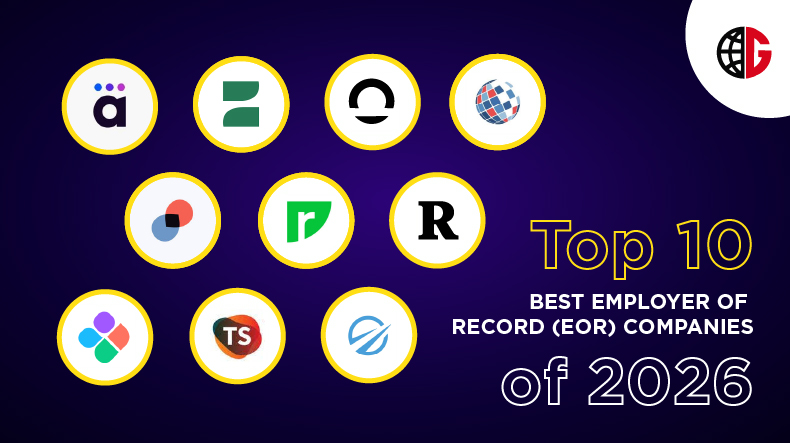
Top 10 Best Employer of Record (EOR) Companies of 2026
The following companies represent the leading EOR platforms of 2026, evaluated on the basis of global coverage, technology innovation, compliance depth, customer ratings, and overall service quality. Companies are listed in alphabetical order.
By Atlas Technology Solutions
Atlas HXM brings a deep technology-first orientation to global workforce management. Built to serve multinational organizations, Atlas offers comprehensive tools for managing payroll, compliance, benefits, and talent operations across dozens of countries from a single centralized platform. Its particular strength lies in supporting companies managing complex employee lifecycle events — from onboarding to benefits transitions to offboarding — with accuracy and auditability.
For large enterprises managing distributed teams across multiple regions simultaneously, Atlas HXM’s centralized control and robust documentation capabilities make it a compelling choice. Its focus on operational scalability appeals to businesses that anticipate rapid international headcount growth.
Best For: Companies expanding internationally that want fast, compliant hiring without setting up local entities.
Borderless AI is among the most technologically sophisticated EOR platforms of 2026. Covering more than 170 countries, it has built its competitive advantage around an AI-powered compliance infrastructure that automates contract generation, monitors regulatory changes in real time, and streamlines payroll workflows across 90+ currencies. For companies that prioritize speed and automation, few platforms come close.
What distinguishes Borderless AI is its ability to reduce onboarding timelines to as little as 1–2 business days — a critical advantage in competitive talent markets where candidates often have multiple offers in play simultaneously. The platform’s self-service employee portal further enhances the experience for distributed teams managing pay, expenses, and documentation independently.
Its 24/7 North America-based support model ensures that time-zone barriers do not compromise service quality for global clients.
- Horizons EOR
By New Horizons Global Partners
Horizons EOR delivers a practical and well-rounded platform for international employment management. Its core strengths include payroll processing, local tax compliance, and benefits administration, all underpinned by centralized documentation and reporting capabilities. For businesses entering new international markets, Horizons provides a reliable framework for compliant hiring without the burden of entity establishment.
The platform’s appeal is particularly strong for mid-market companies that need reliable, straightforward global employment support without extensive configuration overhead.
By INS Global
INS Global has built a strong reputation in the EOR space with a focus on meticulous compliance management in complex international markets. The platform manages employment contracts, payroll processing, and tax obligations according to local regulatory requirements, with particular attention to the administrative nuances of cross-border hiring in emerging markets.
For companies expanding into less commonly served geographies — where compliance risk is higher and local expertise is scarcer — INS Global’s depth of regional knowledge provides a meaningful risk management advantage.
By Omni HR
Omni HR positions itself as a full-service international expansion partner, serving as the legal employer for global candidates while managing the full employment lifecycle — onboarding, payroll, compliance, and benefits. Its platform is designed to reduce the time, complexity, and cost of establishing foreign entities, making international hiring accessible for companies at various stages of growth.
Customer feedback highlights Omni HR’s strong customer service orientation and continuous product enhancements. While some users have noted areas for improvement in user-friendliness, the platform’s responsiveness to feedback and its ease of navigation have been consistently recognized as key strengths.
- Remofirst
Remofirst has positioned itself as a purpose-built solution for the remote-first era. The platform centralizes the management of international remote employees and contractors, covering onboarding, payroll, benefits, and compliance across multiple jurisdictions. Its workforce analytics capabilities are a notable differentiator — providing businesses with visibility into the cost and performance of their globally distributed teams.
For technology companies and startups that have embraced remote work as a core organizational model, Remofirst’s feature set aligns naturally with the operational realities of managing talent across many countries simultaneously.
By Rivermate
Rivermate distinguishes itself through a human-centered service model in a market that often over-indexes on automation. While the platform delivers all the technology capabilities expected of a leading EOR — centralized payroll, local currency payments, tax compliance, and benefits management across 160+ countries — its defining characteristic is the quality of human support that accompanies the technology.
Every Rivermate client is assigned a dedicated account manager who provides proactive compliance, HR, and payroll support. Local in-country experts ensure that each hire meets country-specific requirements, while 24/7 support guarantees personalized resolutions — no automated bots, no impersonal ticket queues. For companies that value expert human guidance as much as software automation, Rivermate represents a compelling option.
By Payoneer
Skuad, operating under Payoneer’s umbrella, offers an end-to-end global employment platform with coverage across more than 160 countries. The platform’s strength lies in its comprehensive approach to the employment lifecycle — from initial onboarding through ongoing payroll processing, compliance monitoring, and benefits administration — delivered through an interface designed for teams that prioritize operational efficiency.
Backed by Payoneer’s global payments infrastructure, Skuad brings particular depth in cross-border financial operations. For companies that need reliable multi-currency payroll execution alongside robust compliance management, this combination of financial and HR capabilities creates a distinctive value proposition.
By TopSource
TopSource Employer of Record delivers a well-structured platform for organizations managing international employment at scale. Its capabilities span payroll processing, local compliance adherence, contract administration, and statutory reporting — the full operational backbone of international employment management. The software is designed to reduce administrative burden while maintaining regulatory compliance across country-specific requirements.
For organizations with established international operations seeking to consolidate their global employment management into a single, reliable platform, TopSource offers a mature and capable solution backed by strong user ratings.
By Velocity Global
Velocity Global has established itself as one of the most recognized names in international workforce management. The platform is designed to support organizations hiring, managing, and compensating remote and international employees with a strong emphasis on compliance automation and risk mitigation. Its automated payroll processing, benefits administration, and documentation management tools streamline the operational complexity of global employment.
Velocity Global’s breadth of market presence and established brand recognition make it a natural consideration for enterprise organizations evaluating EOR partnerships at scale.
How EOR Is Reshaping Global Business Strategy
The rise of EOR is not merely a trend in HR technology — it represents a structural shift in how companies think about market entry, talent acquisition, and workforce architecture. In previous decades, international hiring required legal entity establishment, multi-year compliance buildouts, and significant capital commitment before a single employee could be hired. EOR has compressed that timeline from years to days.
This acceleration has democratized global expansion. Startups with 20 employees can now build truly international teams with the same ease as multinationals. Companies can test new markets by hiring local talent without the irreversible commitment of entity establishment. And organizations can access specialized talent in geographies where it is most abundant — not just where they happen to have offices.
Industries that have been most transformed by EOR adoption include technology (where talent is globally distributed and highly mobile), professional services (where expertise is often geography-specific), and manufacturing and logistics (where local operational talent is critical for market success). The healthcare and life sciences sectors are increasingly exploring EOR models for clinical research teams and specialized medical talent.
‘The companies winning the global talent war in 2026 are not those with the most offices — they are those with the most agile workforce infrastructure.’
Risks, Limitations, and What to Watch
Despite its many advantages, the EOR model is not without limitations, and business leaders should approach provider selection with clear-eyed awareness of the risks involved.
Compliance concentration risk deserves careful consideration. When an organization entrusts all its international employment compliance to a single EOR provider, any failure in that provider’s compliance infrastructure creates direct exposure for the client company. Rigorous due diligence on a provider’s compliance track record, in-country expertise, and insurance coverage is essential before onboarding.
Cultural and employee experience considerations are also increasingly relevant. Employees hired through EOR arrangements may perceive a disconnect between their day-to-day employer (the client company) and their legal employer (the EOR). Leading platforms are investing in employee experience features — portals, communication tools, and benefits programs — to bridge this gap, but companies should proactively manage this dynamic.
The total cost of EOR can surprise companies that focus only on headline per-employee fees. Benefits markups, currency conversion charges, local statutory contributions, and specialist market premiums can substantially increase the all-in cost per employee. Transparent, itemized pricing is a mark of a trustworthy EOR partner.
Finally, EOR is generally more appropriate for employment relationships than for genuinely independent contractor arrangements. Companies that attempt to use EOR as a tool to reclassify contractors as employees — or vice versa — may find themselves facing the exact compliance risks they sought to avoid.
The Future of EOR: AI, Compliance Automation, and What Comes Next
The EOR industry is entering a phase of rapid technological evolution. Artificial intelligence is moving from a differentiating feature to a table-stakes capability — with leading platforms deploying AI for contract generation, regulatory monitoring, payroll anomaly detection, and predictive compliance alerts. As global labor laws continue to evolve rapidly (particularly in areas such as gig worker classification, remote work taxation, and data privacy), AI-powered compliance infrastructure will become indispensable.
The emergence of direct employer models — where EOR providers develop their own legal entities in key markets rather than relying on third-party partners — is also reshaping competitive dynamics. Direct models typically offer greater compliance control, faster onboarding, and better employee experiences, and companies like Borderless AI and Rivermate are investing heavily in expanding owned infrastructure globally.
Integration depth will be another defining competitive dimension. As EOR platforms mature, their ability to integrate seamlessly with HRIS systems, payroll tools, equity management platforms, and finance systems will determine how effectively they serve complex enterprise environments. The winners in the next phase of EOR competition will not just be employment infrastructure — they will be the connective tissue of the entire global workforce management stack.
Looking further ahead, the concept of the ‘global employment platform’ — a single interface managing employment, contracting, payments, equity, benefits, and compliance for every worker type in every country — is fast becoming a reality. Several of the companies profiled in this article are already moving in that direction.
Conclusion: Choosing the Right EOR Partner for Your Business
The Employer of Record landscape of 2026 offers business leaders an unprecedented range of capable, technology-forward options for building and managing global teams. From AI-driven platforms like Borderless AI to human-centered service models like Rivermate, from Payoneer-backed financial depth at Skuad to the enterprise scale of Velocity Global, each provider in this list brings a distinct combination of capabilities suited to different organizational needs.
The decision of which EOR to partner with is ultimately a strategic one — shaped by the geographies you are targeting, the pace at which you need to hire, the level of compliance sophistication you require, and the type of partner relationship that best supports your organizational culture. What is clear is that companies that invest in building robust global employment infrastructure today will be far better positioned to access the world’s talent and compete in an increasingly borderless economy.
For CXOs, HR leaders, and founders evaluating EOR options: the technology is ready. The compliance frameworks are mature. The question now is simply which partner will help your organization move fastest, most safely, and most effectively toward the global team you are building.
Frequently Asked Questions (FAQ)
Q1: What is an Employer of Record (EOR)?
An Employer of Record is a company that legally employs workers on behalf of another business. The EOR handles all formal employment responsibilities — payroll, taxes, benefits, and labor law compliance — while the client business manages the employee’s day-to-day work and performance.
Q2: How is an EOR different from a PEO (Professional Employer Organization)?
A Professional Employer Organization (PEO) operates through a co-employment model, typically requiring the client to have a legal entity in the country of employment. An EOR, by contrast, is the sole legal employer of record, enabling companies to hire in countries where they have no local legal presence. This makes EOR the preferred model for international expansion.
Q3: What countries do top EOR providers cover?
Most leading EOR providers cover between 160 and 170+ countries. Borderless AI covers 170+ countries, while Rivermate, Skuad, and Omni HR each operate across 160+ countries. Coverage depth — meaning the quality of in-country legal expertise — varies and should be evaluated carefully, especially for less commonly served markets.
Q4: How quickly can an EOR onboard a new international employee?
Onboarding timelines vary significantly by provider and country. Borderless AI is among the fastest, advertising onboarding in as little as 1–2 business days. Other providers typically complete onboarding within 2–5 business days, though complex markets may require longer due to local regulatory requirements.
Q5: What are the typical costs associated with an EOR service?
EOR pricing generally ranges from $299 to $699 per employee per month, depending on the provider, country, and services included. Additional costs may include benefits markups, currency conversion fees, and specialist market premiums. Companies should request all-in, itemized pricing from any EOR provider before committing to a partnership.
Q6: Is using an EOR legally safe?
Yes, when partnering with a reputable EOR provider, the arrangement is legally sound in most jurisdictions. The EOR assumes the legal employer status and all associated compliance obligations. However, companies should conduct thorough due diligence on any EOR provider — including reviewing their compliance track record, insurance coverage, and in-country expertise — before onboarding employees through the platform.
Q7: Which EOR is best for startups versus large enterprises?
Startups and fast-growing companies often benefit most from platforms with fast onboarding, transparent pricing, and self-service capabilities — such as Borderless AI, Skuad, or Remofirst. Larger enterprises with complex compliance requirements and high headcount may prefer platforms with deeper enterprise integration, dedicated account management, and broad country coverage — such as Atlas HXM, Velocity Global, or Rivermate.
Q8: Can an EOR support both employees and contractors?
Many EOR platforms support both employment and contractor management. Skuad, Rivermate, and Remofirst, among others, offer combined EOR and contractor management capabilities. However, companies should ensure that worker classification — employee versus independent contractor — is handled correctly in each jurisdiction, as misclassification remains a significant compliance risk.
Q9: What industries benefit most from using an EOR?
Technology, professional services, healthcare and life sciences, and manufacturing are among the industries most actively adopting EOR models. Any business that needs to hire specialized talent in countries where it does not have a legal entity — and wants to do so compliantly and quickly — stands to benefit from an EOR partnership.
Q10: How do I choose the right EOR for my business?
Evaluate providers on five key dimensions: (1) country coverage and in-country compliance depth; (2) technology capabilities, including automation, onboarding speed, and self-service tools; (3) customer support quality and availability; (4) pricing transparency and total cost of ownership; and (5) track record and client references in your target markets. Requesting a detailed demonstration and client references from any shortlisted provider before making a final decision is strongly recommended.