
The global education technology industry is entering a defining era in 2026. What began as a rapid digital transformation during the pandemic years has now evolved into a more mature, impact-driven ecosystem focused on long-term educational outcomes, workforce readiness, and responsible AI integration.
Today, innovation in education is no longer measured by how many tools a school adopts, but by how effectively those technologies improve learning experiences, empower teachers, and create measurable academic growth. As global education spending is projected to approach US$10 trillion by 2030, EdTech companies are becoming the backbone of modern learning infrastructure across K-12 education, higher education, and enterprise training.
Artificial intelligence continues to reshape the sector at an unprecedented pace. Adaptive learning systems now personalize coursework in real time, provide multilingual instruction, automate assessments, and help educators identify student learning gaps faster than ever before. However, 2026 is also the year when ethical AI has become a central conversation. Schools and institutions are prioritizing privacy, transparency, cybersecurity, and accountability while deploying AI-driven solutions in classrooms.
In the United States and across global markets, education leaders are moving away from fragmented app-based systems and toward integrated learning ecosystems capable of managing compliance, analytics, digital safety, student engagement, and curriculum delivery from a single platform. The future belongs to scalable, secure, and student-centric learning environments that blend technology with human guidance rather than replacing it.
Against this backdrop, several EdTech innovators are emerging as industry leaders by redefining how students learn and how organizations prepare talent for the future economy.
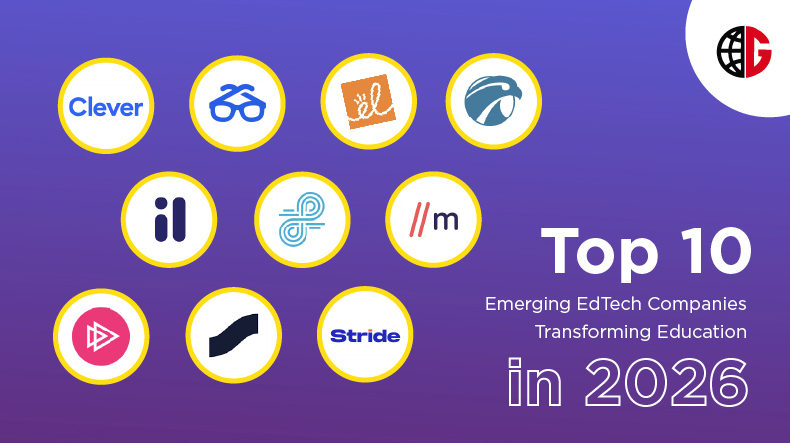
Here are the Top 10 Emerging EdTech Companies Transforming Education in 2026.
1. Clever: Building the Digital Infrastructure of Modern Classroom
Under the leadership of Trish Sparks, Clever continues to play a foundational role in simplifying digital education access for millions of students and educators across the United States.
More than 75% of U.S. K-12 schools now use Clever’s platform to streamline secure access to educational applications, digital curriculum, and classroom resources. In 2026, as schools continue consolidating fragmented technology systems, Clever’s single sign-on and identity management capabilities have become increasingly essential.
The company’s mission goes beyond convenience. Clever is helping educational institutions create more equitable and accessible learning environments by reducing technological barriers for students from diverse socioeconomic backgrounds. With AI-powered learning tools becoming commonplace, the demand for secure and seamless digital ecosystems has accelerated Clever’s relevance in the education sector.
As classrooms evolve into interconnected digital environments, Clever remains a key infrastructure provider enabling safer, smarter, and more personalized learning experiences.
2. Degreed: Revolutionizing Workforce Upskilling Through AI

As the future of work rapidly evolves, organizations are increasingly prioritizing continuous learning and workforce adaptability. That is where David Blake and Degreed continue to make a major impact.
Degreed has established itself as one of the leading AI-powered workforce learning platforms, helping enterprises identify skill gaps, personalize employee learning journeys, and build future-ready talent pipelines. In 2026, companies are no longer viewing learning as an occasional training event but as an ongoing strategic necessity.
The platform integrates formal education, certifications, mentorship, experiential learning, and AI-driven recommendations into one intelligent ecosystem. This allows employees to continuously adapt their skills in line with changing industry demands.
With artificial intelligence reshaping industries worldwide, Degreed is helping businesses create agile workforces capable of thriving in a technology-first economy.
3. ExploreLearning: Transforming STEM Learning Through Interactive Experiences

David Shuster has built ExploreLearning into a recognized leader in K-12 STEM education innovation.
In 2026, the global emphasis on science, technology, engineering, and mathematics education continues to intensify as governments and industries seek to prepare students for high-demand technical careers. ExploreLearning addresses this challenge by creating immersive and engaging learning experiences that make STEM subjects more accessible and enjoyable.
Its interactive simulations, virtual labs, and inquiry-based learning models encourage students to actively participate rather than passively consume information. By combining educational rigor with gamified learning experiences, ExploreLearning helps improve classroom engagement and conceptual understanding.
As schools increasingly adopt experiential learning approaches, ExploreLearning is helping redefine how STEM education is delivered in digital classrooms worldwide.
4. HAWKES LEARNING: Advancing Personalized Learning With Mastery-Based Education
Based in Charleston, HAWKES LEARNING continues to bridge traditional educational pedagogy with advanced AI-driven tutoring technologies.
Led by Scott Virkler, the company focuses on mastery-based learning — an approach that ensures students fully understand concepts before progressing further. In an age where personalized education is becoming increasingly important, this model is gaining widespread recognition for improving retention and academic performance.
The platform uses intelligent tutoring systems to identify student errors instantly and provide corrective feedback in real time. This reduces learning gaps while helping educators support students more effectively.
With more than four decades of educational expertise combined with modern AI capabilities, HAWKES LEARNING is emerging as a powerful force in personalized higher education and developmental learning environments.
5. Imagine Learning: Creating Inclusive and Adaptive Learning Experiences
Under the leadership of Jonathan Grayer, Imagine Learning continues to help educators deliver highly personalized educational experiences for diverse student populations.
The company offers digital curriculum solutions spanning literacy, mathematics, language development, and adaptive learning support. In 2026, schools are increasingly focusing on individualized instruction models, and Imagine Learning’s technology is helping teachers meet students at their unique academic levels.
Its multilingual learning tools and flexible instructional systems also support educational equity in multicultural classrooms. By leveraging real-time analytics and adaptive technologies, the platform empowers educators to make more informed instructional decisions.
As educational institutions prioritize student-centric teaching models, Imagine Learning is helping reshape the future of inclusive digital education.
6. Lightspeed Systems: Protecting Digital Learning Environments Worldwide

As AI adoption grows across schools and universities, cybersecurity and digital safety have become mission-critical priorities for educators. Brian Thomas is leading Lightspeed Systems at the intersection of education technology and online safety.
Since 1999, the company has provided AI-powered visibility and security solutions designed to protect students, secure school networks, and help institutions manage compliance requirements. Today, Lightspeed Systems supports more than 23 million students across 31,000 schools in 42 countries.
Its solutions help educational institutions monitor online activity, optimize technology budgets, and maintain secure learning environments while respecting privacy standards and regulatory frameworks.
In 2026, as concerns around student data privacy and responsible AI governance intensify, Lightspeed Systems is becoming increasingly vital to the global EdTech ecosystem.
7. Mindstone Learning: Helping Businesses Build AI-Ready Teams

The rapid rise of generative AI has created a major demand for practical AI skills across industries. Joshua Wohle is helping organizations close that gap through accessible, real-world AI education.
Mindstone Learning focuses on teaching non-technical professionals how to integrate AI into their daily workflows and operational processes. Rather than relying on purely theoretical instruction, the platform emphasizes hands-on experimentation and practical application.
Trusted by more than 70,000 learners globally, Mindstone combines training programs with an active learning community that encourages collaboration and continuous upskilling.
As AI becomes integrated into nearly every business function in 2026, Mindstone Learning is positioning itself as a critical partner for enterprise AI transformation.
8. Pluralsight: Preparing Tech Talent for the AI Economy

Under the leadership of Erin Gajdalo, Pluralsight continues to empower individuals and organizations with critical technology skills needed for the digital economy.
The platform offers on-demand learning across software development, artificial intelligence, cloud computing, cybersecurity, data science, and IT operations. Its interactive labs, skill assessments, and learning pathways help professionals remain competitive in fast-changing technology industries.
In 2026, businesses are increasingly prioritizing AI literacy and cybersecurity readiness, making technical learning platforms more important than ever. Pluralsight’s enterprise-focused learning solutions help organizations identify capability gaps while building stronger digital teams.
As digital transformation accelerates worldwide, Pluralsight remains one of the leading platforms driving modern workforce education.
9. Skillsoft: Powering Continuous Learning for Global Enterprises
Ron Hovsepian continues to position Skillsoft as a global leader in enterprise learning and professional development solutions.
The company delivers personalized and interactive learning experiences focused on leadership development, compliance, technical skills, and workforce transformation. In 2026, organizations are increasingly embracing skills-based talent strategies, and Skillsoft’s adaptive learning infrastructure aligns perfectly with this shift.
Its AI-enhanced learning systems provide personalized recommendations while enabling organizations to measure learning effectiveness more accurately. By combining analytics with scalable enterprise learning solutions, Skillsoft helps companies foster long-term employee growth and innovation.
In a world where continuous learning is becoming a competitive necessity, Skillsoft remains a key player in helping businesses future-proof their workforces.
10. Stride, Inc.: Reinventing Flexible Education for Modern Learners

Led by James Rhyu, Stride is redefining flexible education by creating learning pathways tailored to individual goals, lifestyles, and career ambitions.
The company offers online K-12 education, career-focused training programs, and workforce readiness initiatives that support learners beyond traditional classroom settings. In 2026, flexible and hybrid learning models continue to gain momentum as students seek more personalized educational experiences.
Stride’s approach focuses on aligning education with real-world career outcomes, helping students develop industry-relevant skills while maintaining flexible learning schedules.
As demand for non-traditional education pathways continues to grow, Stride is emerging as a major force in the future of online and career-connected learning.
The Future of Education Technology in 2026
The EdTech sector in 2026 is no longer driven solely by experimentation. It is being shaped by measurable impact, responsible innovation, and long-term scalability.
Artificial intelligence, adaptive learning, cybersecurity, workforce transformation, and personalized education are redefining how knowledge is delivered across classrooms and organizations worldwide. At the same time, institutions are demanding solutions that combine innovation with transparency, trust, and measurable educational value.
The companies featured in this list are not simply creating digital learning tools — they are building the future infrastructure of global education. By connecting learners, educators, institutions, and enterprises through intelligent ecosystems, these emerging EdTech leaders are helping shape a more inclusive, adaptive, and technology-driven future for education in 2026 and beyond.
Read more: UAE’s Top 10 Indian Billionaires to Watch in 2026