

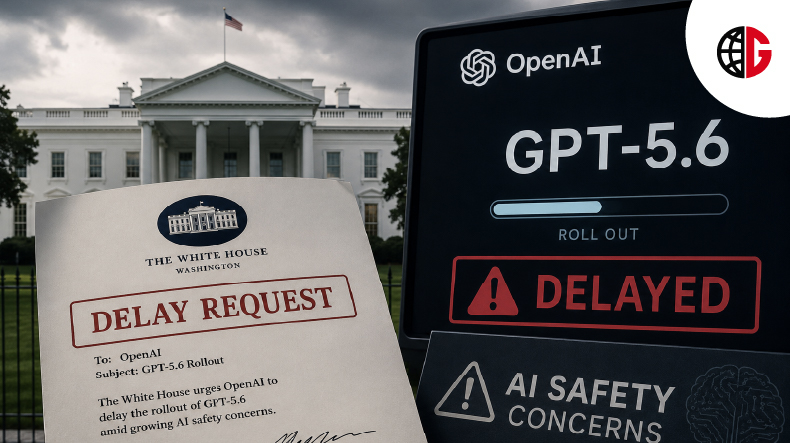
White House Reportedly Pushes for Controlled Launch of OpenAI’s GPT-5.6 as AI Safety Debate Intensifies
The race to build ever more powerful artificial intelligence systems has reached a new turning point. According to recent reports, OpenAI is preparing to launch its next-generation model, GPT-5.6, under an unusually restricted release strategy after concerns raised by the U.S. government regarding advanced AI capabilities and potential cybersecurity risks.
Unlike previous OpenAI launches that quickly became available to millions of users worldwide, GPT-5.6 is expected to begin with a tightly controlled preview program involving only a select group of trusted partners. The move signals a significant shift in how frontier AI systems may be introduced in the future, especially as governments become increasingly involved in overseeing powerful AI technologies.
A New Era of Government Oversight for Advanced AI
Reports suggest that OpenAI CEO Sam Altman informed employees that access to GPT-5.6 during its preview phase could be approved on a customer-by-customer basis, with government agencies closely monitoring the rollout. If the initial deployment proves successful and no major concerns emerge, OpenAI may move toward a broader public release within weeks.
The reported involvement of the White House reflects a growing belief among policymakers that cutting-edge AI systems require additional scrutiny before reaching the public. Agencies, including the Office of the National Cyber Director and the Office of Science and Technology Policy are said to have worked closely with OpenAI during preparations for the model’s launch.
This development represents a notable evolution in Washington’s approach to artificial intelligence. While the Trump administration initially emphasized a lighter regulatory framework for AI innovation, recent actions suggest a stronger focus on evaluating the risks associated with increasingly capable models.
Why GPT-5.6 Is Drawing Attention
The central concern revolves around the capabilities of frontier AI systems and their potential use in cybersecurity-related activities.
Modern large language models have already demonstrated the ability to generate software code, analyze vulnerabilities, automate technical tasks, and assist in cybersecurity research. While these capabilities offer significant benefits for businesses and security professionals, experts warn that the same tools could potentially be misused by malicious actors.
Advanced AI models can accelerate the discovery of software weaknesses, automate portions of cyberattacks, and streamline the creation of malicious code. As AI systems become faster and more capable, policymakers are increasingly concerned about balancing innovation with national security.
The reported caution surrounding GPT-5.6 suggests that authorities view frontier AI models not merely as productivity tools but as technologies with strategic implications for cybersecurity, critical infrastructure, and digital defense.
Following a Path Similar to Anthropic
OpenAI’s reported strategy bears similarities to a model adopted earlier by Anthropic. The AI company generated significant discussion when it limited access to its advanced cyber-focused model, Claude Mythos, making it available only to a restricted group of partners through a specialized program.
Anthropic argued that highly capable cyber models could potentially identify and exploit software vulnerabilities at a scale and speed beyond human analysts, creating risks if broadly distributed. While some industry observers viewed the decision as a responsible safety measure, others questioned whether it also served as a competitive positioning strategy.
Now, OpenAI appears to be facing a similar dilemma: how to release increasingly powerful AI systems while minimizing the risk of misuse.
The Future of Frontier AI Releases
The reported GPT-5.6 launch strategy could mark the beginning of a broader industry trend. Rather than immediately releasing their most advanced models to the public, AI developers may increasingly adopt phased deployment approaches that include government evaluations, limited partner testing, and gradual expansion.
For businesses, governments, and technology leaders, this shift highlights a new reality: the most powerful AI systems are no longer viewed solely as commercial products but as technologies with far-reaching economic, security, and geopolitical implications.
As AI capabilities continue advancing at unprecedented speed, the debate over innovation versus safety is likely to intensify. The rollout of GPT-5.6 may ultimately become a defining case study for how governments and AI companies collaborate to manage the risks and opportunities of next-generation artificial intelligence.
Read more: OpenAI and Broadcom Introduce “Jalapeño” AI Chip to Power the Future of Large Language Models