
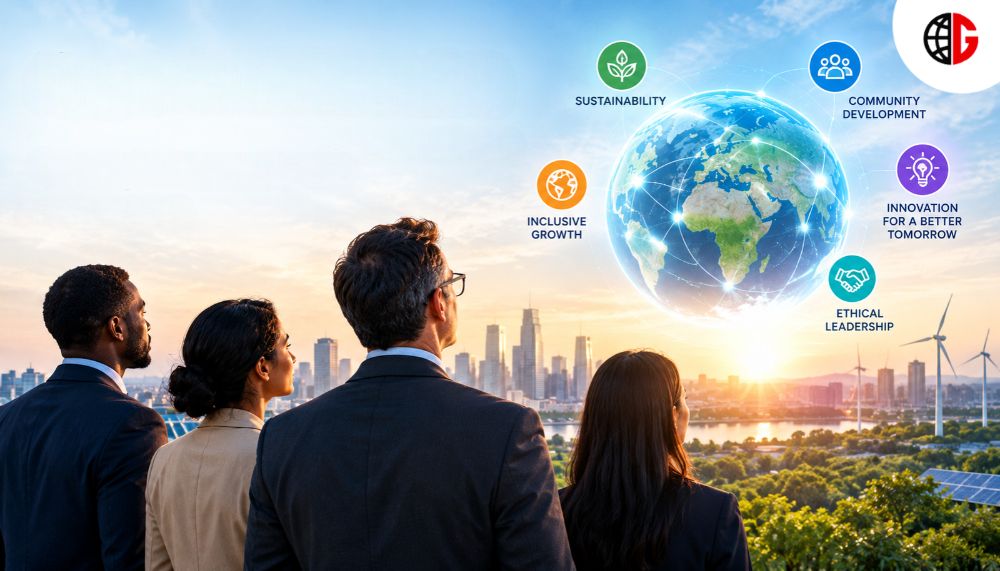
In a rapidly changing world, business success is being measured by more than revenue, market share, and shareholder returns. Today’s most forward-thinking leaders are asking a bigger question: How can businesses create lasting value for people, society, and the planet while continuing to grow?
From climate-conscious investments and ethical supply chains to inclusive workplaces and technology-driven social innovation, a new approach to leadership is taking shape. Across industries and continents, visionary leaders are rethinking the purpose of business, integrating responsibility into corporate strategy, and recognizing that long-term prosperity depends on the well-being of the communities and ecosystems in which companies operate.
This shift is not simply about corporate philanthropy or publishing an annual sustainability report. It is about transforming how organizations make decisions, allocate capital, develop talent, measure performance, and define success. As global challenges become increasingly interconnected, the leaders who create meaningful change will be those who understand that profitability and positive impact do not have to compete. When approached strategically, they can reinforce one another.
The New Definition of Business Leadership
For decades, business leadership was largely associated with financial performance, competitive advantage, operational efficiency, and shareholder value. These objectives remain important, but the expectations placed on modern organizations have expanded considerably.
Customers increasingly scrutinize the values behind the brands they support. Employees want workplaces that offer purpose, fairness, and growth opportunities. Investors are paying closer attention to long-term risks, governance, climate exposure, and the resilience of business models. Meanwhile, communities expect companies to contribute constructively to the places in which they operate.
This evolving outlook is closely associated with stakeholder capitalism; an approach that considers the interests of employees, customers, suppliers, communities, investors, and the environment alongside those of shareholders. The World Economic Forum has highlighted how stakeholder-oriented leadership can connect corporate responsibility with long-term value creation, while warning that vague promises and superficial environmental, social, and governance (ESG) commitments can undermine credibility.
For contemporary leaders, this creates a more demanding but potentially more rewarding mandate. They must build financially sound businesses while considering the wider consequences of their decisions.
A company may report impressive quarterly earnings, but if its growth depends on exploitative labour practices, unsustainable resource consumption, or a disregard for customer trust, its long-term foundations may be fragile. Conversely, organizations that invest in people, responsible innovation, and operational resilience can strengthen their ability to adapt when markets and expectations change.
The new measure of leadership, therefore, is not simply how much value an organization creates, but how responsibly it creates that value and whether the benefits can endure.
From Sustainability Promises to Measurable Progress
Sustainability has moved from the margins of corporate conversations into strategic decision-making. Climate exposure, resource scarcity, waste management, and supply-chain disruption increasingly influence how companies assess risk and plan for the future.
Yet the real challenge is moving beyond commitments to measurable results.
The 2025 UN Global Compact–Accenture CEO Study, drawing on insights from nearly 2,000 CEOs across 128 countries, found that 88% of surveyed CEOs believed the business case for sustainability had strengthened over the preceding five years. The study also reported that 99% intended to maintain or increase their sustainability commitments. These findings indicate that many business leaders increasingly view sustainability as a strategic priority rather than a peripheral responsibility.
However, ambition alone cannot deliver transformation. Leaders must translate broad objectives into operational decisions: reducing emissions, improving energy efficiency, redesigning products, strengthening supplier accountability, and investing in solutions that use resources more responsibly.
Consider the global tyre industry. Natural rubber is essential to production, yet its supply chain faces challenges associated with deforestation, biodiversity loss, traceability, and the livelihoods of smallholder farmers. A Reuters report published in October 2026 highlighted the difficulties tyre manufacturers face in improving sourcing practices across a fragmented supply chain, where approximately 85% of natural rubber is cultivated by smallholders. Industry initiatives include farmer training, agroforestry, and more direct sourcing relationships.
The example illustrates an important leadership lesson: meaningful environmental progress cannot always be achieved through a company’s internal operations alone. It often requires investment, collaboration, and accountability across an entire value chain.
Leaders who take this broader view recognize that sustainability is not merely about reducing a company’s footprint. It is about helping reshape the systems on which its business depends.
Purpose-Driven Leadership That Delivers Real-World Change
Purpose-driven leadership is often misunderstood as a commitment to social causes that exists alongside business strategy. In practice, its strongest form emerges when an organization’s purpose influences what it produces, whom it serves, how it treats people, and where it directs its resources.
A healthcare company, for example, can pursue growth while expanding access to affordable diagnostics. A financial services business can develop products that reach underserved entrepreneurs. An education technology company can use digital platforms to make quality learning more accessible to students who face geographic or economic barriers.
In each case, purpose becomes part of the business model rather than a separate charitable activity.
The United Nations Sustainable Development Goals (SDGs) offer a useful framework for understanding this approach. The 17 goals address interconnected challenges, including poverty, education, gender equality, clean energy, decent work, responsible consumption, and climate action. The UN Global Compact encourages businesses to integrate these priorities into their core strategies, operations, and value chains.
For leaders, the practical question is not whether their organizations can address every global challenge. It is where their expertise, resources, and influence can make the greatest difference.
A manufacturing company may be best positioned to reduce industrial waste and improve workplace safety. A technology business may contribute through accessible digital infrastructure, cybersecurity, or responsible AI. A financial institution may have the greatest impact through transparent lending, responsible investment, and access to capital.
The most credible leaders identify the connection between their commercial capabilities and society’s unmet needs. They then establish clear priorities, assign responsibility, and measure progress.
This approach also requires difficult choices. A business may need to reconsider a profitable but environmentally damaging practice, invest in safer materials, or accept a longer payback period for infrastructure that strengthens long-term resilience. Such decisions test whether purpose genuinely guides leadership or exists primarily as a communications strategy.
Innovation as a Force for Global Good
Innovation has always driven business transformation. What distinguishes impact-oriented innovation is its potential to address problems that extend beyond a company’s immediate customer base.
Artificial intelligence, advanced analytics, renewable energy, digital finance, biotechnology, and connected infrastructure are creating new opportunities to tackle challenges in healthcare, agriculture, education, and environmental protection. Yet technology does not automatically produce positive outcomes. Its impact depends on the problems it addresses, the people who can access it, and the safeguards governing its use.
Responsible leaders must therefore look beyond the novelty of an invention and ask whether it creates meaningful value.
In healthcare, AI-enabled tools can help clinicians analyse information and identify patterns that may otherwise be difficult to detect. In agriculture, digital forecasting and precision-farming systems can support better decisions about water, fertilisers, and crop management. In education, adaptive learning platforms can help tailor instruction to individual needs.
These applications can expand access and improve efficiency, but they also raise questions about privacy, affordability, bias, accountability, and the future of work. Leaders must address these concerns from the beginning rather than treating them as problems to solve after a product has reached the market.
The same principle applies to the global energy transition. Renewable energy infrastructure and energy-efficiency technologies can help organizations reduce emissions while creating new markets and strengthening energy security. Their wider benefits, however, depend on responsible sourcing, reliable infrastructure, affordable access, and appropriate end-of-life management.
The central leadership challenge is to align technological progress with human needs.
Innovation becomes a lasting force for good when it solves a genuine problem, reaches the people who need it, and creates benefits that can be sustained over time.
Building Inclusive Organizations and Expanding Opportunity
Global impact begins within organizations as much as it does in the wider world. The way leaders recruit, compensate, develop, and empower people influences both business performance and the distribution of economic opportunity.
Inclusive leadership recognizes that talent exists across different backgrounds, geographies, genders, abilities, and socioeconomic circumstances. Organizations that overlook this potential limit their own access to ideas, capabilities, and markets.
Building inclusive workplaces involves more than increasing representation in recruitment statistics. It requires examining promotion pathways, pay equity, accessibility, leadership development, workplace safety, and the extent to which employees can contribute to decisions that affect their work.
Women in leadership offer a particularly important illustration. When women have genuine opportunities to influence strategy, manage resources, and shape organizational priorities, leadership talent becomes less constrained by traditional barriers. But meaningful inclusion requires accountability: transparent advancement criteria, fair compensation, supportive policies, and representation in decision-making roles.
The same commitment must extend beyond permanent employees to contractors, suppliers, and workers throughout the value chain.
Responsible leadership also recognizes the importance of fair wages and skills development. As automation and AI reshape occupations, organizations have an opportunity—and a responsibility—to help workers adapt. Reskilling programmes, apprenticeships, continuous learning, and partnerships with educational institutions can help people prepare for changing labour-market demands.
The UN Global Compact identifies gender equality, living wages, and related social priorities as areas in which business commitments can support broader sustainable-development objectives.
For companies, these efforts can also strengthen institutional knowledge, employee engagement, and the ability to attract and retain skilled professionals. For society, they can expand access to opportunity.
The distinction lies in implementation. Inclusion becomes meaningful when it influences everyday decisions about who gets hired, who advances, who is heard, and who shares in the benefits of growth.
Ethical Governance and the Power of Trust
No strategy for lasting global impact can succeed without trust.
In a world shaped by instant communication, digital transparency, and increasingly complex business relationships, corporate conduct can influence reputation far beyond a company’s immediate market. Poor governance, misleading sustainability claims, data misuse, corruption, and irresponsible supply-chain practices can damage relationships with customers, employees, regulators, and investors.
Ethical leadership is therefore more than compliance with laws and regulations. It requires a consistent commitment to integrity, transparency, fairness, and accountability, especially when commercial pressure makes the right decision difficult.
The UN Global Compact’s work on responsible business emphasizes governance, ethical conduct, and transparent reporting as important foundations for sustainable development.
For today’s leaders, this means establishing clear standards for decision-making, strengthening internal controls, protecting whistleblowers, and ensuring that employees understand the organization’s ethical expectations. Boards must also be willing to question management decisions, scrutinize risks, and hold executives accountable for results.
Technology introduces additional responsibilities. Companies using AI must consider data protection, security, bias, explainability, and human oversight. A system that improves efficiency but compromises customer privacy or produces discriminatory outcomes may create serious social and commercial costs.
Trust is also shaped by what organizations communicate. Businesses should distinguish between targets and achievements, disclose material limitations, and avoid presenting isolated initiatives as evidence of comprehensive transformation.
Credibility grows when commitments are specific, progress is verifiable, and setbacks are acknowledged honestly.
In this sense, ethical leadership is not a constraint on ambition. It is an essential foundation for building institutions that can maintain their legitimacy and relationships over the long term.
Global Collaboration: Why Lasting Impact Cannot Be Built Alone
The world’s most pressing challenges rarely respect national borders. Climate change, public health risks, digital inequality, food security, and economic instability require solutions that extend beyond the capabilities of individual companies.
Even the most influential corporations cannot transform complex systems independently. They depend on governments for effective policy, universities for research, communities for local knowledge, suppliers for implementation, and civil society for perspectives that businesses may otherwise overlook.
This makes collaboration one of the defining capabilities of modern global leadership.
The UN Global Compact’s 2026–2030 strategy places collective action at the centre of its approach, emphasizing the need to translate sustainable business ambitions into coordinated action at scale. Its network includes more than 23,000 participating companies across over 160 countries, illustrating the international reach available for responsible business collaboration.
Such partnerships can take many forms. Businesses can work with universities to develop cleaner technologies, collaborate with local organizations to improve access to education, support small suppliers in adopting sustainable practices, and join industry initiatives to establish more responsible sourcing standards.
For multinational companies, collaboration must also account for local realities. A solution that works in a developed economy may not be appropriate in a region with limited infrastructure, different regulatory conditions, or lower purchasing power.
Effective leaders listen to local stakeholders rather than assuming that a global strategy can simply be replicated everywhere. They adapt implementation to regional needs while maintaining consistent standards of ethics, quality, and accountability.
This balance between global ambition and local understanding is essential. Lasting impact depends not only on the scale of an initiative but also on whether the people affected by it can participate in, benefit from, and sustain the change.
Measuring Impact Beyond Financial Performance
One of the biggest challenges in responsible leadership is determining whether an organization is genuinely making a difference.
Financial statements remain essential for assessing business performance, but they cannot independently reveal the full consequences of corporate activity. Revenue growth does not automatically demonstrate improved livelihoods, lower environmental harm, or more equitable access to opportunity.
Leaders therefore need a broader approach to performance measurement.
Rather than relying exclusively on the number of sustainability programmes launched or the amount of money donated, organizations should establish indicators that reflect actual outcomes.
Five dimensions of lasting global impact
Environmental responsibility: Measure emissions, energy consumption, water use, waste reduction, and progress towards science-aligned environmental targets.
Human and social progress: Track workplace safety, fair compensation, employee development, inclusion, and improvements in the communities served.
Ethics and governance: Assess compliance, business integrity, transparency, responsible data use, and the effectiveness of accountability mechanisms.
Long-term economic value: Evaluate financial resilience, productive investment, innovation, responsible growth, and the durability of business relationships.
Supply-chain and global impact: Examine supplier standards, traceability, local economic participation, and the wider effects of business operations across markets.
These measures should be linked to specific targets, assigned to accountable leaders, reviewed regularly, and communicated transparently. Where possible, independent assurance can strengthen confidence in reported results.
The UN Sustainable Development Goals provide a shared reference point for connecting business activities with broader societal objectives. However, companies must identify which goals are most relevant to their operations rather than claiming contributions to every area of sustainable development.
Another important distinction is the difference between outputs and outcomes. The number of employees trained is an output; the improvement in their skills, earnings, or employment prospects is an outcome. Similarly, installing renewable energy equipment is an operational milestone, while the resulting reduction in emissions demonstrates its environmental effect.
The most effective leaders understand this distinction. They do not measure success solely by what their organizations have done, but by what has changed as a result.
The Challenges Leaders Must Overcome
Building lasting global impact is rarely straightforward. Leaders face competing priorities, economic uncertainty, changing regulations, technological disruption, and pressure to demonstrate short-term financial results.
Sustainability investments may require substantial upfront capital. Responsible sourcing can increase procurement complexity. Inclusive hiring and workforce transformation demand sustained organizational commitment. New technologies may offer substantial benefits while introducing risks that are not yet fully understood.
There is also the danger of impact-washing: promoting environmental or social achievements without sufficient evidence to support the claims. Such practices can weaken trust and divert attention from the changes that matter most.
Another challenge is maintaining commitment during difficult periods. When costs rise or markets weaken, organizations may be tempted to postpone long-term investments in favour of immediate savings. Yet abandoning essential resilience measures can leave businesses more exposed to future disruptions.
The answer is not to ignore commercial realities. Responsible leaders must build a convincing business case for their priorities, identify material risks, allocate resources carefully, and integrate impact objectives into mainstream financial and operational planning.
They must also recognize that progress is not always linear. Some initiatives will fail, some targets will require revision, and some innovations will take longer than expected to produce results.
What matters is the ability to learn, adapt, and remain accountable.
Global impact is not created through a single announcement or a one-time investment. It emerges from a consistent pattern of decisions that gradually changes how an organization operates and how it influences the world around it.
The Next Generation of Leaders Must Think Beyond Borders
The next era of leadership will demand a combination of commercial intelligence, technological understanding, ethical judgment, and a long-term perspective.
Leaders will need to anticipate how climate risks affect infrastructure and supply chains, how AI changes employment and decision-making, how demographic shifts reshape markets, and how geopolitical tensions influence international cooperation.
They will also need to develop organizations capable of navigating uncertainty without losing sight of their broader responsibilities.
This calls for a different approach to leadership development. Future executives must learn not only how to manage financial performance but also how to understand interconnected systems, engage diverse stakeholders, assess unintended consequences, and make decisions when the trade-offs are difficult.
Perhaps most importantly, they must create cultures in which responsibility is shared rather than delegated exclusively to sustainability teams or corporate social responsibility departments.
When employees understand the organization’s purpose and see how their work contributes to meaningful outcomes, impact becomes part of everyday decision-making. Procurement teams consider supplier practices. Product designers evaluate durability and accessibility. Finance leaders assess long-term risks. Technology teams build safeguards into their systems.
Leadership then becomes less about making isolated declarations and more about enabling thousands of decisions to move in a common direction.
Outlook: A Legacy That Outlasts the Balance Sheet
Beyond profit lies a broader vision of what business leadership can accomplish.
Financial success provides the resources for growth, innovation, employment, and investment. But the most enduring organizations understand that their future is inseparable from the health of the economies, communities, and natural systems on which they depend.
Today’s most forward-thinking leaders are redefining success by combining commercial ambition with environmental responsibility, inclusive opportunity, ethical governance, and measurable social progress. They recognize that global impact is not an alternative to business performance; when approached with discipline and credibility, it can become an important foundation for resilience and long-term value creation.
The journey requires more than good intentions. It demands clear priorities, measurable objectives, responsible innovation, meaningful collaboration, and the courage to make difficult choices when immediate rewards conflict with long-term well-being.
Ultimately, the legacy of a leader will not be determined solely by the size of the company they built, the markets they entered, or the profits they generated. It will also be reflected in the opportunities they created, the systems they improved, the trust they earned, and the positive changes that continued after their tenure ended.
Because the most influential leaders of the future will not simply ask how much their organizations can achieve. They will ask how much better the world can become because their organizations exist.
Read more: How to Self Disclose and Not Self Explode