

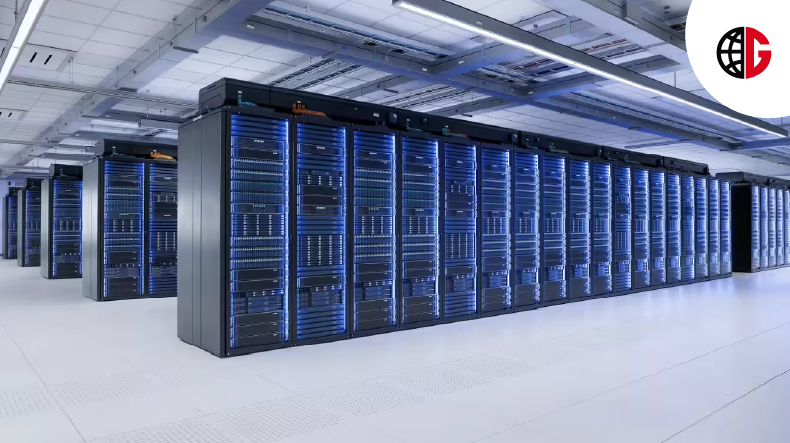
Chinese AI company Z.ai has taken a major step toward technological self-reliance with the completion of a one-gigawatt AI data centre powered entirely by locally developed semiconductor technology, signaling a new chapter in China’s race to build a homegrown AI ecosystem.
As global competition in artificial intelligence intensifies and access to advanced foreign hardware becomes increasingly restricted, Chinese technology firms are accelerating efforts to develop independent computing infrastructure. Z.ai, the AI research company behind the widely known GLM family of large language models, is now emerging as one of the most ambitious players in this transformation.
According to reports, the company has completed construction of a 1 GW AI data centre, making it one of the largest known AI computing facilities in China. The centre is already partially operational and is expected to play a crucial role in training Z.ai’s next-generation GLM foundation models.
A Landmark Investment in China’s AI Future
The scale of the project highlights the growing importance of computing power in the AI era. Training advanced large language models requires enormous amounts of processing capacity, traditionally supplied by high-performance GPUs from global leaders such as NVIDIA.
However, with export restrictions limiting Chinese access to the latest AI accelerators, domestic companies have been forced to rethink their infrastructure strategies. Z.ai’s new facility demonstrates that Chinese firms are increasingly willing to invest heavily in locally sourced alternatives rather than depend on foreign technology.
Industry sources indicate that the company has also established or operates several large AI computing clusters, each containing more than 10,000 AI chips, further strengthening its computing capabilities.
Moving Beyond NVIDIA Dependence
For years, NVIDIA dominated the global AI hardware market, providing the chips that powered many of the world’s most advanced AI systems. But ongoing US export controls have significantly restricted China’s access to these products.
Today, NVIDIA’s H20 processor remains one of the few advanced AI chips that can legally be exported to China, and even those shipments require government approval. Meanwhile, more powerful products such as the H100, H200, B200, GB200, and other Blackwell-series GPUs remain restricted under current export regulations.
These limitations have accelerated China’s determination to build a domestic AI supply chain capable of supporting large-scale model development without relying on foreign hardware.
Chinese Chipmakers Gain Momentum
China’s AI chip ecosystem has expanded rapidly in response to these challenges.
Huawei has emerged as a dominant force in the sector, reportedly controlling nearly half of the country’s AI chip market. At the same time, technology giants including Alibaba and Baidu are investing heavily in proprietary processors designed for their own cloud and AI platforms.
Alongside these established players, a new generation of semiconductor companies is gaining traction. Firms such as Biren Technology, Iluvatar CoreX, Moore Threads, and MetaX are aggressively expanding their presence through fundraising efforts and public market activity, targeting both AI training and inference workloads.
The growth of these companies reflects a broader national effort to establish a competitive domestic semiconductor industry capable of supporting China’s long-term AI ambitions.
Custom AI Chips Could Be the Next Frontier
Reports suggest that both Z.ai and fellow Chinese AI developer DeepSeek have explored the possibility of creating custom AI chips tailored to their own models and workloads.
Such a move would mirror strategies adopted by leading global technology companies, many of which are developing specialized AI processors to reduce costs, improve performance, and gain greater control over their technology stacks.
If successful, custom chip development could further strengthen China’s AI independence while reducing exposure to geopolitical and supply-chain uncertainties.
A Sign of China’s AI Infrastructure Push
The completion of Z.ai’s one-gigawatt AI data centre represents more than just a large infrastructure project. It serves as a powerful symbol of China’s broader effort to build a self-sustaining AI ecosystem amid mounting international technology restrictions.
As Chinese AI companies continue investing in domestic hardware, advanced computing clusters, and next-generation semiconductor technologies, the country is positioning itself to remain a major force in the global AI race—even without access to the most advanced foreign chips.
With demand for AI computing continuing to surge, projects like Z.ai’s massive data centre could become a blueprint for the future of China’s AI infrastructure strategy.
Read more: Alibaba Unveils Qwen3.8 Max AI Model Claims It Ranks Just Behind Anthropic’s Fable 5