

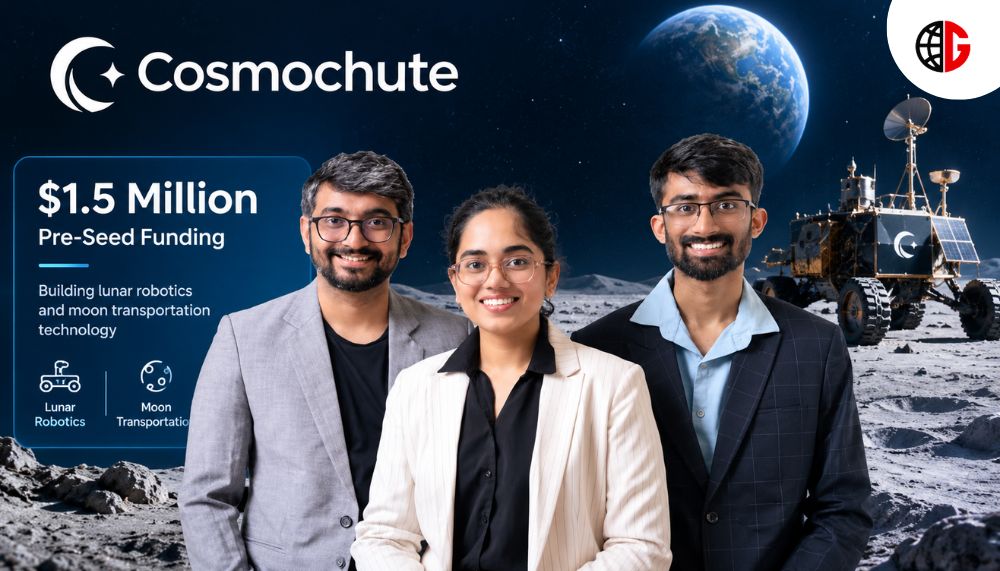
The Indian space robotics startup, backed by Accel and Prosus Ventures under the Atoms X programme, plans to accelerate product development, expand its engineering team, and advance its lunar transportation platform, LEAP.
India’s emerging space technology sector is gaining momentum as Cosmochute, a space robotics startup building infrastructure for the lunar economy, raised $1.5 million in a pre-seed round. Accel and Prosus Ventures led the round through the Atoms X programme, with additional participation from IIMA Ventures’ Deep-tech and Aerospace Acceleration Fund, Operators Studio, and Chinmayi Muthyala.
The funding marks an important milestone for the early-stage company as it works to develop robotic systems and transportation infrastructure designed to support future commercial and scientific missions to the Moon. As global interest in lunar exploration expands beyond government-led missions, Cosmochute aims to address one of the sector’s emerging challenges: making the movement and deployment of equipment on the lunar surface more efficient, standardised, and commercially viable.
According to the company, the newly raised capital will be directed towards product development, expanding its engineering team, and advancing its commercial roadmap. These investments are expected to support the startup as it moves into its next phase of development and strengthens the technological foundation of its first platform.
Building Infrastructure for the Emerging Lunar Economy
Founded in 2026 by Janhavi Gore, Amit Chowdhary, and Dhruv Alok Sangal, Cosmochute is developing space robotics infrastructure to support the growing lunar economy. Rather than focusing solely on individual robotic systems, the startup is working towards a broader transportation and payload deployment framework that could help enable a range of activities on the Moon.
As lunar exploration evolves, future missions are expected to require more than spacecraft capable of reaching the lunar surface. Scientific instruments, research equipment, technological demonstrations, and other payloads must also be transported, positioned, and deployed under challenging environmental conditions. Developing reliable systems for these operations will be essential to supporting more frequent and complex lunar missions.
Cosmochute aims to address this need through standardised lunar mobility and deployment infrastructure. Its approach is intended to reduce the engineering complexity associated with designing separate transportation solutions for individual missions, potentially making lunar operations more repeatable and adaptable to different requirements.
The company’s long-term ambition is to establish a technological foundation that can serve both commercial enterprises and scientific organisations seeking to undertake activities on the Moon.
LEAP: A Modular Platform for Lunar Transportation
At the centre of Cosmochute’s development strategy is LEAP, its first programme. The platform is being designed to facilitate payload transportation and deployment on the lunar surface through a modular architecture that combines a rover and trailer with standardised payload bays.
This configuration is intended to allow multiple payloads to be integrated into a common mission architecture. By establishing a shared transportation and deployment framework, the company aims to make it easier to accommodate different payload requirements without having to engineer an entirely new system for every mission.
Traditional space missions often involve extensive custom engineering, particularly when equipment must be designed around the specific requirements of an individual mission. While such customisation can address unique operational needs, it can also add complexity, time, and cost to mission planning and execution.
LEAP is being developed around a different approach: standardisation and modularity. Its architecture is intended to reduce dependence on mission-specific engineering while enabling more flexible integration of payloads. If successfully developed and deployed, this approach could help mission operators plan lunar transportation activities around a more consistent technological framework.
For a sector in which engineering resources, launch opportunities, and mission budgets are significant considerations, reusable design principles and standardised interfaces could become important enablers of broader commercial participation.
Cosmochute’s platform is therefore positioned not simply as a mobility system, but as an effort to develop the supporting infrastructure required for future lunar operations. The company aims to make the transportation and deployment of equipment on the Moon more accessible to organisations pursuing scientific research, technology development, and commercial activities.
Accel and Prosus Ventures Back the Startup Through Atoms X
The participation of Accel and Prosus Ventures provides Cosmochute with early-stage investor backing as it develops its technology and works towards commercial readiness. The round also includes IIMA Ventures’ Deep-tech and Aerospace Acceleration Fund, Operators Studio, and Chinmayi Muthyala.
Cosmochute is one of seven startups selected for the inaugural Atoms X cohort, a programme launched earlier in 2026. Its selection places the company among a group of early-stage ventures receiving support through the initiative as they work to develop their businesses and advance their respective technologies.
For deep-tech startups, pre-seed funding can be particularly important because product development often requires substantial technical work before a solution is ready for commercial deployment. In space robotics, this can involve developing engineering capabilities, refining system architecture, validating technologies, and establishing the infrastructure needed to progress towards operational applications.
The latest capital is expected to help Cosmochute strengthen these foundational capabilities while advancing its development priorities. The company has identified engineering team expansion and product development as key areas for investment, alongside work on its longer-term commercial roadmap.
Establishing a Presence in India’s Space Technology Ecosystem
Cosmochute is also setting up its lunar laboratories at IIMA Ventures’ incubation facility. This move provides an institutional base for its development activities as the startup works to advance its space robotics capabilities.
The company’s presence within the incubation ecosystem reflects its connection to India’s broader deep-tech and aerospace landscape, where startups, investors, research institutions, and other stakeholders are contributing to the development of private-sector space capabilities.
India’s space technology sector has been attracting growing entrepreneurial interest across areas such as satellite technology, launch systems, space applications, and advanced engineering. As private enterprises explore opportunities beyond conventional space services, specialised technologies for lunar mobility and robotics could represent another area of long-term development.
However, building space-ready hardware remains a demanding undertaking. Companies operating in this segment must address stringent technical requirements, reliability considerations, and the practical challenges of adapting technologies to environments significantly different from those on Earth. Turning early-stage concepts into commercially viable systems will therefore require sustained engineering development, testing, and collaboration across the space ecosystem.
For Cosmochute, establishing its laboratory infrastructure and expanding its engineering capabilities will be important steps as it works to translate its modular lunar transportation concept into a more mature platform.
Beyond the Moon: Expanding the Potential of Space Robotics
While LEAP represents the startup’s first major programme, Cosmochute intends to build broader capabilities in lunar mobility and space robotics. The company sees potential applications beyond its initial platform, including other in-space and terrestrial use cases.
Space robotics can serve a wide range of functions, from moving equipment and supporting scientific experiments to assisting with operations in environments where direct human intervention is difficult, costly, or impractical. Developing modular robotic architectures could help create systems that can be adapted for different operational requirements over time.
Nevertheless, the extent of these applications will depend on the platform’s eventual technical performance, validation, and commercial adoption. For now, Cosmochute’s immediate priorities centre on developing LEAP, expanding its engineering team, and advancing its product and commercial strategy.
The startup’s progress will also depend on how effectively it can demonstrate the practical value of its standardised approach in a sector where mission requirements can vary considerably.
A New Chapter for Lunar Infrastructure
Cosmochute’s $1.5 million pre-seed funding round signals an early step towards its ambition of building infrastructure for the emerging lunar economy. With support from Accel, Prosus Ventures, and its other investors, the company is preparing to advance its first platform and strengthen the engineering capabilities needed to pursue its long-term objectives.
As scientific exploration and commercial interest in the Moon continue to create new opportunities for specialised technologies, transportation and payload deployment are likely to remain important considerations for future missions. Solutions that can simplify these operations and accommodate different mission requirements could help support the development of a more structured lunar services ecosystem.
Through LEAP, Cosmochute is seeking to contribute to that evolution by developing a modular approach to lunar mobility and payload deployment. Its immediate challenge will be to turn this vision into a technically robust and commercially relevant platform.
The latest funding provides the startup with an opportunity to take those next steps, positioning it to explore the role that Indian deep-tech innovation can play in the development of future space infrastructure.