
The global race toward artificial intelligence-powered industries has entered a new phase as NVIDIA and LG Group announce an ambitious collaboration to build an advanced AI factory designed to accelerate innovation across robotics, autonomous driving, data centers, cloud computing, and next-generation manufacturing.
The partnership marks a significant step in the evolution of physical AI, bringing together NVIDIA’s cutting-edge accelerated computing and AI technologies with LG Group’s extensive expertise in electronics, mobility, energy solutions, telecommunications, robotics, and industrial manufacturing. The new AI factory will serve as the technological backbone of LG’s future AI-driven businesses, creating an ecosystem in which intelligent machines, digital twins, and real-world operations work together seamlessly.
A New Era of AI-Powered Industrial Transformation
At the heart of the collaboration is a shared vision of creating a comprehensive AI infrastructure capable of training, simulating, validating, and deploying advanced AI applications at scale. By combining NVIDIA’s full-stack AI factory platform with LG Group’s industrial capabilities, the companies aim to establish a unified workflow that connects AI model development, robotics training, simulation environments, edge deployment, and factory-scale digital twins.
This integrated approach is expected to significantly reduce development cycles while improving efficiency and accuracy across multiple industries. The initiative reflects a growing trend among global technology leaders to move beyond traditional AI software applications and embrace physical AI systems that can interact intelligently with the real world.
Building the Smart Factories of Tomorrow
One of the most transformative aspects of the partnership is the creation of an autonomous manufacturing ecosystem powered by data and artificial intelligence. LG plans to leverage decades of production expertise from its global manufacturing operations alongside NVIDIA’s AI infrastructure and digital twin technologies.
The goal is to create factories where every stage of the production process—from raw material procurement and manufacturing to logistics and customer delivery—is connected in real time. Through AI-driven decision-making and predictive analytics, the companies hope to establish a new benchmark for smart factories worldwide.
This vision extends beyond automation. It represents a shift toward intelligent manufacturing environments that can continuously optimize operations, reduce inefficiencies, and respond dynamically to changing market demands.
Advancing Home Robotics Through Physical AI
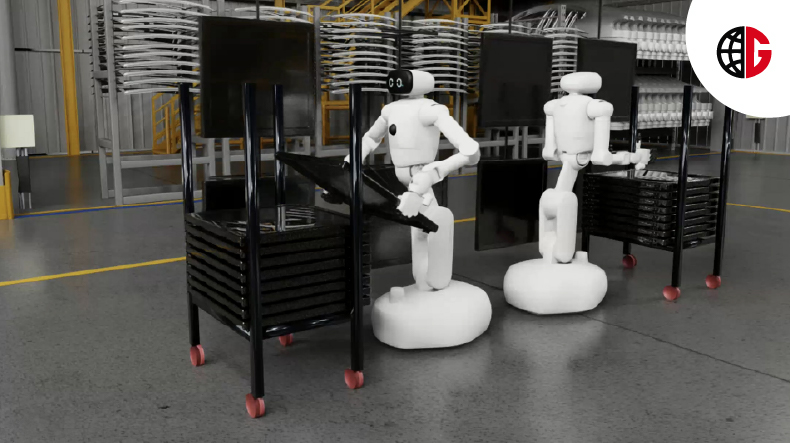
Robotics is another major pillar of the collaboration. LG Electronics is already developing advanced home robots designed to assist with everyday household tasks, making homes more intelligent and convenient.
To accelerate innovation in this space, LG will integrate NVIDIA’s robotics development frameworks into its workflow. These technologies enable robots to be trained and tested in highly realistic virtual environments before entering the real world. By simulating thousands of scenarios digitally, developers can improve robot performance, safety, and reliability while reducing development costs.
The companies are also exploring the use of NVIDIA’s advanced reasoning-based robotics model, which can give robots enhanced decision-making capabilities and the ability to execute more complex tasks. This could pave the way for a new generation of home assistants capable of understanding context, adapting to user needs, and performing sophisticated actions with greater autonomy.
Adding further momentum, NVIDIA and LG Electronics plan to jointly develop reference robots, strengthening LG’s position within the rapidly growing global robotics ecosystem.
Tackling the Robotics Data Challenge
One of the biggest obstacles in robotics development is access to large volumes of high-quality training data. To address this challenge, LG Electronics is creating a dedicated physical AI data factory aimed at generating and enhancing training datasets for robotics and industrial AI projects.
Using NVIDIA’s AI-powered world foundation models, LG plans to produce synthetic data that can supplement real-world datasets, accelerating AI development while improving model performance. This initiative has the potential to benefit not only LG but also organizations worldwide seeking to scale physical AI applications.
Meanwhile, LG Innotek will contribute advanced sensing technologies and robotics components optimized for NVIDIA-based development environments, further strengthening the ecosystem supporting next-generation robots.
Transforming Logistics and Manufacturing Operations
LG CNS is also playing a central role in the partnership by expanding AI adoption across industrial environments. By integrating NVIDIA’s robotics technologies, world models, and robotic foundation models into its industrial automation platform, LG CNS aims to simplify AI robot deployment across manufacturing plants and logistics centers.
The move is expected to accelerate digital transformation efforts across industries where efficiency, automation, and intelligent decision-making are becoming increasingly important competitive advantages.
Building AI Infrastructure for the Future
Beyond robotics and manufacturing, the collaboration extends into AI infrastructure and data center technologies. As demand for AI computing power continues to surge globally, NVIDIA and LG are working together to develop scalable and energy-efficient AI factories capable of supporting next-generation workloads.
LG Electronics is expanding its cooperation with NVIDIA through advanced cooling technologies and modular infrastructure designs that support high-performance AI systems. These innovations are designed to address the growing power and thermal management challenges associated with modern AI data centers.
Several LG Group companies are expected to contribute to this effort. LG Uplus plans to build large-scale AI data centers capable of hosting the latest NVIDIA GPU technologies, while LG CNS intends to develop high-performance AI factories powered by NVIDIA’s advanced computing platforms.
At the same time, LG Energy Solution is collaborating on emerging energy technologies designed to support future generations of AI infrastructure. These efforts highlight the increasing importance of energy efficiency and sustainability as AI workloads become more computationally demanding.
Accelerating the Future of Autonomous Mobility
The partnership also has significant implications for the automotive sector. LG Electronics is working closely with NVIDIA to align its advanced driver-assistance systems and in-vehicle AI platforms with NVIDIA’s autonomous driving technologies.
The collaboration will focus on integrating sensors, computing systems, and software architectures that support autonomous driving capabilities and software-defined vehicles. Future mobility solutions developed through this partnership could include intelligent vehicle cockpits, AI-powered edge processing systems, and enhanced autonomous driving technologies.
Additionally, LG Innotek plans to develop next-generation automotive components optimized for NVIDIA platforms, further strengthening its position in the rapidly evolving autonomous vehicle market.
Strengthening Korea’s Sovereign AI Ambitions
Beyond hardware and infrastructure, NVIDIA and LG AI Research are deepening their collaboration around EXAONE, one of South Korea’s most prominent sovereign AI models.
Using NVIDIA’s latest GPU technologies, AI frameworks, datasets, and inference optimization tools, LG AI Research has enhanced the development and deployment capabilities of EXAONE. The model is expected to play an increasingly important role across LG Group’s businesses, supporting enterprise AI applications, intelligent automation, and productivity improvements.
The collaboration also supports broader efforts to strengthen national AI capabilities, helping organizations adopt sovereign AI technologies while maintaining greater control over data, innovation, and digital transformation strategies.
A Blueprint for the Physical AI Economy
The NVIDIA-LG partnership represents more than a technology collaboration—it offers a glimpse into the future of the AI-powered economy. By bringing together robotics, autonomous mobility, smart manufacturing, AI infrastructure, and sovereign AI development under a single ecosystem, the two companies are laying the foundation for a world where intelligent machines and digital systems operate in harmony.
As industries worldwide seek to harness the transformative potential of artificial intelligence, the AI factory initiative could emerge as a model for how enterprises build, deploy, and scale physical AI technologies in the years ahead.
Read more: The Business of Sustainability: Why Companies Must Invest in Climate Action