
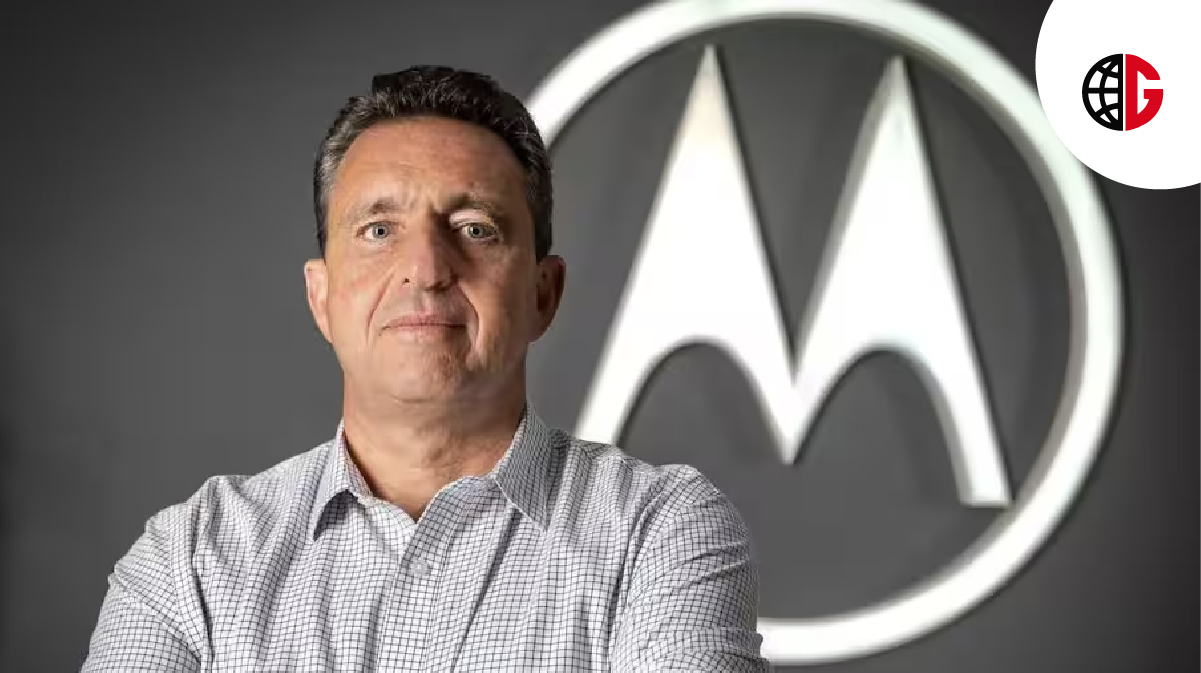
Qualcomm has appointed longtime Motorola executive Sergio Buniac as Executive Vice President and Group General Manager of Mobile, Compute and Personal AI, strengthening its leadership as the semiconductor giant accelerates its push into AI-powered devices, personal computing and next-generation consumer experiences.
Qualcomm is making a significant leadership move at a time when the boundaries between smartphones, PCs, wearables and artificial intelligence are rapidly disappearing. The company has named Sergio Buniac to lead its Mobile, Compute and Personal AI business at Qualcomm Technologies, with his appointment taking effect on September 2, 2026.
Buniac will report directly to Cristiano Amon, President and CEO of Qualcomm Incorporated, and will oversee a broad portfolio covering smartphones, personal computing, smart wearables, extended reality (XR) and a new generation of AI-powered devices.
The appointment comes as Qualcomm increasingly positions its Snapdragon platform not simply as the engine inside smartphones, but as a foundation for intelligent computing across multiple categories.
A Veteran of the Mobile Industry Takes the Helm
Buniac brings more than 30 years of experience in the mobile industry to Qualcomm. His career includes more than three decades at Motorola, where he held regional and global leadership positions across strategy, product development, sales, marketing, operations and supply chain. Since 2018, he has served as President of Motorola Devices.
That breadth of experience is particularly relevant to Qualcomm’s current strategy. The company is moving beyond its traditional strength in mobile processors and expanding its technology footprint across PCs, wearables, XR and emerging AI hardware.
Buniac’s background gives him experience across the entire consumer-device lifecycle, from product strategy and design to commercialization and global business execution. Qualcomm CEO Cristiano Amon highlighted this combination as a key reason for the appointment, describing Buniac as a leader with a strong record of driving innovation, transforming businesses and navigating major industry transitions.
Before his extensive career at Motorola, Buniac also held leadership roles at IBM and Booz Allen Hamilton. He holds a Bachelor of Engineering degree from the University of São Paulo, a postgraduate degree from Fundação Getulio Vargas and an MBA from the University of Chicago Booth School of Business.
Qualcomm’s Bigger Bet on Personal AI
The timing of the appointment is especially significant.
AI is rapidly moving from cloud-based applications toward devices capable of processing intelligence locally. Smartphones, laptops, watches, XR headsets and other connected products are increasingly expected to understand context, respond naturally and perform tasks with greater autonomy.
Qualcomm has been building its strategy around this transition. Its Snapdragon platforms are being positioned to support on-device and edge AI, allowing AI workloads to be handled closer to the user rather than relying entirely on remote data centres.
The company’s recent work around agentic AI illustrates this direction. Qualcomm says Snapdragon X Series PCs already support agentic AI applications capable of monitoring context, reasoning through tasks, and taking actions under user direction.
In wearables, Qualcomm has also been pushing the concept of Personal AI at the edge. Its Snapdragon Wear Elite platform is designed to enable AI processing directly on wearable devices, supporting experiences such as context-aware recommendations, natural voice interactions and AI agents that can perform tasks on a user’s behalf.
Buniac’s new mandate therefore places him at the centre of a much broader transformation: making AI a native capability across the devices people use every day.
From Smartphones to an AI-Powered Device Ecosystem
For Qualcomm, the opportunity extends well beyond selling chips for smartphones.
The company’s strategy increasingly revolves around connecting different categories of computing into a unified ecosystem. Smartphones can act as personal hubs, PCs can provide sustained computing power, wearables can continuously collect contextual information, while XR devices can create new interfaces between people and digital environments.
Qualcomm’s leadership page says Buniac will help expand Snapdragon-powered experiences across mobile, compute, wearables, XR and emerging AI device categories as the company advances its strategy of bringing intelligent computing everywhere.
This creates a significant leadership mandate for Buniac. Rather than managing a single product category, he will be responsible for businesses that collectively represent Qualcomm’s vision for the next generation of personal computing.
A Strategic Moment for Qualcomm’s PC Ambitions
Buniac’s appointment also arrives as Qualcomm continues challenging established players in the PC processor market.
The company’s Snapdragon X platform has become an important part of its effort to establish Arm-based computing as a credible alternative for Windows PCs. Qualcomm is betting that a combination of performance, energy efficiency and integrated AI capabilities can help reshape the PC market.
The broader opportunity is increasingly tied to AI PCs, where processors are expected to deliver dedicated computing resources for AI workloads while maintaining battery life and responsiveness.
Buniac’s experience building and commercializing consumer devices could be particularly valuable as Qualcomm works to deepen relationships across the PC and device ecosystem.
His appointment follows the departure of Alex Katouzian, a longtime Qualcomm executive who moved to Intel earlier in 2026 to lead its Client Computing and Physical AI Group. Buniac will therefore step into a role that is strategically important as competition around AI-enabled computing intensifies.
Why the Appointment Matters
The move reflects a broader shift taking place across the semiconductor and technology industries.
Chip companies are no longer competing only on processor performance. They are increasingly competing on the ability to provide complete computing platforms capable of supporting AI, connectivity, power efficiency and increasingly sophisticated software experiences.
Qualcomm describes itself as a computing company operating at the centre of the AI era, with technologies spanning high-performance and low-power computing, advanced AI and connectivity.
Buniac’s appointment fits directly into that evolution.
His experience on the device side of the industry gives Qualcomm a leader who understands how semiconductor technology ultimately translates into products that consumers buy and use. That perspective could become increasingly important as AI moves from a software feature to a defining characteristic of the hardware itself.
The Road Ahead
Buniac officially takes charge of Qualcomm’s Mobile, Compute and Personal AI group on September 2. His immediate mandate will span some of the company’s most strategically important growth areas, including smartphones, PCs, wearables, XR and emerging AI devices.
The larger challenge will be turning Qualcomm’s technology investments into compelling consumer experiences.
As agentic AI evolves, devices are expected to become more proactive, contextual and interconnected. Instead of simply responding to commands, future devices could increasingly anticipate user needs, coordinate across platforms and execute tasks with minimal intervention.
That makes Buniac’s appointment more than a routine executive transition. It signals Qualcomm’s determination to place experienced consumer-device leadership behind its next phase of growth—one where mobile computing, personal AI and intelligent devices increasingly converge.
With more than three decades of experience navigating the mobile industry, Buniac now enters Qualcomm at a defining moment. The next chapter of the device industry is being shaped not only by faster chips or better connectivity, but by how naturally intelligence can become part of everyday technology.
And Qualcomm is betting that Buniac can help lead that transformation.
Read more: Sparsh Hospitals Names Kalappa K.B. as Group CHRO to Lead People and Culture Transformation