
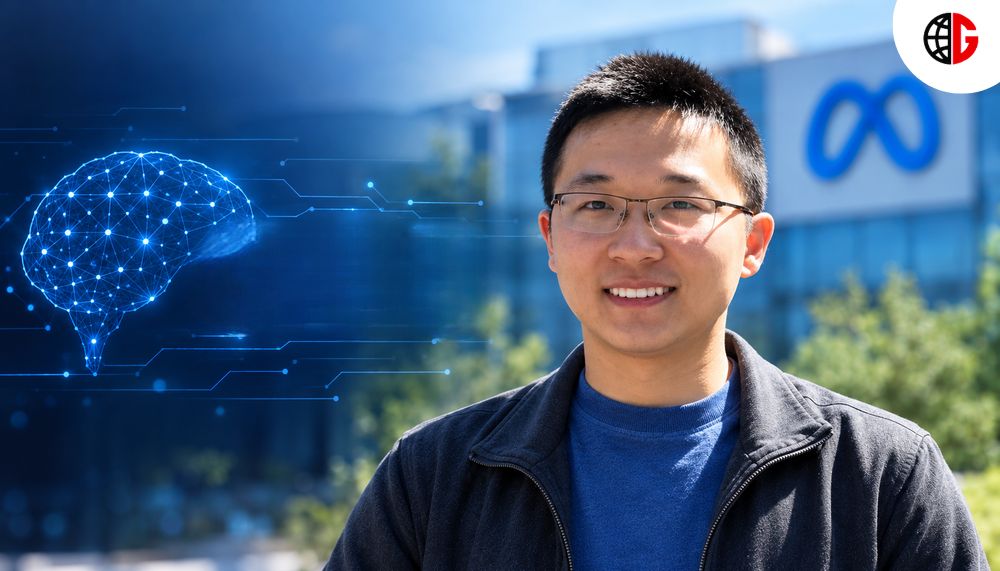
From Stanford’s research laboratories to OpenAI’s frontier models and Meta’s superintelligence ambitions, Shengjia Zhao’s journey reflects the scientific thinking, technical depth, and long-term vision driving the next chapter of AI innovation.
In the rapidly evolving world of artificial intelligence, some of the most influential people are not necessarily those who stand at the centre of public attention, but those who help build the technology transforming how people work, learn, communicate, and solve complex problems. Shengjia Zhao, Chief Scientist at Meta Superintelligence Labs, is one of the researchers whose work has helped develop advanced AI systems and the evolving science of machine reasoning.
With an academic foundation spanning Tsinghua University and Stanford University, followed by research experience at OpenAI, Zhao has built a career around a fundamental question: how can artificial intelligence move beyond generating plausible responses to solving problems that require deeper reasoning, multiple steps, and more reliable decisions?
His professional journey brings together several important dimensions of modern AI research, including generative modelling, machine learning reliability, synthetic data, and reasoning at inference time. These fields are central to the industry’s efforts to build systems capable of tackling increasingly sophisticated tasks.
In 2025, Zhao took on a significant leadership position at Meta, joining CEO Mark Zuckerberg’s ambitious effort to accelerate the company’s work on advanced AI. As Chief Scientist at Meta Superintelligence Labs, he works alongside Alexandr Wang, the lab’s chief AI officer, in an environment where scientific research, computing infrastructure, product development, and long-term technological ambition intersect.
His rise offers a compelling perspective on how expertise developed through academic research can translate into leadership at the forefront of the global AI industry.
The Academic Foundations Behind a Career in AI
Zhao’s professional trajectory began with a strong grounding in computer science. He earned his bachelor’s degree from Tsinghua University in China before pursuing a PhD in computer science at Stanford University, one of the world’s leading centres for artificial intelligence research.
These academic experiences provided a foundation for investigating some of the most difficult questions in machine learning: how models represent information, how they learn patterns from data, how their predictions can be evaluated, and how their outputs can become more dependable.
Artificial intelligence is often discussed through the lens of visible breakthroughs, such as conversational assistants, image generators, and increasingly capable digital tools. However, the technologies behind these applications depend on years of research into mathematical frameworks, optimisation techniques, representation learning, and model evaluation.
Zhao’s early research reflected this deeper scientific dimension. Rather than concentrating exclusively on a single application, his work addressed the underlying principles that influence how machine learning systems learn and generate information.
That research-oriented perspective would become particularly valuable as the industry moved from conventional predictive models towards large-scale generative AI and systems designed to handle complex reasoning tasks.
The significance of his academic background lies not simply in the institutions he attended, but in the research problems he pursued. Understanding the internal representations of models, improving the quality of generated outputs, and establishing reliable measures of predictive performance are essential challenges for any organisation seeking to develop more capable AI systems.
For Zhao, these questions would eventually connect academic machine learning with the practical demands of building frontier models.
OpenAI: From Machine Learning Research to Frontier AI Development
In 2022, Zhao joined OpenAI, entering a research environment focused on developing increasingly capable AI systems. During his time there, from 2022 to 2025, he contributed to work associated with ChatGPT, GPT-4, and the company’s emerging reasoning models.
His work at OpenAI placed him within a generation of researchers tackling the technical challenges of moving large language models beyond basic text generation. These systems needed to become better at following instructions, evaluating possible answers, handling complex tasks, and producing useful outputs across different domains.
Zhao’s documented contributions to GPT-4 included work on reward modelling, an important component of training AI systems to produce responses that better align with human preferences. Reward models help assess candidate responses and guide the process of improving a system’s behaviour.
This work is significant because a powerful AI model does not automatically become a useful or dependable assistant simply by learning patterns from large amounts of data. Its behaviour must also be refined, evaluated, and tested against the expectations placed upon it.
GPT-4 represented an important step in the evolution of generative AI, demonstrating capabilities across language and image-related tasks. Zhao’s contribution formed part of the broader research and engineering effort behind the system, which involved hundreds of people working across training, evaluation, infrastructure, and safety.
His work also intersected with the development of reasoning-focused AI. This emerging area of research sought to improve a model’s ability to work through challenging problems rather than relying solely on the generation of an immediate response.
The distinction is important. In many applications, a plausible answer is not enough. A model may need to compare alternatives, identify contradictions, reconsider an initial approach, and determine whether its conclusion follows from the available information.
For researchers such as Zhao, the challenge was to understand how these capabilities could be developed, trained, measured, and scaled.
Rethinking AI Progress Through Inference-Time Compute
One of the defining developments in frontier AI has been the growing emphasis on reasoning at inference time.
Traditionally, much of the industry’s progress came from scaling up models, training them on more data, and increasing the computing resources used during training. These approaches remain important, but reasoning models have introduced another dimension: allowing a model to use additional computation when generating an answer.
This approach is commonly known as inference-time scaling.
Instead of treating every question as a task that should receive an immediate response, a reasoning-oriented model can devote additional computational effort to difficult problems. Depending on its design, it may explore intermediate steps, evaluate possible solutions, or revise an approach before returning an answer.
Zhao contributed to the research environment at OpenAI in which these ideas became central to the development of advanced reasoning systems, including o1. His broader work connects to the industry’s effort to establish new scaling approaches that improve problem-solving performance, rather than relying exclusively on increasing model size.
The potential applications are substantial. Mathematical reasoning, scientific research, complex coding, and multi-stage planning can require more than recognising patterns in a prompt. They often involve several connected decisions, each of which can influence the final result.
However, inference-time compute is not a universal solution. Giving a model more time or computational resources does not guarantee correctness, and reasoning traces are not necessarily proof that its conclusions are valid. The quality of training, evaluation methods, underlying model capabilities, and safeguards still matters.
The larger lesson is that AI progress depends on more than building bigger systems. It also requires discovering better ways for those systems to use their capabilities.
For Zhao, this represents a natural extension of his earlier research into machine learning representations and reliability: understanding not only what a model can produce, but also how its capabilities can be developed and evaluated more effectively.
Synthetic Data: Addressing a Critical AI Training Challenge
Another important dimension of Zhao’s work at OpenAI was synthetic data generation.
As AI models become more advanced, access to high-quality training data becomes increasingly important. Human-generated examples of difficult mathematical problems, sophisticated reasoning, specialist knowledge, and carefully verified solutions can be expensive and time-consuming to produce.
Synthetic data offers an alternative. It involves generating training examples using computational systems, including existing AI models, rather than relying exclusively on material created by people.
Zhao’s work in this area was relevant to the development of training approaches for advanced models. Properly designed synthetic data pipelines can help generate additional examples, explore different solution strategies, and support the development of capabilities that are difficult to teach through ordinary text alone.
For example, a training system might generate a challenging problem, produce a proposed solution, evaluate whether that solution satisfies defined criteria, and retain suitable examples for subsequent training. More sophisticated approaches can incorporate multiple candidate solutions, automated verification, and feedback mechanisms.
The advantage is not simply the ability to create more data. It is the possibility of producing targeted, structured training material that helps models practise specific skills.
Yet synthetic data comes with significant challenges. Models can generate incorrect answers, reproduce biases present in their original training, or create large quantities of examples that reinforce the same weaknesses. If generated material is not properly evaluated, increasing its volume may amplify errors rather than improve performance.
Consequently, synthetic data requires careful design, filtering, verification, and evaluation. Its value depends on the quality of the examples and how effectively they support the intended learning objectives.
Zhao’s involvement in this research area reflects a broader shift in AI development: training systems are increasingly being designed to generate and assess the material used to improve subsequent generations of models.
This approach has implications for both the economics and the science of AI. If researchers can reliably generate high-quality examples for complex tasks, they may gain greater control over how models learn particular capabilities.
For companies competing to develop frontier AI, that possibility makes synthetic data a strategic research priority.
Research Beyond Large Language Models: Generative AI and Reliability
Although Zhao is widely associated with frontier language models, his research interests extend beyond conversational AI. His academic portfolio includes generative modelling, prediction calibration, and methods for understanding how machine learning systems represent information.
One notable contribution is InfoVAE: Information Maximizing Variational Autoencoders, a research direction that explores how generative models can preserve meaningful information in their internal representations.
Variational autoencoders, or VAEs, are machine learning models that learn compressed representations of data and use them to generate new examples. They have applications in image generation, data modelling, and other generative tasks. A longstanding challenge is balancing the quality of reconstructed outputs with the amount of useful information retained in the model’s latent representation.
InfoVAE investigates this balance, offering methods intended to improve representation learning and address limitations in conventional variational autoencoder objectives.
Although this research predates today’s generative AI boom, it belongs to the scientific foundation on which modern generative modelling has developed. The ability to represent information effectively, learn meaningful patterns, and generate useful outputs remains relevant across different families of AI systems.
Zhao has also worked on prediction calibration, including research addressing how confidence estimates relate to the accuracy of model predictions.
Calibration matters because an AI system can produce a prediction with an apparently high level of confidence without necessarily being correct. A well-calibrated model should, under the relevant evaluation conditions, demonstrate a meaningful relationship between its stated confidence and its observed accuracy.
In practical settings, this distinction can influence how people use AI recommendations, assess uncertainty, and decide when additional human review is necessary.
Such research highlights an important principle in AI development: capability and reliability are different objectives. A system may become more capable while still requiring better methods to evaluate uncertainty, identify limitations, and prevent inappropriate reliance on its outputs.
Together, Zhao’s work across generative modelling and prediction reliability reflects an approach to AI research that considers both the mechanisms behind model performance and the standards needed to assess it.
Meta Superintelligence Labs: A New Chapter in AI Leadership
In July 2025, Zhao joined Meta as Chief Scientist at Meta Superintelligence Labs, the organisation established to accelerate the company’s ambitions in advanced artificial intelligence. He works alongside Alexandr Wang, who leads the lab as chief AI officer.
The move represented a significant transition from contributing to frontier models at OpenAI to helping shape the research direction of another major technology company.
For Meta, attracting researchers with experience in advanced model development was part of a broader effort to strengthen its competitive position in AI. For Zhao, the role created an opportunity to apply his research background to a wider programme encompassing model architecture, reasoning, multimodal capabilities, and the infrastructure required to develop increasingly capable systems.
The distinction between a research scientist and a chief scientist is meaningful. The former may concentrate on specific technical questions, while the latter also helps establish research priorities, evaluate scientific approaches, and connect long-term investigations with organisational objectives.
At a frontier AI laboratory, those responsibilities involve difficult choices. Researchers must determine which problems deserve investment, how to measure progress, which capabilities should be prioritised, and how to balance ambitious development with rigorous evaluation.
Zhao’s experience across foundational machine learning and large-scale model development gives him a background relevant to these decisions.
His appointment also reflects a broader transformation in the AI industry. As competition intensifies, leading companies increasingly seek researchers who understand not just individual algorithms, but the interconnected systems involved in training, evaluating, and deploying advanced models.
Muse Spark and Meta’s Multimodal AI Ambitions
A major milestone for Meta Superintelligence Labs arrived in April 2026 with the introduction of Muse Spark, the first model in Meta’s Muse family. Meta described it as a model designed to support complex reasoning and multimodal tasks, with an emphasis on building more capable AI experiences into its products.
Multimodal AI refers to systems capable of processing or working across different types of information, such as text and images. The broader research ambition is to enable AI assistants to interpret context more effectively and help users with tasks that extend beyond conventional text-based conversations.
Muse Spark was subsequently followed by Muse Spark 1.1 in July 2026, which expanded capabilities in coding, agentic workflows, multimodal reasoning, and computer use. Meta also introduced public-preview access through its model API, opening the system to selected development use cases.
These developments illustrate the direction in which Meta is investing: models that can reason through complex tasks, work with multiple information formats, and support applications across a broad technology ecosystem.
Zhao’s role as chief scientist places him within this wider research effort. However, it is important to distinguish individual leadership from collective achievement. Frontier models are built by large teams spanning research, engineering, infrastructure, product development, and safety. Muse Spark’s development is therefore a laboratory-wide accomplishment rather than the work of one scientist alone.
The model’s introduction also does not, by itself, establish that artificial general intelligence has been achieved. It represents a step in Meta’s stated pursuit of more advanced AI capabilities, with further progress dependent on continued research, evaluation, and deployment.
For Zhao, the significance of this chapter lies in bringing foundational research closer to the products and systems through which people may eventually experience more capable AI.
A Research Philosophy Built Around Difficult Questions
Zhao’s career offers a useful perspective on what it takes to advance artificial intelligence. His work spans problems that may initially appear separate: learning meaningful representations, generating useful training data, calibrating predictions, refining language models, and improving reasoning.
These areas share an underlying concern with how AI systems acquire, apply, and demonstrate knowledge.
The development of more capable models requires researchers to investigate questions at several levels. How should a model learn from data? How can its reasoning improve? How can its performance be measured reliably? And how can the resulting capabilities be translated into systems that people can use effectively?
There are no simple answers to these questions. Improvements in one area can expose limitations in another, and progress on benchmark tests does not always translate directly into dependable real-world performance.
This is why the combination of scientific depth and practical experience matters. Researchers working at the frontier must continually test assumptions, examine failures, and refine methods as models become more sophisticated.
Zhao’s professional trajectory illustrates how foundational research can inform that process, from university laboratories to large-scale AI development and strategic scientific leadership.
Outlook: Building More Capable and Reliable AI
The next phase of artificial intelligence will be shaped not only by the scale of computing infrastructure or the size of training datasets, but also by advances in reasoning, data quality, model evaluation, and the ability to work across different forms of information.
For Meta Superintelligence Labs, these priorities are connected to the company’s ambition to develop increasingly capable AI systems. For Zhao, they represent a continuation of research themes that have accompanied his career: improving the way models learn, strengthening their problem-solving abilities, and developing methods for understanding their performance.
Important challenges remain. Advanced AI systems can still make factual errors, struggle with unfamiliar situations, and produce outputs that require independent verification. More sophisticated reasoning and multimodal capabilities must therefore be accompanied by careful testing, responsible deployment, and ongoing improvements in reliability.
The long-term value of frontier AI will depend on whether technical progress translates into useful outcomes for people, researchers, businesses, and society.
Shengjia Zhao’s Journey to the Frontiers of AI Innovation
Shengjia Zhao’s success is not simply a story of moving from Stanford to OpenAI and then to Meta. It is a story of how sustained work on fundamental machine learning problems can lead to opportunities to influence the direction of an entire research organisation.
His contributions to generative modelling, prediction calibration, model training, and frontier AI development reflect the interconnected nature of modern artificial intelligence. His move to Meta Superintelligence Labs extends that work into a leadership role at a company investing heavily in the next generation of AI systems.
In an industry often dominated by product launches and competition between technology giants, Zhao’s career highlights the importance of the scientific thinking behind those developments.
His journey demonstrates that the future of artificial intelligence will be shaped not only by those who deploy new technologies, but also by the researchers who investigate how machines learn, reason, and improve.
As AI systems continue to evolve, the questions Zhao and his peers are working to answer will remain central to the industry’s progress: how to build models that are more capable, how to make their outputs more dependable, and how to turn advances in machine learning into meaningful real-world applications.
Read more: Apollo Taps Fintech Visionary Micky Malka to Board, Strengthen Its Global Leadership