

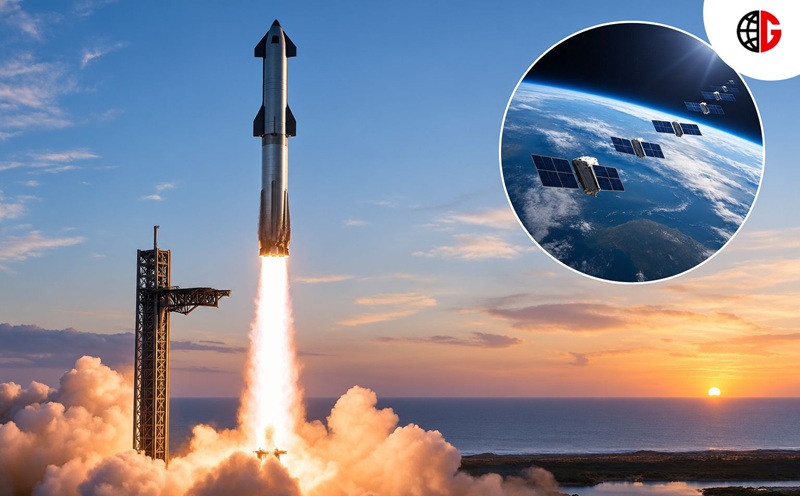
SpaceX is preparing for one of the most consequential tests yet in Starship’s development. The company is targeting September 22, 2026, for the 14th flight of its giant rocket, with the mission designed to take the Starship upper stage into Earth orbit for the first time. The launch remains subject to regulatory approval.
The 75-minute launch window is scheduled to open at 7:15 a.m. Central Time from SpaceX’s Starbase facility in South Texas. Unlike earlier Starship flights that primarily focused on testing individual systems, Flight 14 is intended to push the vehicle into a new phase: actually reaching orbit while carrying an operational payload.
Starship’s First Orbital Test Comes With a Commercial Payload
A major part of the mission will be deploying 26 third-generation Starlink V3 satellites. These satellites are part of SpaceX’s broader effort to expand and upgrade its internet constellation with significantly greater capacity.
The mission is particularly notable because it would mark the first Starship flight carrying a payload intended for SpaceX’s operational Starlink network. The July Flight 13 mission successfully demonstrated Starship’s ability to deploy V3 Starlinks, but those satellites were deliberately placed on a trajectory that ended with them burning up in the atmosphere after roughly 20 minutes rather than remaining in orbit.
SpaceX’s own IPO materials indicate that V3 satellites are designed for substantially greater communications capacity, with the company expecting Starship eventually to carry as many as 60 V3 satellites on a single orbital mission.
That makes Flight 14 more than another developmental demonstration. If the mission performs as planned, Starship will begin demonstrating its potential as an actual satellite-delivery system rather than simply a vehicle undergoing flight testing.
A Critical Step Toward Reusable Heavy-Lift Launches
For SpaceX, reaching orbit is only one piece of a much larger objective. The company is developing Starship as a fully reusable transportation system capable of launching large payloads, returning its components to Earth, and flying again with short turnaround times.
That ambition has major implications for SpaceX’s existing Falcon rocket fleet. The company has indicated that Starship is ultimately expected to take over roles currently handled by Falcon 9 and Falcon Heavy once it can fly reliably at a much higher frequency.
SpaceX’s IPO documentation also highlights Starship’s planned role in deploying V3 Starlink satellites, along with other future applications including heavy cargo, human missions and deep-space transportation.
However, Flight 14 is not yet a demonstration of full Starship reusability.
No Tower Catch for the Ship or Booster
SpaceX is deliberately keeping the recovery objectives limited for this flight.
The company will not attempt to catch the Starship upper stage with the launch tower, despite earlier discussion around eventually using the tower for rapid recovery. Elon Musk has indicated that attempting such a maneuver during this mission would introduce unnecessary risk while the vehicle is still being developed.
The Super Heavy booster also will not be caught during Flight 14.
Instead, the mission will focus heavily on gathering flight data and demonstrating that the upper stage can achieve orbital flight. This approach reflects the development priorities surrounding the latest version of Starship: establish reliable ascent and orbital performance before adding increasingly complex recovery operations.
Booster Reliability Remains a Key Challenge
The Super Heavy booster has been one of the more difficult pieces of the Starship system to stabilize.
During Flight 13 in July, the booster successfully separated from Starship but encountered problems when attempting to restart the engines needed for its return flight. The booster ultimately failed during its simulated landing sequence.
SpaceX says it has since implemented additional hardware and software modifications designed to address problems identified during the previous mission. That means Flight 14 will also provide another opportunity to determine whether those changes improve the booster’s performance.
The company has already undergone multiple rounds of modifications to the Super Heavy system following earlier failures. In May, the FAA required SpaceX to conduct a mishap investigation after a Super Heavy booster experienced a failure during a Starship test.
Flight 13 Gave SpaceX Valuable Data
While Flight 13 did not send Starship into orbit, its upper stage performed considerably better than the booster.
After separating from Super Heavy and deploying the test Starlink payload, the Starship upper stage completed a simulated return sequence and survived its descent into the ocean. Unlike some previous vehicles, it did not immediately break apart after landing in the water, giving SpaceX an unusual opportunity to inspect the spacecraft directly.
The company subsequently recovered and transported the vehicle back to Texas for examination. The experience provided engineers with information about the spacecraft’s heat shield and other systems.
SpaceX says it has incorporated what it learned from that recovered vehicle into additional heat-shield modifications ahead of Flight 14.
Why September 22 Matters
The significance of Flight 14 goes beyond whether Starship simply survives another launch.
The ultimate challenge for SpaceX is to transform Starship from an experimental rocket into a high-frequency, reusable orbital transportation system. Reaching orbit would establish an important technical milestone, but the company would still need to demonstrate reliable atmospheric reentry, controlled recovery, rapid refurbishment, and repeated launches.
The upcoming mission therefore represents a transition point. After years of development and numerous test flights, SpaceX is now attempting to prove that Starship can perform the central task for which it was designed: reach Earth orbit while carrying a useful payload.
If the September 22 attempt proceeds as scheduled, the 26 V3 Starlink satellites will provide an additional measure of the mission’s success. For SpaceX, Starship’s first orbital attempt is simultaneously a rocket-development test, a Starlink deployment mission, and a crucial step toward the company’s long-term reusable-launch architecture.
Read more: Sandoz Appoints Ha Vo as General Manager, Vietnam