
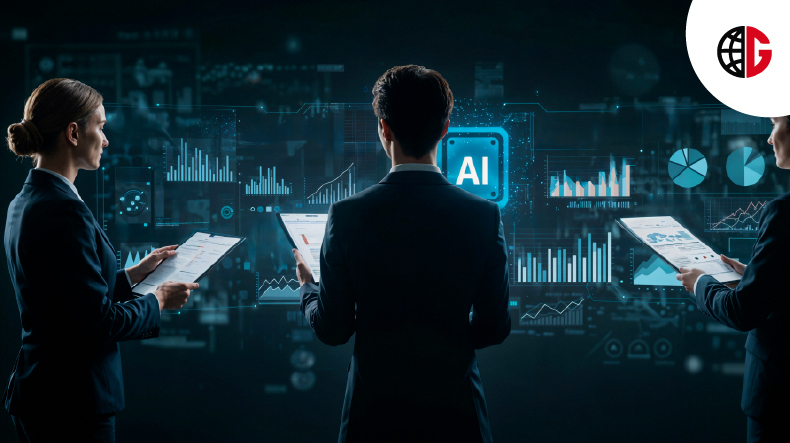
In today’s fast-moving digital economy, decision-making has become one of the most valuable competitive advantages for businesses. Enterprises are no longer relying solely on intuition, spreadsheets, or historical reports to guide strategic choices. Instead, Artificial Intelligence (AI) is transforming how organizations analyze information, predict outcomes, reduce uncertainty, and respond to market changes in real time.
From multinational corporations to emerging startups, AI-powered decision systems are redefining leadership across industries such as healthcare, finance, retail, manufacturing, logistics, and human resources. Modern enterprises are now using AI not only to automate repetitive tasks but also to support critical business decisions that once depended entirely on human judgment.
As AI technologies continue to evolve, businesses that successfully integrate intelligent decision-making systems are gaining a stronger edge in efficiency, innovation, customer experience, and profitability. Here are 10 major ways AI is reshaping decision-making in modern enterprises.
1. Real-Time Data Analysis Is Accelerating Business Decisions
One of the biggest transformations AI brings to enterprises is the ability to process massive volumes of data instantly. Traditional decision-making often relied on quarterly reports, delayed analytics, and manual interpretation. AI changes this dynamic by enabling real-time analysis of structured and unstructured data.
Modern AI systems can evaluate customer behavior, operational performance, financial metrics, and market trends within seconds. This allows leaders to make faster and more informed decisions without waiting for lengthy reporting cycles.
For example, retailers now use AI to analyze customer purchases in real time, enabling instant pricing adjustments and inventory optimization. Financial institutions rely on AI algorithms to detect fraud patterns immediately rather than after financial damage occurs.
Real-time intelligence has become essential in industries where delays can lead to revenue loss or operational disruption.
2. Predictive Analytics Is Reducing Business Uncertainty
AI-powered predictive analytics helps organizations forecast future outcomes using historical and real-time data. Instead of reacting to problems after they occur, enterprises can proactively prepare for opportunities and risks.
Predictive AI models are now widely used for:
- Sales forecasting
- Demand planning
- Risk assessment
- Customer churn prediction
- Supply chain optimization
- Equipment maintenance forecasting
For example, manufacturers use predictive maintenance systems powered by AI to identify machine failures before they happen, reducing downtime and repair costs. Similarly, e-commerce companies forecast buying trends to manage inventory more efficiently during seasonal demand spikes.
By reducing uncertainty, AI enables leaders to make strategic decisions with greater confidence.
3. AI Is Enhancing Customer-Centric Decision-Making
Modern enterprises are increasingly making decisions based on customer behavior and preferences. AI helps businesses understand consumers at a much deeper level through advanced analytics, sentiment analysis, and personalization engines.
AI-driven systems can analyze:
- Browsing patterns
- Purchase history
- Social media activity
- Customer feedback
- Support interactions
This enables companies to create highly personalized experiences and make customer-focused business decisions.
Streaming platforms recommend content using AI algorithms, while online retailers personalize product suggestions to increase engagement and conversions. Banks and telecom companies also use AI to identify dissatisfied customers before they leave, allowing proactive retention strategies.
Customer-centric decision-making powered by AI improves loyalty, satisfaction, and long-term profitability.
4. Intelligent Automation Is Improving Operational Efficiency
AI is transforming operational decision-making by automating repetitive and time-consuming tasks. Intelligent automation allows enterprises to streamline workflows, reduce human error, and improve productivity.
Businesses are now using AI-powered automation for:
- Invoice processing
- HR screening
- Customer support chatbots
- Data entry
- Procurement management
- Compliance monitoring
Instead of spending hours on manual administrative work, employees can focus on strategic and creative responsibilities.
For executives, AI-generated operational insights help identify bottlenecks, inefficiencies, and performance gaps more effectively than traditional systems. This leads to faster operational decisions and better resource allocation.
5. AI Is Revolutionizing Financial Decision-Making
Financial departments are among the biggest adopters of AI-driven decision systems. Enterprises are increasingly relying on AI to improve budgeting, investment analysis, fraud detection, and financial forecasting.
AI systems can identify financial anomalies, detect suspicious transactions, and evaluate credit risks with remarkable accuracy. Investment firms use machine learning models to analyze market movements and optimize portfolio strategies.
Additionally, CFOs now use AI-powered dashboards to simulate multiple financial scenarios before making critical business decisions. This level of analytical precision allows organizations to minimize risks while maximizing profitability.
As financial environments become more volatile, AI is helping enterprises make smarter and faster fiscal decisions.
6. Human Resource Decisions Are Becoming More Data-Driven
AI is also reshaping talent management and workforce planning. Human resource departments are using AI to improve hiring accuracy, employee engagement, and performance analysis.
AI recruitment tools can analyze resumes, identify skill matches, and reduce hiring biases by focusing on competency-based evaluations. Enterprises are also using AI-powered workforce analytics to predict employee turnover and identify productivity trends.
In large organizations, AI helps HR leaders make better decisions regarding:
- Talent acquisition
- Employee retention
- Leadership development
- Workforce planning
- Training needs
This data-driven approach creates more efficient hiring processes and stronger workforce strategies.
7. AI Is Strengthening Risk Management and Cybersecurity
Modern enterprises face growing risks related to cybersecurity, fraud, compliance, and operational disruptions. AI has become a critical tool for identifying and mitigating these threats before they escalate.
AI-powered security systems can continuously monitor networks, detect unusual behavior, and respond to cyber threats in real time. Unlike traditional security tools, machine learning systems improve over time by learning from evolving attack patterns.
In sectors like banking and healthcare, AI-driven risk assessment models help organizations comply with regulations while minimizing vulnerabilities.
By improving threat detection and response speed, AI enables businesses to make more secure and resilient operational decisions.
8. Strategic Planning Is Becoming More Intelligent
AI is no longer limited to operational tasks; it is increasingly influencing high-level strategic decision-making.
Executives now use AI tools to evaluate market trends, competitor activity, consumer behavior, and economic conditions before making expansion or investment decisions. AI-driven simulations allow leaders to test multiple business scenarios and predict potential outcomes.
For example, companies can assess:
- Market expansion opportunities
- Product launch success probabilities
- Pricing strategy effectiveness
- Consumer demand shifts
- Supply chain vulnerabilities
This capability helps enterprises build smarter long-term strategies with greater adaptability in uncertain business environments.
9. AI Is Enabling Faster Innovation
Innovation has become essential for enterprise survival, and AI is accelerating the pace of product development and business transformation.
AI systems can analyze customer demands, identify emerging market gaps, and support rapid experimentation. Companies are using generative AI and machine learning to develop new products, optimize designs, and enhance research capabilities.
In industries such as pharmaceuticals, AI significantly reduces research timelines by analyzing complex biological data faster than human teams alone.
By shortening innovation cycles, AI empowers enterprises to make bold decisions and respond more quickly to evolving market demands.
10. Decision Intelligence Is Creating Smarter Enterprises
A growing trend in modern business is the rise of “Decision Intelligence,” where AI combines data analytics, machine learning, and human expertise to improve enterprise-wide decision-making.
Rather than replacing human leaders, AI acts as a strategic assistant that provides recommendations, risk assessments, and scenario modeling. Decision intelligence platforms help organizations unify data from multiple departments, creating a more holistic view of business performance.
This approach supports better collaboration between leadership teams and enables more consistent decision-making across the enterprise.
As organizations continue embracing digital transformation, decision intelligence is expected to become a defining feature of next-generation enterprises.
Challenges Enterprises Must Still Address
Despite its advantages, AI-driven decision-making also presents several challenges. Enterprises must address concerns related to:
- Data privacy
- Algorithmic bias
- Ethical AI use
- Transparency
- Workforce adaptation
- Overreliance on automation
AI systems are only as effective as the data they are trained on. Poor-quality data or biased algorithms can lead to flawed recommendations and unfair outcomes.
Businesses must therefore combine AI capabilities with human oversight, ethical governance, and responsible implementation strategies.
The Future of AI-Driven Enterprise Decisions
The future of enterprise decision-making will likely involve even deeper collaboration between humans and intelligent systems. As AI technologies mature, businesses will increasingly shift toward autonomous decision-support systems capable of learning, adapting, and improving continuously.
Emerging technologies such as generative AI, agentic AI, and advanced predictive intelligence will further reshape leadership strategies and operational models. Enterprises that invest early in AI-driven decision ecosystems will be better positioned to compete in an increasingly data-centric world.
AI is no longer just a technological upgrade—it is becoming the foundation of modern enterprise intelligence.
Outlook
Artificial Intelligence is fundamentally changing how enterprises think, operate, and compete. From predictive analytics and intelligent automation to cybersecurity and strategic planning, AI is enabling faster, smarter, and more accurate decision-making across every business function.
Organizations that successfully integrate AI into their decision-making processes are not only improving efficiency but also building stronger resilience and innovation capabilities for the future.
In the coming years, the enterprises that thrive will not simply be those with the most data, but those that know how to use AI to transform that data into intelligent action.
Read more: The Rise of Human-Led AI Leadership