
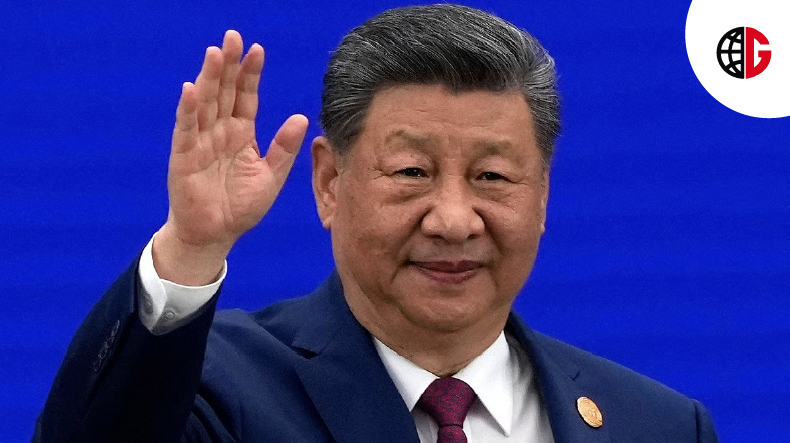
China’s President Xi Jinping has called for a more collaborative approach to artificial intelligence, warning against concentrating AI power in the hands of a single nation and urging countries to work together to shape the technology’s future.
Speaking at the opening of the World Artificial Intelligence Conference (WAIC) in Shanghai, Xi emphasized that AI should be developed through international partnerships rather than geopolitical competition. His remarks come at a time when AI is rapidly becoming one of the most strategic technologies in the world, influencing economies, national security, and global innovation.
Xi Advocates a Shared Global AI Future
Addressing global policymakers, technology leaders, and industry experts gathered in Shanghai, Xi described artificial intelligence as a transformative force that should benefit all nations.
He stressed that AI development should resemble a collaborative global effort rather than being driven by a single dominant country. According to Xi, international cooperation is essential to ensure that technological advancements are distributed fairly and do not create new forms of inequality between developed and developing nations.
The Chinese leader also highlighted the importance of preventing technological barriers that could restrict access to AI innovation, particularly for emerging economies seeking to participate in the digital revolution.
China Expands AI Partnerships Across Developing Regions
As part of its broader AI strategy, China announced plans to strengthen cooperation with countries across Africa, Asia, Latin America, and the BRICS bloc. The initiative aims to provide AI-related opportunities, capacity-building programs, and technological collaboration to nations looking to accelerate their digital transformation.
Xi framed the move as an effort to avoid what he described as “new historical injustices,” where access to advanced technologies becomes concentrated among a small group of countries while others are left behind.
The announcement reflects Beijing’s growing ambition to position itself as a leading advocate for inclusive AI development on the global stage.
Human-Centric AI Remains a Key Priority
Beyond international collaboration, Xi placed significant emphasis on responsible AI governance.
He called for stronger regulatory frameworks, technological oversight mechanisms, risk-monitoring systems, and emergency response measures to ensure artificial intelligence remains under human supervision.
According to Xi, AI should be developed with a people-first mindset, balancing innovation with safety and ethical considerations. His comments echo growing global concerns over the misuse of AI technologies in areas such as cybercrime, misinformation, surveillance, and military applications.
The Chinese president argued that governments and industry stakeholders must work together to create safeguards that keep AI aligned with human interests while maximizing its economic and social benefits.
Rising Competition Between China and the West
Xi’s remarks arrive amid increasing technological tensions between China and Western nations.
The United States and several European governments have tightened restrictions on advanced technology exports to China, particularly in the semiconductor sector. Washington has introduced measures limiting access to high-end AI chips and related technologies, citing national security concerns.
Recent U.S. export controls have also extended licensing requirements to Chinese companies operating outside mainland China, highlighting the growing strategic importance of AI infrastructure and computing power.
Despite these restrictions, China has continued investing heavily in its domestic AI ecosystem, ranging from chip manufacturing and cloud infrastructure to consumer-facing AI applications.
China’s AI Industry Gains Momentum
China’s artificial intelligence sector has experienced rapid growth in recent years, supported by strong government backing and significant investment.
Chinese AI companies are increasingly challenging leading American firms by offering advanced models at competitive costs, attracting users both domestically and internationally.
Industry usage has surged dramatically, with reports indicating that AI-related computing activity and token consumption have multiplied at an extraordinary pace over the last two years. This growth reflects the expanding adoption of AI across industries including manufacturing, finance, healthcare, education, and consumer services.
Energy Advantage Strengthens China’s AI Ambitions
One of China’s most significant advantages in the global AI race lies in its energy infrastructure.
Modern AI systems rely on massive data centers that require enormous amounts of electricity. While access to advanced semiconductors remains a challenge due to international restrictions, China possesses a substantial edge in power generation capacity.
The country already produces more than twice as much electricity as the United States and continues to expand its energy grid through large-scale state-backed investments.
This abundant and relatively affordable electricity supply positions China favorably as demand for AI computing continues to rise. Large hyperscale data centers, which power advanced AI models, consume energy on a scale comparable to millions of households, making reliable power access a critical competitive advantage.
A New Vision for Global AI Governance
Xi Jinping’s speech signals China’s intention to play a larger role in shaping the future rules and governance of artificial intelligence. As AI becomes increasingly central to economic growth, national security, and technological leadership, debates over access, regulation, and global cooperation are expected to intensify.
By promoting a vision of shared innovation, inclusive growth, and human-centered governance, China is seeking to position itself not only as a major AI developer but also as a key voice in defining how the technology evolves worldwide.
With AI rapidly transforming industries and societies, Xi’s call for international cooperation highlights a growing global debate: whether the future of artificial intelligence will be driven by competition among nations or built through collective collaboration.