
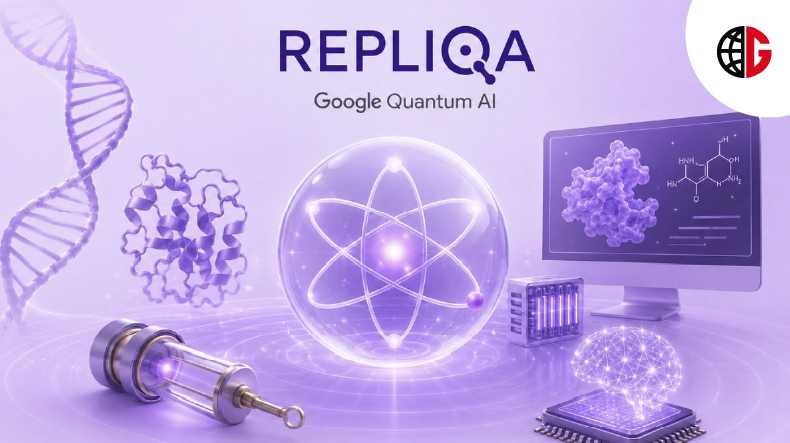
Google has unveiled a new initiative aimed at transforming the future of biological and healthcare research through the combined power of quantum science and artificial intelligence. The program, named the Research Program at the Intersection of Life Sciences & Quantum AI (REPLIQA), will support groundbreaking scientific exploration focused on improving human health and advancing molecular-level biological understanding.
As part of the initiative, Google.org has committed $10 million in funding to five leading universities to accelerate research in this emerging field. The institutions selected for the program include Harvard University, Massachusetts Institute of Technology, University of California San Diego, University of California, Santa Barbara, and University of Arizona.
Exploring the Future of Biology with Quantum Technology
Understanding the complexities of human biology at the molecular and atomic level remains one of science’s most difficult challenges. Processes such as protein folding, cellular reactions, and drug interactions involve highly intricate molecular behavior that traditional computing systems often struggle to simulate accurately.
Quantum technologies, however, are uniquely suited for these challenges because they operate using the same principles of quantum mechanics that govern molecular interactions. Researchers believe this could open entirely new possibilities in life sciences and healthcare innovation.
Quantum sensors are already enabling scientists to observe biological activity with extraordinary precision. At the same time, emerging studies suggest that quantum spin — the rotational behavior of subatomic particles — may influence cellular functions in ways not previously understood.
In drug development, quantum computing could dramatically improve the simulation of complex molecular systems, including enzymes like P450, which play a vital role in how medicines are processed in the body. Faster and more accurate simulations may eventually help researchers design safer and more effective treatments.
Building a Collaborative Scientific Ecosystem
Google stated that solving challenges of this scale requires collaboration across multiple scientific disciplines. Through REPLIQA, the company aims to create a strong research ecosystem that brings together experts in quantum science, artificial intelligence, biology, and healthcare research.
The selected universities are already recognized for pioneering work in these fields and are expected to contribute foundational research that may shape future medical and scientific breakthroughs.
A Long-Term Research Vision
While the potential of quantum AI in healthcare is significant, Google emphasized that REPLIQA is a long-term foundational research effort rather than a short-term commercial project.
The initiative will focus on developing critical technologies such as advanced quantum sensors and quantum-enhanced AI algorithms that could support future discoveries in biology and medicine. By investing in the underlying scientific infrastructure today, Google hopes to accelerate the next generation of breakthroughs in life sciences and human health.
Read more: AI Literacy Is the New Leadership Advantage for Women in Business