
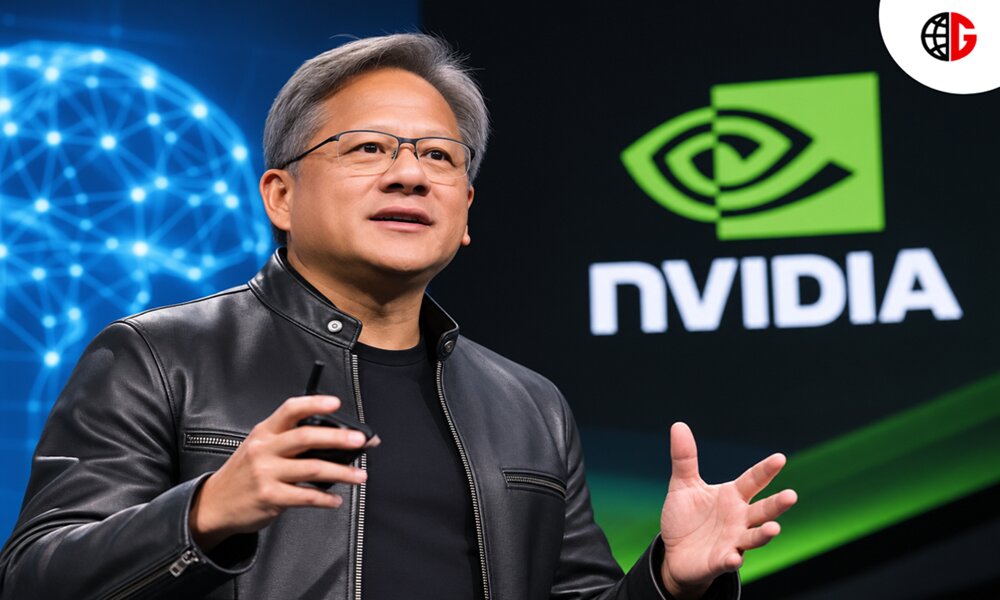
The debate over how quickly artificial intelligence should advance has taken another turn after NVIDIA CEO Jensen Huang rejected predictions that AI could bring about humanity’s extinction by the end of the decade.
Speaking with CBS News, Huang dismissed claims that humans could be “gone in a decade,” arguing that such predictions are not supported by science or facts. He also questioned the motivations behind some of the most dramatic warnings about AI, saying those making such claims could have “ulterior reasons” ranging from politics to attracting attention.
Huang’s comments arrive at a time when the AI industry is increasingly divided over the pace of frontier AI development. While some technology leaders and researchers are calling for greater caution and stronger safeguards, Huang is advocating continued progress while maintaining safety standards.
Jensen Huang: AI Extinction Claims Are Overstated
Huang was responding in part to recent warnings from former Anthropic researcher Jacob Coxon, whose comments about the potential risks of advanced AI sparked renewed discussion about whether increasingly capable systems could eventually pose an existential threat to humanity.
Asked directly whether humanity could disappear because of AI within the next decade, Huang rejected the idea.
He characterized the prediction as dramatic and said that claims about the end of the world by 2030 are not grounded in science. At the same time, Huang made a distinction between the prediction itself and the broader issue of AI safety.
According to Huang, concerns about building AI safely are legitimate. His objection is to presenting catastrophic outcomes as an established or near-certain future.
That distinction has become increasingly important as frontier AI systems grow more capable and companies race to develop models that can perform increasingly complex tasks.
“Ulterior Reasons” Behind AI Doomsday Narratives
Huang also questioned why some AI leaders and researchers are emphasizing the possibility of catastrophic outcomes.
He suggested that there could be political, commercial, media-related or other motivations behind particularly alarming predictions, while acknowledging that he does not know the precise reasons behind individual claims.
His comments add another layer to an already heated debate within the technology industry. The discussion is no longer simply about whether AI needs safety measures. It is increasingly about how much caution is appropriate, who should determine the pace of development and what evidence should guide those decisions.
For NVIDIA, the issue is particularly significant. The company is one of the world’s most important suppliers of the computing hardware used to train and operate advanced AI systems. Demand for its AI chips has made the company a central player in the global AI boom.
Huang Wants AI Development to Move “As Fast as We Can”
Rather than supporting a broad slowdown, Huang argued that AI development should continue at a rapid pace—but not at the expense of safety.
His position can be summarized by his statement that companies should move “as fast as we can, but not faster than we should.”
For Huang, existing laws already provide mechanisms for dealing with companies that release unsafe products or cause harm. He argued that governments should first enforce existing regulations rather than continually creating new AI-specific rules.
This approach places greater emphasis on applying existing product liability, cybersecurity and other laws to AI-related risks.
Huang has also argued that countries developing advanced AI should share safety practices and work toward common standards. In his CBS interview, he pointed to international cooperation as a way to establish expectations around AI products and services.
Anthropic Takes a Different Approach
Huang’s position contrasts with concerns expressed by Anthropic CEO Dario Amodei.
Amodei has described the rapid development of AI as a warning sign and argued that the industry needs to slow the pace of frontier AI development so that safety research can keep up. He has stressed that this does not necessarily mean shutting down AI development, but rather creating more time and mechanisms for safety work to accompany increasingly capable systems.
Anthropic has been putting that philosophy into practice through new evaluation initiatives.
The company recently announced a partnership with Accenture under which Faculty, Accenture’s specialist AI business, will lead independent evaluations of Anthropic’s frontier models. The work will include red-teaming, alignment assessments, model evaluations and testing of safeguards. Anthropic and Accenture each expect to invest at least $1 billion over five years to build capacity for the effort.
Anthropic has also published measurements intended to provide greater visibility into how AI is being used in its own research and development process. The company said that, as of August 2026, Claude was leading 26% of its measured AI R&D work, while more than 90% of the work involved AI at or above its “collaborates” level.
These developments illustrate why the question of AI safety is becoming more complex. AI systems are not simply being used as consumer chatbots; they are increasingly being incorporated into the process of developing future AI systems.
The Bigger AI Debate: Speed vs. Safety
The disagreement between Huang and AI safety advocates reflects a larger question confronting the technology industry: Can AI development accelerate without allowing safety risks to grow faster than oversight?
There is no single consensus within the industry.
Huang believes rapid development can continue if companies take responsibility for deploying AI safely and governments enforce existing laws. Anthropic, meanwhile, has advocated greater coordination, independent evaluation and mec
Read more: UN and Google Build AI-Ready Global Data Infrastructure to Bring Trusted Statistics to AI