

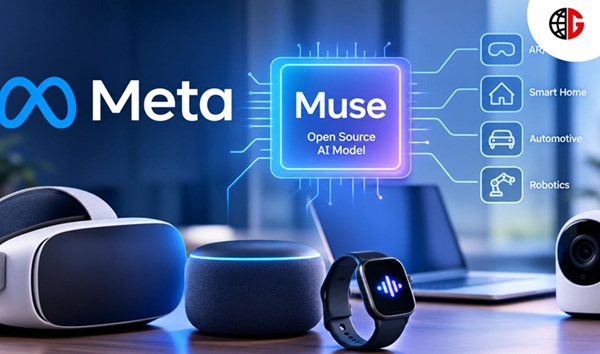
Meta is taking its Muse AI agent beyond the screen – and into the hands of developers, makers, and hardware enthusiasts.
The company introduced Muse Gadgets, an open-source initiative that lets developers build physical devices that connect directly to Muse. The move signals Meta’s broader ambition to turn Muse from an AI assistant that lives inside an app into an adaptable AI layer that can interact with the physical world.
Meta Opens the Door to Custom Muse Hardware
Muse is already designed to act on a user’s behalf, including tasks such as booking travel, completing forms, and shopping. With Muse Gadgets, Meta is giving developers the tools to decide how that AI agent interacts with custom hardware.
The project provides open-source firmware – the software embedded in a device – as well as a Linux software development kit (SDK) that developers can use to create their own Muse-connected gadgets.
Rather than limiting developers to a particular piece of hardware, Meta is taking a much more open-ended approach.
A hobbyist could use an inexpensive Raspberry Pi, an ESP32 development board, or other compatible components and connect Muse to displays, buttons, sensors, actuators, and other hardware.
That could turn Muse into something far more flexible than a conventional chatbot.
From E-Ink Displays to TV-Connected AI
Meta has already suggested several possibilities for the project, including giving Muse a color e-ink display or installing it on a small device that connects to a television through an HDMI port.
The concept is essentially to let developers create their own physical interface for Muse.
Instead of interacting with an AI agent exclusively through a smartphone or computer, users could potentially build devices that allow Muse to see information, display responses, trigger actions, or communicate with connected equipment.
For hardware enthusiasts, that opens up a broad playground for experimentation.
Meta describes the project as something that can connect Muse to the various components developers may already have on their workbenches from screens and physical controls to sensors and other electronic components.
Meta Has Already Built a Muse Home Gadget
The company isn’t merely releasing the tools and leaving developers to figure everything out themselves. Meta has also been experimenting with its own Muse-connected hardware.
Nat Friedman, head of product at Meta’s Superintelligence Labs, said the company developed a device called Muse Home Link.
Powered through USB-C, Home Link is designed to allow Muse to connect to a home network and communicate with smart devices connected to it, including smart speakers and smart TVs.
Meta reportedly produced 5,000 Home Link devices and planned to distribute them at no cost to Muse subscribers, while supplies lasted.
The initial response also suggests there was considerable curiosity around the device. Friedman’s post about Home Link attracted nearly 30,000 views within a few hours, although it remains unclear how quickly the limited giveaway was exhausted.
Muse Is Becoming More Than a Chatbot
The launch of Muse Gadgets is important because it fits into a much larger strategy surrounding Meta’s AI ambitions.
Meta appears to be positioning Muse not simply as another conversational AI product, but as an AI agent capable of performing tasks and interacting with digital and physical environments.
The hardware initiative gives developers another way to experiment with that vision.
A Muse-connected device could, for example, combine AI with a physical display, sensors or smart-home equipment. The possibilities will ultimately depend on what developers build—and that is precisely where the open-source nature of the project becomes significant.
Rather than creating every Muse device internally, Meta can encourage an ecosystem of independent developers, hobbyists and hardware builders to explore applications the company may not have anticipated.
Meta Is Building an AI Ecosystem Around Muse
Muse Gadgets also arrives as Meta expands Muse into other parts of the technology market.
Earlier, Meta introduced Muse for Small Business, offering businesses access to the AI agent with usage limitations and integrations with services such as Shopify, Dropbox and Slack.
The company has also created Meta Enterprise Platform, a new business unit focused on bringing Meta’s AI products and services to enterprise and corporate customers.
Taken together, these moves point toward a broader strategy: making Muse available across consumer devices, custom hardware, small-business tools and enterprise environments.
That could give Muse a role well beyond the traditional AI chatbot category.
Why Muse Gadgets Could Matter
Open-source hardware projects are not guaranteed to become mainstream products. Muse Gadgets may ultimately remain a niche platform for developers, makers and technology enthusiasts.
But that niche could be valuable.
Giving developers access to the underlying tools allows Meta to test how an AI agent might operate outside conventional apps and websites. It also creates opportunities for experimentation with AI-powered smart homes, custom interfaces, interactive displays and connected devices.
For developers, the appeal is relatively straightforward: instead of waiting for Meta to release a dedicated Muse device for every possible use case, they can potentially build one themselves.
And for Meta, every new experiment could help expand the role of Muse – from an assistant users talk to into an AI system that can act, connect and interact with the world around it.
Meta’s Bigger Bet on Agentic AI
The introduction of Muse Gadgets comes at a time when the technology industry is increasingly moving from generative AI that simply produces responses toward agentic AI systems capable of taking actions on behalf of users.
Meta’s approach suggests that this transition may not stop with software.
If developers begin connecting AI agents to physical interfaces, sensors, displays and smart devices, the next generation of AI assistants could become less like apps and more like an underlying layer connecting the digital and physical worlds.
For now, Meta is giving developers the building blocks. What they ultimately build with Muse could determine just how far that idea goes.
Read more: Dana McNabb Appointed Chief Executive Officer of General Mills