

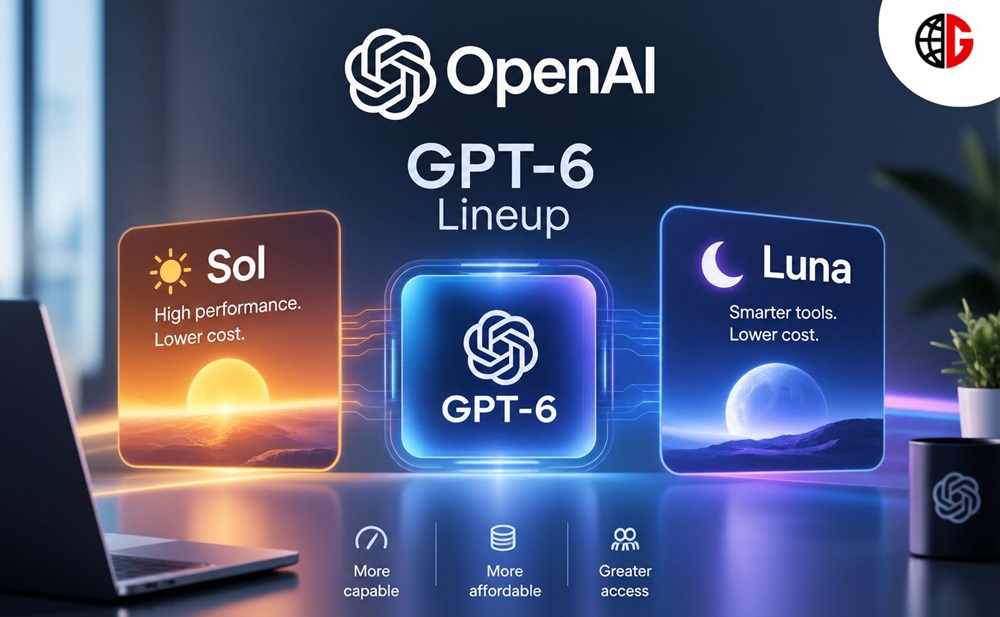
OpenAI is expanding its GPT-6 model family with the launch of updated versions of GPT-6 Sol and GPT-6 Luna, focusing on lower costs, improved efficiency and fewer factual and coding errors.
The latest models arrive just weeks after OpenAI introduced GPT-6 Astra, which the company positioned as its most capable model yet for demanding applications such as coding and computer-based tasks. With the new Sol and Luna releases, OpenAI is now bringing some of the GPT-6 generation’s capabilities to models designed for different levels of workload and complexity.
According to OpenAI, the new models are intended to make advanced AI more accessible by improving efficiency while reducing the cost of running them.
GPT-6 Sol and Luna Target Different AI Workloads
The Sol and Luna families serve different purposes within OpenAI’s model lineup.
GPT-6 Sol is aimed at more complex and technically demanding work, including software development and coding. It is designed for users who need stronger reasoning and performance across sophisticated tasks.
GPT-6 Luna, meanwhile, is positioned toward high-volume, clearly defined workloads. These include summarizing documents, extracting information and responding to straightforward questions.
OpenAI says the new models extend the intelligence introduced with GPT-6 Astra while making it more efficient and accessible for everyday and professional use.
OpenAI Cuts GPT-6 API Costs
One of the biggest changes accompanying the launch is pricing.
OpenAI says the GPT-6 versions of Sol and Luna will be available through its API at about half the cost of their GPT-5.6 counterparts. The company attributes the reduction to improvements in caching and inference efficiency.
The lower pricing could make the models more attractive for developers and businesses running AI applications at scale, particularly for workloads involving large numbers of requests.
The move also highlights an increasingly important direction in the AI industry: improving model performance while bringing down the cost of inference.
GPT-6 Sol Claims Fewer Mistakes
OpenAI is also highlighting improvements in factual accuracy and coding reliability.
The company says GPT-6 Sol produces substantially fewer mistakes than its predecessor. Based on OpenAI’s internal factuality evaluation, which uses de-identified real-world conversations in which users identified model errors, GPT-6 Sol makes roughly half as many mistakes as its predecessor.
OpenAI further says the model reaches a level of reliability comparable to GPT-6 Astra while operating at a significantly lower cost.
The company is also reporting improvements in coding performance, suggesting that GPT-6 Sol is intended to provide developers with stronger results while reducing the frequency of errors.
OpenAI and Anthropic Race to Improve AI Models
The release comes amid intensifying competition between OpenAI and Anthropic.
OpenAI is making strong performance claims for GPT-6 Sol and Luna against Anthropic’s leading models, including its Fable and Opus families. Such comparisons have become increasingly common as both companies compete to establish their models across coding, reasoning, business workflows and other professional applications.
The timing of the announcement was particularly notable. Anthropic released a new version of Opus 5.5 roughly 90 minutes before OpenAI announced its updated Sol and Luna models, underscoring how quickly the two AI companies are moving to update their flagship offerings.
Rather than simply competing on raw model capabilities, the latest releases also show the growing importance of pricing, inference efficiency and reliability.
GPT-6 Sol and Luna Availability
The new GPT-6 Sol and Luna models are now being made available across several OpenAI products.
They are available through ChatGPT Work and Codex for most paid accounts, as well as through the ChatGPT API. GPT-6 Luna is also being offered through the desktop application and to Free and Go users.
OpenAI is expected to introduce the new models to the broader ChatGPT app and website progressively throughout the day.
With GPT-6 Astra already serving the company’s highest-end model strategy, the arrival of Sol and Luna gives OpenAI another way to distribute GPT-6 capabilities across different users, workloads and price points.
The latest launch also reflects where the AI market is heading: increasingly capable models are no longer competing only on intelligence. Cost, speed, accuracy and scalability are becoming equally important as businesses move AI from experimentation into everyday operations.
Read more: Xanadu Names Tara Deakin Chief People Officer as Quantum Computing Firm Scales Global Team